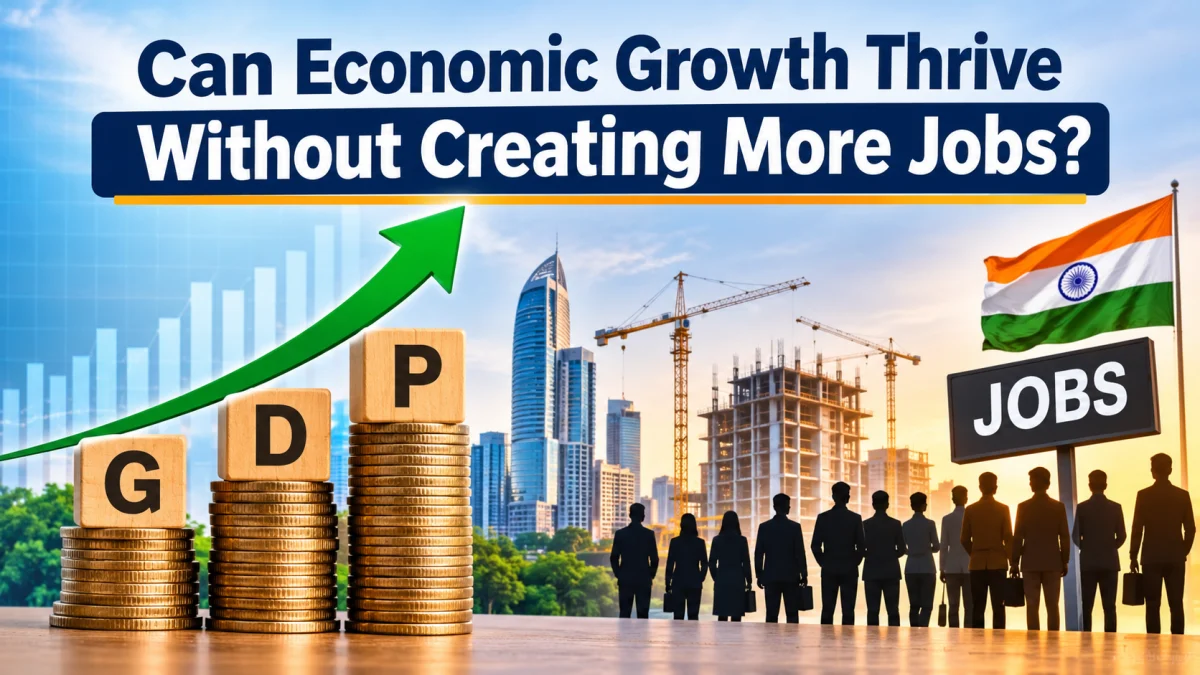
- India's economic growth is driven by investment, industrial development, infrastructure expansion and the performance of the services sector.
- Employment generation depends on manufacturing, technological advancements, labour market conditions, education and skill development.
- Sustainable economic development must be assessed through employment quality, income distribution, productivity and improvements in living standards alongside GDP growth.
Economic growth is commonly measured through the expansion of a country's Gross Domestic Product (GDP). It reflects the overall value of goods and services produced within an economy and is an important indicator of economic performance. However, rising GDP does not necessarily mean that employment opportunities and household incomes are improving at the same pace.
India's economy has experienced significant structural changes, particularly through the expansion of services, infrastructure development, manufacturing initiatives and digital technologies. These developments contribute to productivity and economic output, but they also raise an important question: can economic growth remain sustainable if it does not generate sufficient employment opportunities?
Understanding this relationship requires examining the nature of economic growth, changes in the labour market and the distribution of its benefits across different sections of society.
Also Read: Calcutta High Court Questions Abhishek Banerjee’s Allegations of Judicial
1. Economic Growth and Employment Trends
Economic growth and employment are closely connected, but their relationship is not always proportional. An economy can increase production through investment, technology and improved efficiency without creating an equivalent number of new jobs.
GDP Growth and Job Creation
When businesses expand production, they may increase recruitment. However, companies can also raise output by adopting advanced machinery, automation and more efficient production methods. Consequently, economic output may grow faster than employment.
This distinction is important because GDP growth measures overall economic activity, whereas employment indicators provide insight into how people participate in that activity.
According to the Ministry of Statistics and Programme Implementation's Periodic Labour Force Survey (PLFS) Annual Report 2025, India's unemployment rate for people aged 15 years and above stood at 3.1% under the usual status measure. The Labour Force Participation Rate was 59.3%, while the Worker Population Ratio stood at 57.4%. These figures provide an overview of labour market participation, although they do not independently establish whether available jobs offer adequate wages or security.
Understanding Employment Quality
The number of people employed is only one aspect of economic development. Regular salaries, stable working conditions, social security and opportunities for career progression also influence living standards.
An economy may record an increase in employment while a significant proportion of workers remain in informal, low paid or insecure occupations. Therefore, employment quality should be considered alongside the number of jobs created.
Also Read: Rajeev Goswami: The Face of India's Anti-Mandal Movement
2. Manufacturing and the Services Sector
The structure of an economy influences the type and scale of employment it generates. Manufacturing and services contribute differently to production, investment and labour demand.
Manufacturing as an Employment Driver
Manufacturing can create employment across several stages of production, including raw material processing, assembly, transportation, distribution and maintenance. It can also support small businesses and ancillary industries.
Expanding manufacturing capacity may therefore generate employment beyond the factories themselves. However, the actual impact depends on the scale of investment, the use of labour intensive production methods and the participation of domestic suppliers.
India's PLFS Annual Report 2025 recorded an increase in manufacturing's share of employment to 12.1%, compared with 11.2% in 2022. This indicates a gradual change in the composition of employment, although manufacturing remains one part of a broader labour market.
Expansion of the Services Sector
The services sector includes information technology, finance, telecommunications, tourism, healthcare, education and professional services. It contributes significantly to economic output and provides employment for workers with different educational and skill backgrounds.
However, high productivity services may require specialised qualifications, limiting access for people without relevant training. Other service activities, including retail, transportation and hospitality, can provide employment on a broader scale but may involve varying levels of income and job security.
A balanced economic structure requires growth across manufacturing, services and other productive sectors.
Also Read: India’s Strategic Engagement at Chabahar Port
3. Technology and Changing Employment Patterns
Technological development has become an important factor influencing productivity, business operations and labour market requirements.
Automation and Productivity
Automation, artificial intelligence and digital systems allow businesses to improve efficiency, reduce operational costs and increase production capacity. These developments can strengthen competitiveness and create demand for new professional roles.
At the same time, certain repetitive and routine occupations may experience reduced demand as technology replaces some tasks previously performed by workers.
The overall employment impact depends on whether new industries and occupations generate opportunities for workers whose existing roles are affected by technological change.
Skills and Workforce Adaptation
Education and vocational training play an important role in helping workers adapt to changing employment requirements. Digital literacy, technical knowledge, communication and specialised professional skills can improve access to emerging opportunities.
The International Labour Organization and the Institute for Human Development, in the India Employment Report 2024, examined the relationship between youth employment, education and skills. Its findings highlight the importance of improving the connection between educational qualifications and labour market requirements.
Also Read: Kulgam CRPF Checkpoint Comes Under Fire; Three Personnel Injured, Search Operation Launched
4. Employment, Income Distribution and Living Standards
Economic growth becomes more meaningful when its benefits reach a broad section of the population.
Income and Economic Participation
Employment provides households with income, supports consumption and contributes to domestic demand. When more people have access to stable and adequately paid work, they are better positioned to spend on education, healthcare, housing and other essential needs.
In contrast, economic growth concentrated in a limited number of industries or among a relatively small section of the population may not translate into widespread improvements in living standards.
Regional and Social Differences
Employment opportunities are not distributed equally across regions, industries and demographic groups. Rural and urban labour markets often differ in the types of occupations available, while women and young people may face additional barriers to workforce participation.
Addressing these differences requires improvements in infrastructure, education, transportation, workplace accessibility and access to formal employment.
Also Read: U.S. Midterm Election Results 2026: Democrats Win Control of Congress in Major Political Shif
5. Investment, Education and Sustainable Development
Long term economic sustainability requires policies that support productivity while creating opportunities for a growing workforce.
Role of Public and Private Investment
Investment in infrastructure, manufacturing, renewable energy, healthcare and education can support economic activity and generate employment across different sectors.
Public investment can strengthen essential infrastructure, while private investment can expand production capacity, encourage innovation and create business opportunities. Their combined contribution can support both economic expansion and job creation.
Linking Education with Employment
Educational institutions, vocational training centres and industries need stronger connections to ensure that workforce skills match changing economic requirements.
Improving apprenticeship opportunities, technical training and access to professional education can help workers participate in emerging sectors. Supporting small and medium sized enterprises can also widen employment opportunities beyond large corporations.
Sustainable economic development therefore requires more than increasing national output. It involves creating productive opportunities, improving workforce capabilities and ensuring that economic progress contributes to better living standards across society.
Also Read: The 1991 Economic Reforms and India's Changing Economic Order
Conclusion
Economic growth and employment generation must progress together to support sustainable development. For India, the challenge is not only to increase GDP but also to create productive jobs, improve employment quality and ensure that economic progress benefits a wider section of society.
Also Read: Ghaziabad Blast: ATS Probes Viral Responsibility Claim
Sources and Further Reading
1. Ministry of Statistics and Programme Implementation — Periodic Labour Force Survey (PLFS) Annual Report 2025
https://www.pib.gov.in/PressReleasePage.aspx?PRID=2246009
2. International Labour Organization — India Employment Report 2024
https://www.ilo.org/publications/india-employment-report-2024-youth-employment-education-and-skills
3. Institute for Human Development — India Employment Reports
https://www.ihdindia.org/publications/india-employment-reports/

Join the Conversation