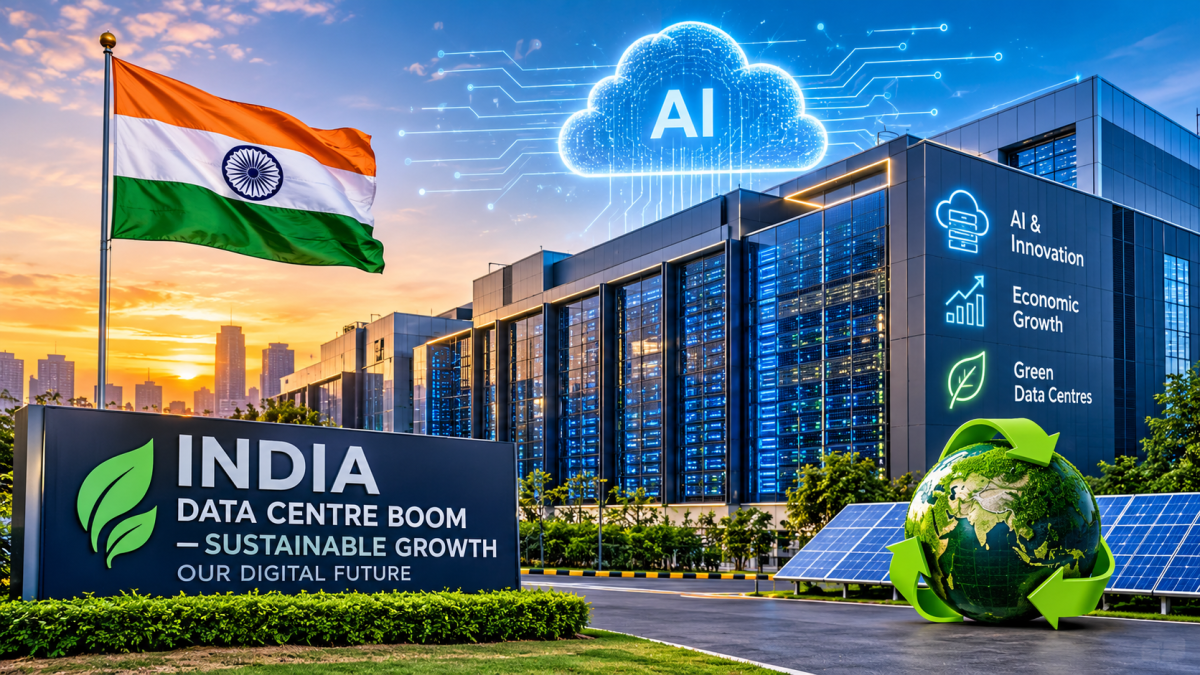
Should India Prioritise Sustainable Data Centres Over Rapid Expansion?
India's ambition to become a major global digital and artificial intelligence (AI) hub is driving an unprecedented expansion of data centre infrastructure. These facilities are essential to cloud computing, digital payments, online services and advanced AI applications. However, the growing competition among states to attract technology investments raises an important question: should India prioritise rapid data centre expansion, or ensure that such growth remains environmentally and economically sustainable?
The expansion of digital infrastructure is undoubtedly important for India's technological future. Yet, investment announcements and installed capacity should not become the only measures of progress. Electricity availability, water consumption, environmental protection and local economic benefits deserve equal attention. India's digital ambitions will be meaningful only if infrastructure development is supported by responsible planning.
1. India's Digital Ambitions Should Not Outpace Infrastructure
India's data centre industry has expanded significantly over the past few years. According to the Ministry of Electronics and Information Technology, installed data centre capacity increased from approximately 375 megawatts (MW) in 2020 to around 1,500 MW by 2025.
This growth reflects increasing demand for cloud services, digital platforms and AI computing. The government has also supported the development of domestic computing infrastructure through initiatives such as the IndiaAI Mission.
However, rapid expansion without adequate infrastructure planning could create long-term challenges. Data centres require uninterrupted electricity, reliable connectivity, cooling systems and substantial investment in supporting infrastructure.
States competing to attract large technology companies must therefore evaluate whether their electricity networks, water resources and land availability can support additional facilities.
Investment attraction should not become more important than infrastructure readiness.
2. Electricity Demand Requires Greater Attention
One of the most significant challenges associated with data centre expansion is electricity consumption.
Unlike many conventional commercial buildings, data centres operate continuously. Their servers, networking equipment and cooling systems require a stable power supply.
Research published by the Council on Energy, Environment and Water (CEEW) in February 2026 estimated that data centres accounted for approximately 0.5 per cent of India's national electricity consumption in 2025. The organisation warned that electricity demand could more than double by 2030.
This raises questions about how additional demand will be accommodated without placing unnecessary pressure on existing power infrastructure.
Renewable energy can contribute to a more sustainable model. However, simply purchasing renewable energy certificates or announcing green-energy commitments is not sufficient. Companies should demonstrate how their electricity requirements are being met, including during periods when renewable generation is unavailable.
Government incentives should encourage measurable improvements in energy efficiency and responsible electricity procurement.
3. Water Security Must Be Part of the Investment Debate
Electricity is not the only resource that deserves attention. Cooling systems are essential to prevent data centre equipment from overheating, and certain cooling technologies require substantial quantities of water.
CEEW's 2026 research estimated that India's data centres used approximately 150 billion litres of water annually in 2025. It also warned that consumption could increase as the industry expands.
This deserves particular attention because several important data centre markets, including Hyderabad, Chennai, Bengaluru and Mumbai, face competing demands for urban water resources.
Technology companies should not be discouraged from investing in India merely because their facilities require cooling. However, projects must be evaluated according to local water availability and the cooling systems they intend to deploy.
Water recycling, closed-loop cooling, efficient technologies and transparent reporting should become important requirements for responsible development.
Economic growth cannot be considered successful if its costs are transferred to local communities.
4. Government Incentives Must Deliver Measurable Benefits
India has introduced several policy measures to encourage digital infrastructure investment. Data centres received infrastructure status in the Union Budget 2022–23, while the Union Budget 2026 introduced a long-term tax incentive for eligible foreign cloud service providers using India-based data centre infrastructure.
Such measures can improve investment conditions and strengthen India's position in the international technology market.
Nevertheless, tax incentives and other government support should be evaluated against the benefits delivered to the country.
Do projects generate skilled employment? Do they encourage domestic manufacturing? Are Indian companies included in the supply chain? Do they contribute to technological research and development?
These questions should form part of the evaluation process.
In October 2026, NITI Aayog's Frontier Tech Hub released a Data Centre Evaluation Framework to help states assess proposed investments through infrastructure readiness, environmental sustainability, economic value and implementation capacity.
This is a positive development because it encourages states to look beyond headline investment commitments.
However, the framework's effectiveness will depend on how consistently its recommendations are implemented.
5. Should States Compete for Every Data Centre Investment?
Competition among Indian states can encourage infrastructure development, attract businesses and create employment opportunities. However, competition without common standards may encourage excessive incentives or insufficient attention to environmental constraints.
A state should not approve a large facility simply because another state has attracted a similar investment.
Each project must be assessed according to local conditions, including electricity availability, water resources, land suitability and connectivity.
For example, a project requiring substantial water resources may not be appropriate for a location already facing serious water stress. Similarly, a facility should not receive preferential treatment if the supporting electricity infrastructure cannot accommodate its requirements.
The objective should be responsible investment rather than investment at any cost.
6. Domestic Technology and Employment Should Remain Priorities
India's data centre expansion also offers an opportunity to strengthen domestic technological capabilities.
The development of servers, electronic components, power-management systems, cooling equipment and cybersecurity services could support Indian manufacturing and technology companies.
However, infrastructure investment does not automatically translate into widespread employment. Modern data centres are capital-intensive facilities, and their permanent workforce may be relatively limited compared with their overall investment value.
Government policies should therefore encourage technical training, domestic procurement, research partnerships and the development of Indian technology suppliers.
The long-term objective should be to build an ecosystem that creates value beyond the construction of physical facilities.
7. A More Responsible Model for India's Digital Future
India should continue expanding its data centre infrastructure, but the process must be guided by clear environmental and economic standards.
First, electricity and water availability should be assessed before approving major projects.
Second, government incentives should be linked to measurable outcomes, including employment, renewable energy adoption, domestic procurement and resource efficiency.
Third, companies should disclose relevant information about their energy consumption, water usage and environmental performance.
Finally, states should coordinate their infrastructure planning instead of treating data centre investment as a competition based solely on financial commitments.
These measures would not discourage investment. Rather, they would create greater certainty for businesses while protecting public resources.
Conclusion
India's data centre expansion represents an important opportunity to strengthen its digital economy and global technological position. However, rapid growth should not be confused with sustainable progress.
The country must avoid a model in which investment announcements receive greater attention than electricity security, water availability, employment and environmental responsibility.
The government's recent evaluation framework is a constructive step, but its success will depend on effective implementation and accountability.
India should welcome investment, encourage innovation and develop world-class digital infrastructure. At the same time, it must ensure that the benefits of expansion are shared more widely and that its environmental costs are properly managed.
The real measure of India's digital progress should not be how many data centres it builds, but how responsibly it builds and operates them.
Sources and Further Reading
1. "NITI Aayog – Data Centre Evaluation Framework (October 2026)" https://www.pib.gov.in/PressReleasePage.aspx?
2. "CEEW – Scaling India's Data Centre Ecosystem (February 2026)" https://www.ceew.in/publications/how-is-data-centre-infrastructure-in-india-shaping-power-and-water-use
3. "Ministry of Jal Shakti – Data Centre Water Consumption (March 2026)" https://www.pib.gov.in/PressReleasePage.aspx?
4. "Ministry of Electronics and Information Technology" https://www.meity.gov.in/
5. "IndiaAI Mission – Government of India" https://indiaai.gov.in/

Join the Conversation