Is Vote-Bank Politics Affecting India's Development?
India's democratic system is built on political representation, public participation and the principle that governments must remain accountable to citizens. Elections provide people with an opportunity to choose representatives based on policies, leadership and performance. However, an increasingly important question in Indian politics is whether electoral competition is always centred on long-term development or whether vote-bank politics is influencing political priorities.
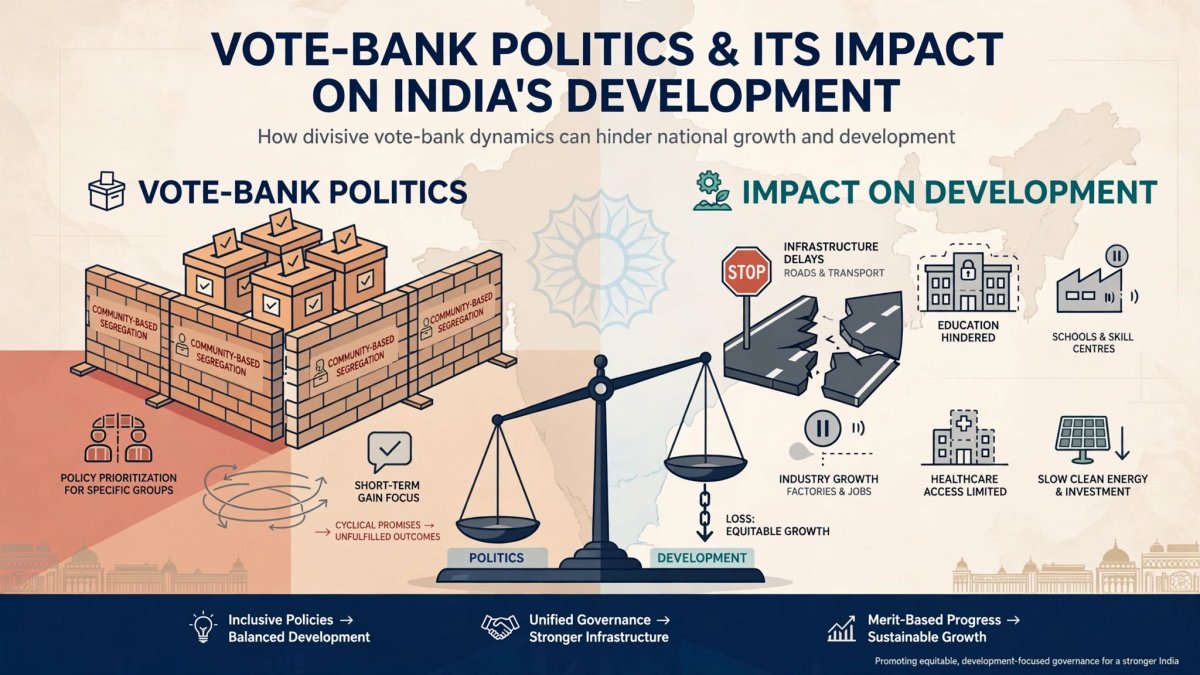
Vote-bank politics refers to electoral strategies in which political parties seek the support of particular communities, social groups or sections of the electorate through targeted promises, identity-based appeals and specific benefits. Although addressing the needs of different communities is a legitimate responsibility of democratic governments, concerns arise when electoral calculations take precedence over inclusive development, institutional accountability and public welfare.
1. Understanding Vote-Bank Politics in India
India's social diversity makes political representation particularly complex. Differences in economic circumstances, caste, religion, language, region and access to public services influence political participation and electoral preferences.
Political parties frequently develop policies aimed at specific sections of society. Such policies may include scholarships, employment programmes, agricultural assistance, social security, housing schemes and financial support for economically disadvantaged households.
These initiatives are not inherently examples of vote-bank politics. In a democratic society, governments are expected to address unequal circumstances and ensure that public resources reach those who need them.
The concern emerges when policies are designed primarily to secure electoral support rather than address clearly identified public needs. When political competition becomes dominated by short-term electoral calculations, broader questions concerning education, healthcare, employment and economic development may receive insufficient attention.
2. Electoral Promises and the Politics of Welfare
Election manifestos are important instruments of democratic accountability. They communicate the policies and priorities that political parties intend to pursue if elected to office.
However, electoral promises have increasingly become a subject of debate, particularly when parties announce extensive financial benefits without adequately explaining their funding arrangements.
Direct financial assistance, subsidised services and welfare programmes can provide meaningful support to vulnerable households. For families experiencing economic hardship, such assistance may contribute to financial stability and access to essential services.
Nevertheless, governments must consider the financial sustainability of their commitments. Public expenditure involves competing priorities, and resources allocated to one programme may affect the funding available for infrastructure, healthcare, education and other essential services.
The real question should therefore not be whether welfare programmes are desirable, but whether they are properly designed, transparently funded and capable of delivering measurable public benefits.
3. Identity-Based Politics and Social Divisions
Identity remains an influential factor in Indian electoral politics. Political parties frequently engage with communities through discussions surrounding representation, social justice, cultural recognition and historical inequalities.
Representation of disadvantaged communities is an important democratic objective. Groups that have experienced social exclusion must have opportunities to participate meaningfully in political and administrative institutions.
However, identity-based mobilisation can become problematic when political narratives encourage social divisions or portray communities as permanent electoral constituencies rather than citizens with shared national interests.
Political leadership should recognise social differences without allowing them to weaken democratic cooperation. Electoral competition must provide space for constructive disagreement while maintaining respect for constitutional equality and individual rights.
India's democratic strength depends not only on representing diverse communities but also on building institutions that serve citizens without discrimination.
4. The Impact on Economic Development
Long-term development requires consistent investment in infrastructure, education, healthcare, industrial capacity, technology and employment generation.
When electoral strategies dominate policymaking, governments may face pressure to prioritise measures that produce immediate political benefits over reforms whose results take several years to become visible.
This does not mean that welfare spending necessarily harms economic development. Properly implemented welfare programmes can improve human development, strengthen household security and support economic participation.
The distinction lies in policy design and implementation.
For example, investment in quality public education can create lasting opportunities, while accessible healthcare can improve productivity and reduce financial vulnerability. Similarly, infrastructure development can strengthen economic activity and generate employment.
A government should therefore evaluate policies according to their social and economic outcomes rather than their immediate electoral popularity.
Research by political scientists Oliver Heath and Louise Tillin, published in Studies in Comparative International Development, examines the relationship between institutional performance and vote-buying behaviour in India. Their research highlights how weaknesses in public institutions can make voters more responsive to immediate inducements when the reliable delivery of public services remains uncertain.
This raises a fundamental governance question: should citizens have to depend on political intermediaries for benefits that ought to be delivered through effective public institutions?
5. Election Commission and the Regulation of Political Promises
The Election Commission of India plays an important role in maintaining the integrity of electoral processes.
In its 2013 judgment in S. Subramaniam Balaji v. Government of Tamil Nadu, the Supreme Court examined the issue of election promises involving free distribution of goods and services. The Court directed the Election Commission to develop guidelines concerning election manifestos.
The Election Commission subsequently incorporated guidelines into the Model Code of Conduct.
These guidelines state that political parties should explain the rationale behind their promises and broadly indicate the methods through which the financial requirements would be met. They also emphasise that promises should be realistic and capable of fulfilment.
This framework recognises that welfare commitments have a legitimate place in democratic politics while highlighting the importance of transparency and financial responsibility.
However, the broader debate over the regulation of electoral promises continues. Greater transparency regarding projected expenditure, funding sources and implementation plans could help voters evaluate competing political programmes more effectively.
6. The Responsibility of Political Parties and Voters
Political accountability cannot rest exclusively with election authorities. Political parties, elected representatives and citizens all have responsibilities in strengthening democratic governance.
Political parties should prioritise policy-based competition and present realistic programmes addressing employment, education, healthcare, infrastructure and economic development.
Elected representatives should be evaluated according to their legislative performance, constituency development, transparency and ability to deliver public services.
Voters, meanwhile, should have access to reliable information about political promises, government expenditure and administrative performance. Electoral decisions become more meaningful when citizens assess policies alongside leadership and political claims.
Independent journalism, public audits, legislative scrutiny and transparent government data can further strengthen accountability.
7. Moving Beyond Electoral Calculations
India does not need to choose between social welfare and economic development. Both are essential components of a functioning democracy.
The objective should be to create a system in which welfare programmes reduce genuine disadvantages while long-term investments expand opportunities for future generations.
Political parties should compete over the quality of education, employment opportunities, healthcare infrastructure, economic growth and administrative efficiency. Financial commitments should be supported by credible budgets and measurable outcomes.
Most importantly, government institutions must deliver essential services consistently, reducing the dependence of citizens on political connections or electoral considerations.
Conclusion
Vote-bank politics becomes a governance concern when electoral calculations begin to overshadow public interest, institutional responsibility and long-term development. Although targeted welfare policies and community representation are legitimate democratic functions, they should not become substitutes for sustainable economic planning and accountable administration.
India's democratic future depends on the ability of political parties to move beyond narrow electoral considerations and compete through credible policies, effective governance and measurable achievements.
Ultimately, the success of democracy should not be judged only by electoral victories. It should also be measured by the quality of public institutions, economic opportunities, social equality and improvements in citizens' everyday lives.
Sources and Further Reading
1. "Election Commission of India – Guidelines on Election Manifestos" https://www.eci.gov.in/election-manifestos/
2. "Election Commission of India – Model Code of Conduct" https://www.eci.gov.in/mcc
3. "Supreme Court – S. Subramaniam Balaji v. Government of Tamil Nadu (2013)" https://indiankanoon.org/doc/106854428/
4. "Oliver Heath and Louise Tillin – Institutional Performance and Vote Buying in India" https://link.springer.com/article/10.1007/s12116-017-9254-x
5. "Francesca R. Jensenius and Pradeep Chhibber – Privileging One's Own? Voting Patterns and Politicized Spending in India" https://journals.sagepub.com/doi/10.1177/00104140221109430
6. "Association for Democratic Reforms – Election and Political Reforms" https://adrindia.org/

Join the Conversation