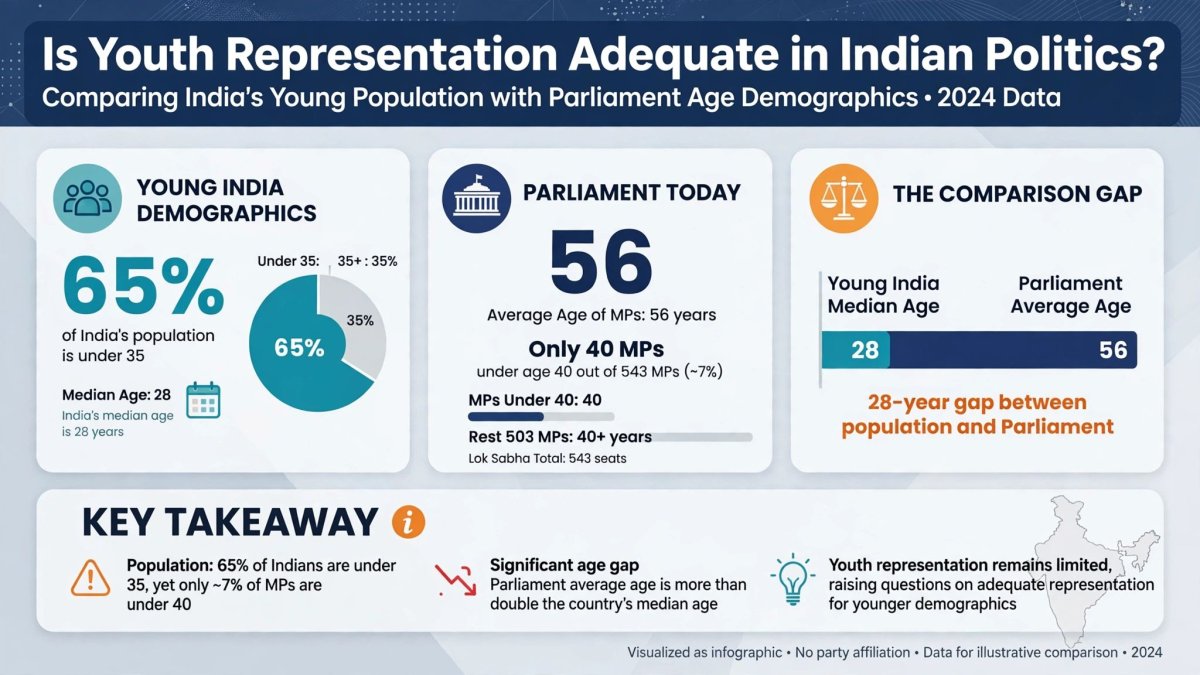
India is a country full of young people, young ambitions and new ideas. Every year, millions of young Indians enter universities, prepare for competitive examinations, start businesses, join the workforce and participate in public life. They vote in elections, question government decisions, participate in social movements and discuss the future of the country.
Yet, when we look at India's political institutions, an important question emerges: Are young Indians getting a fair opportunity to shape the political decisions that will determine their own future?
India's democracy gives every eligible adult citizen the right to vote. But democracy should not be understood only as the freedom to choose representatives. It should also provide meaningful opportunities for citizens from different generations and backgrounds to become representatives themselves.
Young people are directly affected by decisions concerning education, employment, economic opportunities, technology, entrepreneurship and social development. Their voices deserve to be heard not only during election campaigns but also inside Parliament, State Assemblies and political organisations.
This does not mean that experienced leaders should be replaced simply because they are older. Experience has its own importance in public life. However, a healthy democracy must create opportunities for capable individuals from every generation.
The real question is whether India's political system is doing enough to make that possible.
1. The Gap Between Youth Participation and Political Representation
India's young population plays an important role in its democratic process. Young voters participate in elections, follow political developments and increasingly use digital platforms to express their views.
However, having a large number of young voters does not automatically mean that young people have adequate representation in political institutions.
The composition of the 18th Lok Sabha offers an important example.
According to PRS Legislative Research, the average age of Members of Parliament elected to the 18th Lok Sabha in 2024 was approximately 56 years, compared with 59 years in the previous Lok Sabha.
The International Parliamentary Union (IPU) provides another important perspective. Its June 2024 parliamentary age data shows that only 1.3% of Lok Sabha members were aged 30 or younger, while 9.6% were aged 40 or younger.
There is an important distinction here: India's National Youth Policy 2014 defines youth as people between 15 and 29 years of age. Therefore, the parliamentary category of members aged 40 or younger should not be treated as the official definition of youth.
Nevertheless, these figures highlight the limited presence of younger representatives in the national legislature.
The issue is not whether older politicians deserve their positions. They have valuable experience and constitutional rights like every other citizen. The concern is whether capable younger candidates receive sufficient opportunities to enter electoral politics and contribute to important national decisions.
A democracy becomes stronger when people from different generations can participate in shaping its future.
Sources: PRS Legislative Research – Profile of the 18th Lok Sabha | International Parliamentary Union – Youth Representation in India's Lok Sabha | Ministry of Youth Affairs and Sports – National Youth Policy 2014.
2. Political Parties Must Create More Opportunities for Young Leaders
Political parties play one of the most important roles in determining who gets an opportunity to contest elections.
Before a candidate reaches Parliament or a State Assembly, that person generally has to establish a position within a political organisation, build public support and secure a party nomination.
This process can be particularly challenging for young aspirants.
Most major political parties have youth wings and student organisations. These platforms allow young members to participate in campaigns, organise activities and develop political awareness.
However, participation in a youth wing does not necessarily guarantee an opportunity to contest elections or become part of senior party leadership.
Young political aspirants may face several barriers. Limited financial resources, a lack of established political connections, insufficient organisational support and difficulties accessing influential party networks can make the journey particularly demanding.
There is also a broader concern about political opportunities being concentrated among individuals who already have established family or organisational connections.
Political experience and family backgrounds should not automatically disqualify anyone. However, electoral opportunities should be based on ability, public acceptance, leadership and commitment to public service rather than access to privileged networks alone.
Political parties must therefore examine whether their internal structures are genuinely open to new leadership.
Young members should be given meaningful responsibilities, opportunities to participate in policy discussions and transparent pathways towards leadership positions.
A youth wing should not exist only to mobilise crowds during elections. It should also help develop the next generation of political leaders.
3. Employment, Education and Economic Opportunities Need Stronger Representation
For millions of young Indians, the most important political questions are not limited to election results or party rivalries.
They concern everyday life.
Will they find suitable employment after completing their education? Will they have access to affordable and quality education? Will their skills match the demands of a changing economy? Will they have opportunities to establish businesses and build financially independent lives?
These are some of the most significant questions facing younger generations.
Employment generation, skill development, competitive examination pressures, educational accessibility, entrepreneurship and technological change require consistent attention from policymakers.
Young representatives can bring valuable first-hand perspectives into these discussions. They may have a closer understanding of the difficulties faced by students, first-time job seekers, young entrepreneurs and professionals entering new industries.
However, meaningful representation should not depend entirely on the age of elected representatives. Older leaders must also understand the changing realities of the younger generation.
The objective should be to ensure that policies concerning young people are developed with their meaningful participation.
Young citizens should not be treated merely as beneficiaries of government schemes. They should also have opportunities to participate in designing, evaluating and improving those policies.
A country cannot fully utilise its demographic potential if the people who will shape its future have limited influence over the decisions being made today.
4. Constitutional Eligibility and the Question of Political Reform
India's Constitution establishes minimum age requirements for individuals seeking election to Parliament and State Legislatures.
Under Article 84(b) of the Constitution:
-
A person must be at least 25 years old to become a member of the Lok Sabha.
-
A person must be at least 30 years old to become a member of the Rajya Sabha.
Similarly, Article 173(b) establishes a minimum age of 25 years for membership of a State Legislative Assembly and 30 years for membership of a State Legislative Council.
These provisions establish the legal eligibility requirements for entering India's legislative institutions.
However, fulfilling the minimum age requirement does not guarantee that a young person will receive a party nomination or have the resources to contest an election successfully.
India's parliamentary framework does not provide a separate category of seats reserved exclusively for young representatives.
This raises an important policy question: Should India consider introducing stronger mechanisms to improve youth representation?
Some may argue that a dedicated youth quota could help younger citizens gain access to legislative institutions. Others may believe that such an arrangement could create unnecessary restrictions and that political parties should independently ensure greater generational diversity.
Both perspectives deserve consideration.
Any proposed reform must be examined carefully, taking into account constitutional principles, democratic competition, political freedom and practical implementation.
Regardless of whether a formal quota is introduced, there is a clear need to improve opportunities for young people to participate in political leadership.
Source: Constitution of India – Legislative Department, Government of India.
5. Social Media Has Given Young Indians a Voice, But Is That Voice Being Heard?
The rise of digital platforms has changed the way young Indians participate in politics.
Earlier, political discussions were largely shaped by traditional media, public meetings, newspapers and political organisations. Today, young citizens can question government decisions, discuss public policies, organise campaigns and share information through social media.
A student can raise concerns about an examination system. A young professional can question employment policies. An entrepreneur can discuss difficulties faced by small businesses. A social activist can bring attention to an issue that may otherwise receive limited public coverage.
Digital platforms have created opportunities for people who may not have access to traditional political institutions.
However, there is an important difference between having a voice and having influence.
A post can attract thousands of views without reaching a policymaker. An online campaign can create public awareness without resulting in legislative action. Digital popularity does not automatically translate into political authority.
The challenge for Indian democracy is to connect this growing digital participation with actual decision-making.
Political parties and elected representatives should create meaningful opportunities for young citizens to contribute to discussions, present policy suggestions and communicate their concerns.
Social media should become more than a campaigning tool. It should also become a bridge between citizens and democratic institutions.
6. Youth Participation and Political Experience Must Work Together
The debate over youth representation should never become a battle between younger and older generations.
Experienced political leaders bring valuable institutional knowledge, administrative understanding and familiarity with parliamentary procedures. Their contributions remain important to democratic governance.
Younger leaders, meanwhile, may bring different perspectives shaped by contemporary education, technological developments, changing employment patterns and the expectations of a new generation.
Both perspectives can strengthen public decision-making.
It is equally important to recognise that age alone does not determine someone's ability to govern.
A young politician is not automatically honest, capable or effective. Similarly, an older politician should not be considered unsuitable merely because of age.
What matters is leadership, integrity, public accountability, policy understanding and commitment to constitutional values.
India needs a political environment in which experience and new ideas complement each other.
The objective should not be to replace one generation with another. It should be to build political institutions where capable people from different generations can work together in the public interest.
7. Building a Political System That Gives Young Indians a Fair Opportunity
Improving youth representation requires more than speeches, promises and election-time campaigns. It requires practical efforts from political parties, educational institutions and democratic organisations.
Political parties should introduce transparent candidate-selection processes and provide young members with genuine opportunities to take on leadership responsibilities.
Leadership development programmes should focus on constitutional knowledge, public administration, policy research, communication and democratic accountability.
Educational institutions can also play an important role by encouraging student participation, public debates, discussions about constitutional institutions and awareness of democratic responsibilities.
There should also be greater opportunities for young professionals, researchers, entrepreneurs, women and individuals from rural and underrepresented communities to participate in political decision-making.
Governments and political organisations should regularly consult young citizens when developing policies concerning employment, education, technology, economic development and social welfare.
Most importantly, young people must be encouraged to participate in politics beyond social media discussions and election campaigns.
Democracy becomes more meaningful when citizens have the opportunity to move from expressing their opinions to taking responsibility for public decisions.
India has the talent, energy and intellectual potential to develop a much broader generation of political leadership. What is needed is a system that gives that potential a fair opportunity.
Conclusion: India's Youth Should Not Remain Only Voters in Its Democracy
Youth representation in Indian politics is not merely an issue of age. It is a question of democratic accessibility, equal opportunity and the future direction of the country.
India has a large young population, yet the limited presence of younger representatives in Parliament raises important questions about political entry barriers, leadership development and opportunities within established political institutions.
The country does not need to exclude experienced politicians or replace older leadership simply to achieve a younger Parliament. Experience remains valuable, and every generation has something important to contribute.
However, young Indians should not be encouraged to participate in democracy only when their votes are needed. They should also have genuine opportunities to contest elections, enter political leadership, contribute to policymaking and take responsibility for the country's future.
A democracy cannot fully represent the aspirations of its people if large sections of society struggle to find a place in its decision-making institutions.
India's young generation should have more than a voice during election campaigns. It should have a meaningful place in the institutions where the country's future is decided.
The future of Indian democracy must be built through experience, fresh thinking, equal opportunity and accountability. Giving capable young people a fair chance to lead is not simply an investment in a new generation of politicians. It is an investment in the strength of India's democracy itself.

Join the Conversation