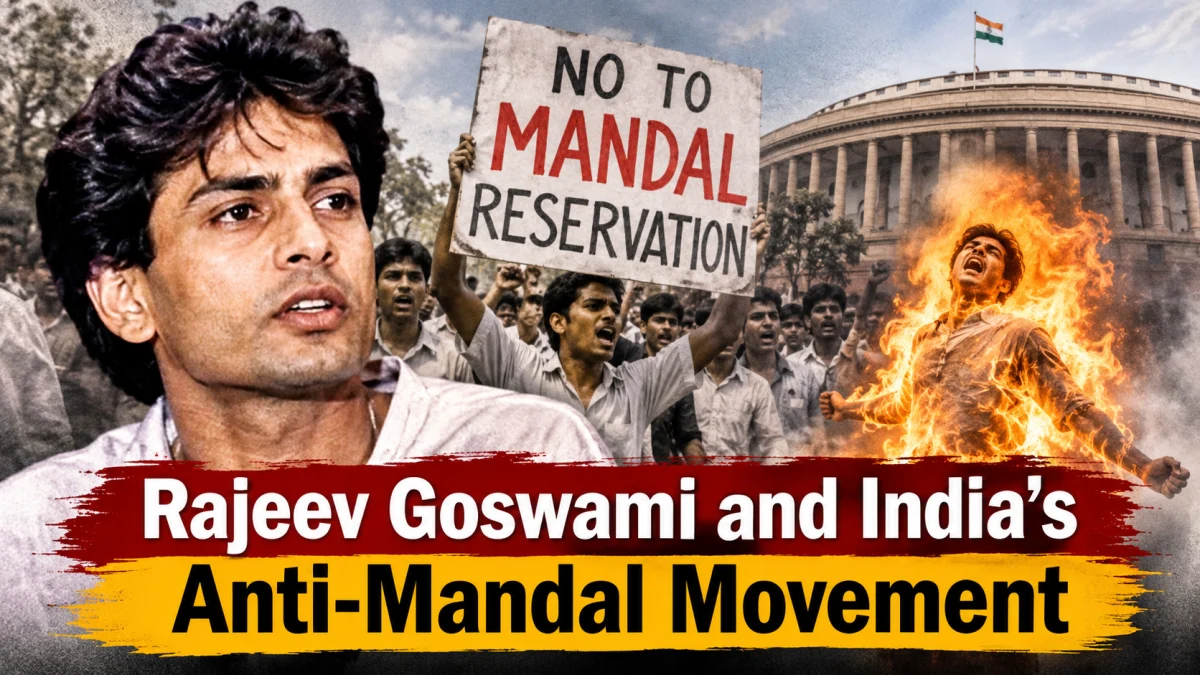
Rajeev Goswami Is The Face of the Anti-Mandal Movement
On September 19, 1990, as protests against the Mandal Commission spread, Delhi University student Rajeev Goswami set himself on fire in Delhi. He survived with burns covering about half his body. The incident made him the most recognisable face of the agitation.
The Decision That Sparked Protests
Established in 1979 under B. P. Mandal, the Second Backward Classes Commission submitted its report on December 31, 1980, recommending 27% reservation for Other Backward Classes (OBCs) in central government services. On August 7, 1990, Prime Minister V. P. Singh announced its implementation, triggering widespread student protests.
Opponents feared the decision would narrow access to limited government jobs and open competition. Supporters argued reservations were necessary to address historical exclusion and improve representation. The protests exposed a fundamental disagreement over equality, merit and social justice.
What Rajeev Goswami Said
In a December 31, 1995, India Today interview, Goswami continued to defend his protest. He stated:
"I have no regrets about what I did."
He called implementation:
"It would be a great injustice if the recommendations are implemented."
He further warned:
"It would cost ordinary people jobs."
Life After the Agitation
Goswami was elected president of the Delhi University Students’ Union in 1991. By 1995, his injuries still affected his movement and speech. He was running a tailoring business and a sewing-machine assembly unit.
In November 1992, the Supreme Court upheld the 27% OBC quota, subject to excluding the socially advanced "creamy layer", and established a general 50% ceiling on reservations, with exceptions for extraordinary circumstances.
Goswami died on February 24, 2004, aged 33, after liver and kidney failure.
His protest remains one of the defining images of the Anti-Mandal movement—and a reminder that India's debate over representation, merit and social justice is far from simple.
Sources and Further Reading
-
India Today (December 31, 1995) – I Have No Regrets at All About What I Did
-
India Today Archives (October 15, 1990) – Anti-Mandal Agitation: The Tragic Turn
-
Government of India, Department of Personnel and Training – Office Memorandum dated August 13, 1990
-
Parliamentary Archives – V. P. Singh's Statement on Employment Measures, August 27, 1990
-
Supreme Court of India – Indra Sawhney v. Union of India, November 16, 1992
-
Rediff / PTI (February 24, 2004) – Pioneer of Anti-Mandal Stir Dies


Join the Conversation