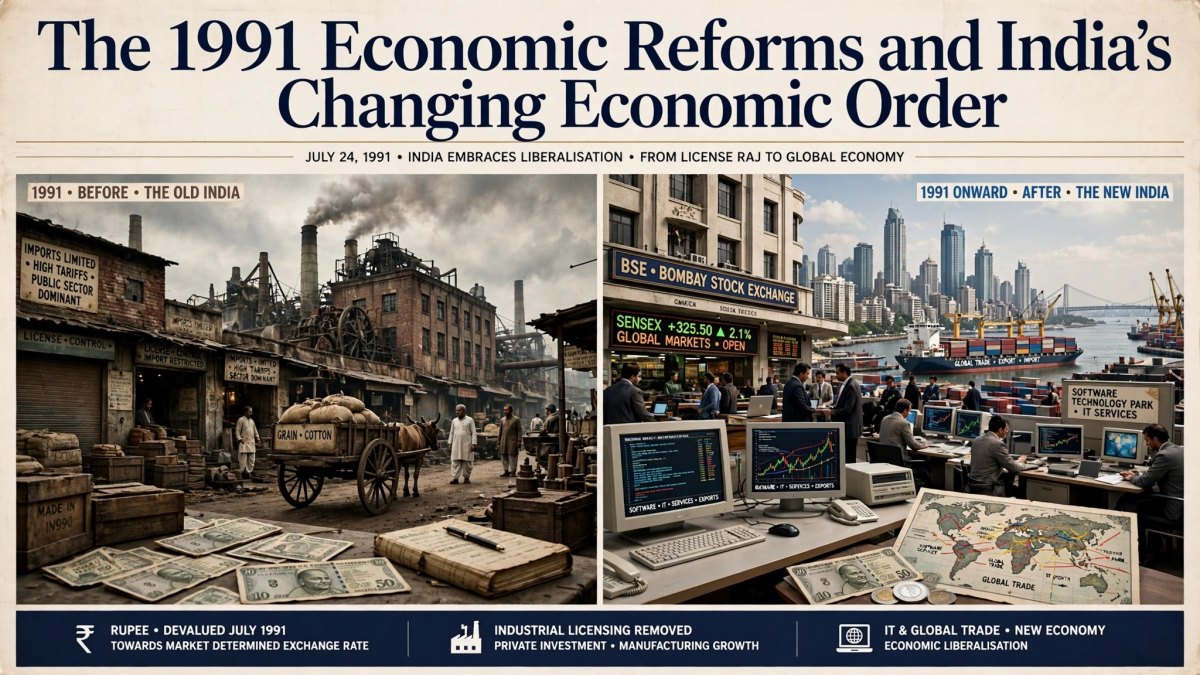
The 1991 Economic Reforms marked a defining turning point in modern Indian history. Faced with a severe balance of payments crisis, declining foreign exchange reserves and growing economic pressures, India fundamentally changed its development strategy. Under Prime Minister P. V. Narasimha Rao and Finance Minister Dr. Manmohan Singh, the government introduced liberalisation, privatisation and globalisation to reduce excessive controls, encourage private investment and connect the Indian economy with international markets. These reforms reshaped India's industrial, financial and trade systems while generating continuing debates about inequality, employment and inclusive growth.
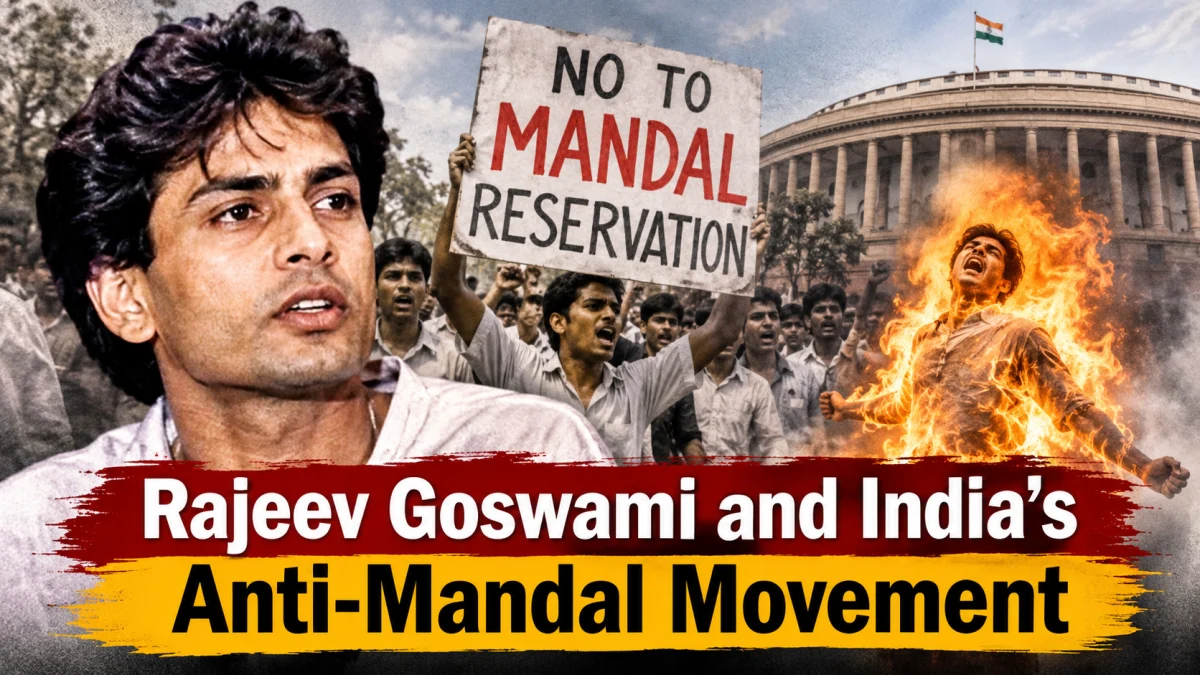
Also Read: Rajeev Goswami: The Face of India's Anti-Mandal Movement
1. India's Economic System Before 1991
Following independence in 1947, India adopted a planned economic development model in which the government played a central role in industrialisation, infrastructure and resource allocation. Public sector enterprises dominated several important industries, while private businesses operated under extensive government regulations.
Industrial licensing, import restrictions and controls over investment became defining features of the economic system. Businesses often required government permission to establish factories, expand production or introduce certain products. Although these policies aimed to develop domestic industries and reduce dependence on foreign countries, excessive regulation also created bureaucratic obstacles and limited competition.
During the 1980s, government expenditure and fiscal deficits increased, while external economic pressures gradually intensified. India's economic difficulties became particularly serious towards the end of the decade.
2. The Balance of Payments Crisis of 1991
By 1990–91, India was experiencing a severe external financial crisis. Rising oil prices following the Gulf War, political instability, increasing import costs and declining confidence among international lenders placed considerable pressure on the country's foreign exchange reserves.
The situation became critical when India struggled to finance essential imports and meet its external payment obligations.
According to the Reserve Bank of India (RBI), India's foreign currency assets declined from approximately US$3.1 billion in August 1990 to US$975 million on 12 July 1991. This exposed the seriousness of the country's external financial position.
To address the immediate crisis, the government introduced stabilisation measures, sought international financial assistance and used part of its gold reserves as collateral to obtain emergency foreign exchange. The crisis demonstrated that India's existing economic framework required substantial changes.
3. The Leadership Behind the Economic Reforms
Following the 1991 general election, P. V. Narasimha Rao became Prime Minister and assumed responsibility for managing an economy facing extraordinary financial difficulties.
He appointed Dr. Manmohan Singh as Finance Minister, who played a central role in designing and implementing the reform programme.
On 24 July 1991, Manmohan Singh presented the Union Budget, outlining a new economic direction for the country. His approach focused on restoring financial stability, reducing unnecessary government controls, encouraging investment and improving India's international competitiveness.
The government also introduced the New Industrial Policy of 1991, which became a major instrument in changing India's industrial structure.
4. Liberalisation, Privatisation and Globalisation
The 1991 reforms are widely associated with three principles: Liberalisation, Privatisation and Globalisation, commonly known as the LPG model.
Liberalisation
Liberalisation involved reducing government restrictions on industrial activities and private businesses. Industrial licensing was abolished for most industries, allowing companies greater freedom to establish and expand operations.
The objective was to encourage competition, improve productivity and reduce the bureaucratic procedures that had restricted business development.
Privatisation
Privatisation increased the role of private enterprises in economic activities. The government began reducing its ownership in selected public sector enterprises and encouraged private participation in industries where government organisations had previously dominated.
Disinvestment became an important policy instrument for restructuring public sector participation and mobilising government resources.
Globalisation
Globalisation aimed to integrate India with the international economy. The government gradually reduced import restrictions, encouraged foreign investment and improved opportunities for international business partnerships.
The 1991 industrial policy also permitted automatic foreign investment approval of up to 51 per cent equity in specified high priority industries, subject to applicable conditions. These changes helped establish a more open investment environment.
5. Currency, Trade and Financial Sector Reforms
The reforms extended beyond industrial policy. They also transformed India's foreign exchange management, banking system and international trade arrangements.
Changes in the Rupee's Exchange Rate
On 1 and 3 July 1991, the Indian rupee was devalued in two stages, involving a cumulative adjustment of approximately 18 per cent against the US dollar. The measure was intended to improve export competitiveness and address the country's external payment difficulties.
In March 1992, the government introduced the Liberalised Exchange Rate Management System (LERMS), establishing a dual exchange rate mechanism. A unified exchange rate followed on 1 March 1993.
Banking and Financial Reforms
The banking sector also underwent significant changes. The Narasimham Committee, established in 1991, recommended improvements in banking efficiency, financial supervision, capital adequacy and regulatory standards.
These recommendations contributed to the gradual modernisation of India's financial system. Reforms also encouraged greater operational flexibility and strengthened the framework for managing banking risks.
6. Economic Impact and New Opportunities
The reforms gradually changed India's business environment. Greater competition, private investment and international economic connections created opportunities across several industries.
The information technology, telecommunications, automobile, pharmaceutical and financial services sectors became important contributors to India's economic development.
Indian companies gained improved access to foreign markets, modern technology and international investment. The growth of software and information technology services also strengthened India's position in the global services economy.
The reforms also changed the relationship between the government and private businesses. Companies received greater freedom to make investment decisions, while foreign enterprises gained opportunities to participate in India's expanding market.
7. Criticism and Unequal Distribution of Benefits
Despite their economic significance, the reforms generated debate about their social consequences. Supporters argued that liberalisation improved competition, encouraged investment and reduced inefficient government controls.
Critics, however, raised concerns about unequal access to the benefits of economic growth. Small scale industries faced increased competition, while employment insecurity and regional economic differences remained important challenges.
Agriculture and rural development also required continued policy attention. Economic expansion did not automatically translate into equal opportunities for every section of society.
The debate surrounding the reforms therefore extended beyond economic growth to questions of employment, social protection, regional development and the distribution of national wealth.
Sources and Further Reading
1. Reserve Bank of India – Chronology of Events: Crisis and Reforms (1991–2000)
https://rbi.org.in/scripts/chro_1991.aspx
2. Government of India – Union Budget 1991–92: Manmohan Singh's Budget Speech
https://www.indiabudget.gov.in/budget2021-22/doc/bspeech/bs199192.pdf
3. Reserve Bank of India – India's Balance of Payments Crisis in 1991
https://www.rbi.org.in/scripts/PublicationReportDetails.aspx?ID=363
4. Reserve Bank of India – Economic Reforms and Financial Developments
https://www.rbi.org.in/Scripts/PublicationReportDetails.aspx?ID=170
5. Reserve Bank of India – Fiscal Reforms in India
https://www.rbi.org.in/scripts/PublicationsView.aspx?Id=10871
6. Government of India – Economic Survey and Historical Economic Policy Documents


Join the Conversation