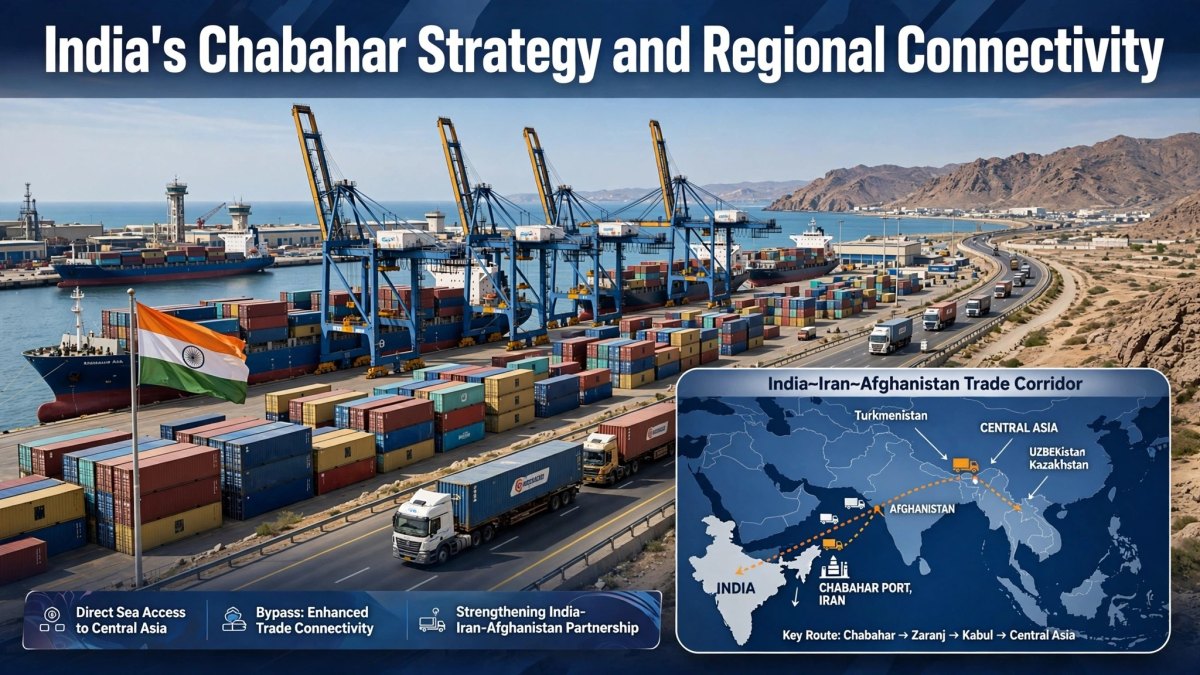
- India’s involvement in Chabahar aims to improve connectivity with Afghanistan and strengthen economic links with Central Asia.
- The ten Year agreement signed in May 2024 covers the equipping and operation of the Shahid Beheshti Terminal not ownership of the entire port.
- India reported completing its USD 120 million financial commitment under the main contract in July 2026. That milestone should be assessed separately from the project’s wider trade and connectivity goals.
Chabahar shows how infrastructure has become part of India’s regional diplomacy. The project combines a terminal operating agreement with broader ambitions for trade and access to Afghanistan and Central Asia. Understanding its importance means separating what India has committed and completed from what the wider connectivity initiative still aims to deliver.
Also Read: Karnataka Moves Supreme Court to Restore 56% Reservatio
1. Why India Has Invested in Chabahar?
India's interest in Chabahar is rooted in the objective of improving regional connectivity. The Ministry of External Affairs identifies Afghanistan's reconstruction and economic development, along with stronger trade and economic links with Central Asia, as important purposes behind India's involvement.
Infrastructure and regional diplomacy
Chabahar provides India with an opportunity to develop transportation connections through Iran. Its geographical position makes it relevant to India's efforts to strengthen economic engagement with Afghanistan and Central Asian countries.
The project also reflects the growing importance of infrastructure in international diplomacy. Port development, transportation networks and trade arrangements form part of India's broader engagement with countries across the region.
Connecting regional markets
Afghanistan's landlocked geography makes access to international transportation routes particularly important. Chabahar offers a maritime connection through Iran, creating opportunities for trade and the movement of goods between India and Afghanistan.
Its wider regional significance is linked to the possibility of improving commercial connections with Central Asian markets.
Also Read: जनता की आवाज़, सत्ता के दरवाज़े तक: राज शेखावत का 15,000 किमी का संघर्ष रंग लाया
2. How the Partnership Took Shape?
India's involvement in Chabahar developed through several agreements over different periods. An India–Iran memorandum of understanding in May 2015 was followed by a trilateral agreement involving India, Iran and Afghanistan in May 2016. The ten Year terminal contract was signed later, in May 2024.
The 2016 transport agreement
The trilateral agreement established an international transport and transit corridor between India , Iran and Afghanistan. It provided a framework for the movement of goods across the participating countries.
This arrangement extended beyond the management of the port terminal and placed Chabahar within a broader regional transportation framework.
India's operational involvement
India's operational participation began before the ten Year agreement was signed.
According to a February 2026 parliamentary response, India Ports Global Limited, through its wholly owned subsidiary India Ports Global Chabahar Free Zone, began operating at the port in 2018.
This established India's operational presence several years before the long term contractual arrangement of 2024.
Also Read: Ajeet Bharti’s 50-seat Challenge to Giriraj Singh
3. What the 2024 Agreement Actually Covers?
On May 13, 2024, India Ports Global Limited signed a ten Year contract with Iran's Ports and Maritime Organisation.
The agreement covers the equipping and operation of the Shahid Beheshti Terminal at Chabahar Port. It provides a longer term framework for India's participation in the terminal's operations.
Terminal operations and port ownership
The distinction between operating a terminal and owning an entire port is important when understanding the agreement.
India's contract concerns the Shahid Beheshti Terminal rather than ownership of Chabahar Port as a whole. Its responsibilities relate to the terminal's equipment and operations.
The arrangement represents an infrastructure and commercial partnership between India and Iran, with a defined contractual scope.
Also Read: Kulgam CRPF Checkpoint Comes Under Fire; Three Personnel Injured, Search Operation Launched
4. Where India's Financial Commitment Stands?
India's financial contribution is another significant part of its involvement in the project.
In a parliamentary response dated July 31, 2026, the government stated that India had fulfilled its USD 120 million financial commitment under the main contract. It also confirmed that the final tranche had been transferred to Iran's Ports and Maritime Organisation in August 2025.
Understanding the funding milestone
The completion of the specified financial commitment represents an important development in India's contractual participation.
However, financial contributions, terminal operations and the performance of wider transportation routes are separate aspects of the project. Completing the agreed financial contribution does not establish that every associated transport connection is operational or that all regional trade objectives have been achieved.
Also Read: India's border latest Development: Defence News
5. Chabahar's Wider Regional Significance?
Chabahar connects India's infrastructure engagement with broader economic and diplomatic interests. Its development involves cooperation with Iran, transportation arrangements involving Afghanistan and potential access to Central Asian markets.
The 2016 transport agreement, India's operational involvement from 2018 and the ten Year contract signed in 2024 illustrate the different stages of the partnership.
The completion of India's USD 120 million financial commitment in 2026 adds another milestone to this development.
Together, these arrangements establish the framework of India's participation in Chabahar. The port remains an important component of India's regional connectivity strategy, linking infrastructure cooperation with its wider economic interests in Afghanistan and Central Asia.
Also Read: PM Modi and Zelenskyy Discuss India's Possible Role in Black Sea Food Corridor
Sources and Further Reading
1. Ministry of External Affairs — India’s Engagement in Chabahar Port (February 6, 2026)
https://www.mea.gov.in/lok-sabha.htm?dtl/40697/QUESTION_NO1287_INDIAS_ENGAGEMENT_IN_CHABAHAR_PORT=
2. Ministry of External Affairs — Chabahar Port Project (November 28, 2024)
https://www.mea.gov.in/rajya-sabha.htm?dtl/38631/QUESTION_NO_44_CHABAHAR_PORT_PROJECT
3. Ministry of External Affairs — Development of Chabahar (July 31, 2026)
https://www.mea.gov.in/press-releases?dtl/41601
4. Ministry of External Affairs — India–Afghanistan–Iran International Transport and Transit Corridor Agreement (May 23, 2016)


Join the Conversation