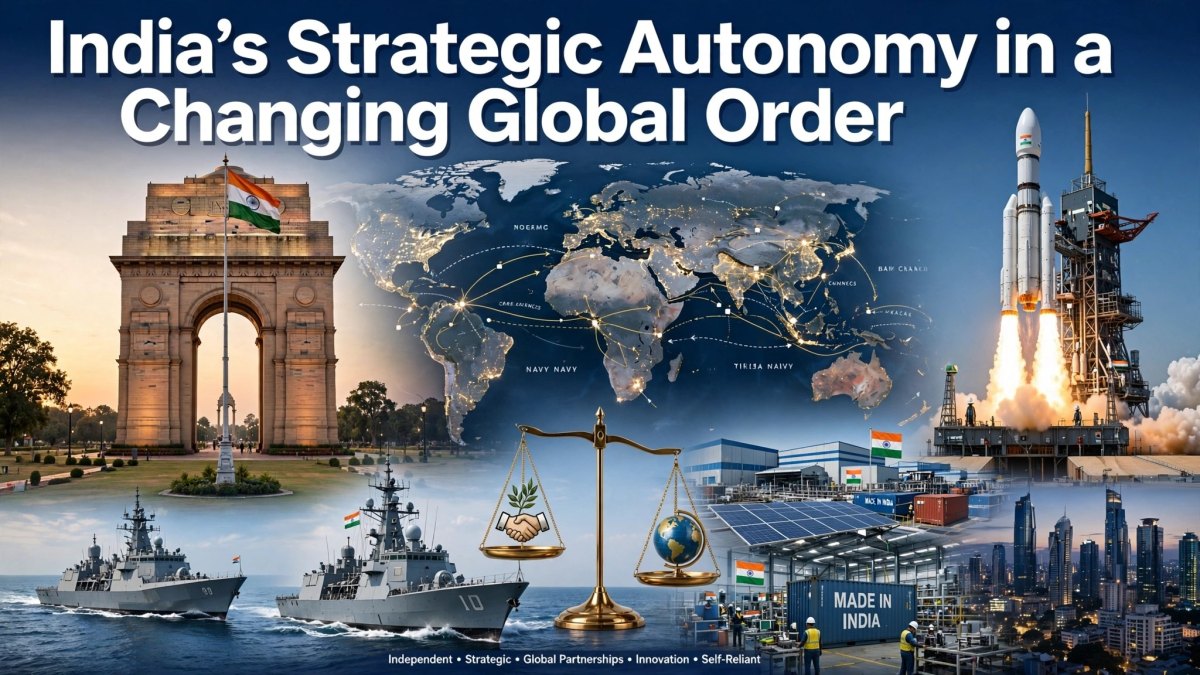
- India describes strategic autonomy as the freedom to make decisions according to its national interests while maintaining partnerships with different countries.
- Security, availability and diversification guide the government’s stated approach to energy and defence sourcing.
- Regional connectivity, maritime cooperation and domestic capabilities help explain how India seeks to preserve its options.
India’s foreign policy seeks to preserve independent choices while building partnerships that meet its needs. Energy supplies, defence requirements, neighbourhood connectivity and maritime cooperation explain this approach. Its effectiveness depends not only on diplomatic relationships, but also on the economic and technical capabilities that support India’s freedom to act.
Also Read: जनता की आवाज़, सत्ता के दरवाज़े तक: राज शेखावत का 15,000 किमी का संघर्ष रंग लाया
1. Understanding India’s Strategic Autonomy
Strategic autonomy is an important strand of India’s stated foreign policy. In a parliamentary response dated February 12, 2026, the Ministry of External Affairs said that national interest guides India’s approach and that engagements with different partners are based on mutual benefit.
Cooperation without automatic alignment
This approach leaves room for cooperation with different countries according to India’s requirements. A partnership is therefore not necessarily an exclusive commitment. The government’s explanation places national priorities at the centre of engagement rather than presenting every relationship as part of a single international alignment.
Independence within real World limits
Autonomy does not mean complete freedom from pressure. In a November 2020 address at the National Defence College, the foreign secretary described strategic autonomy as relative rather than absolute. The distinction is important for preserving choices involves managing external constraints, not assuming that they can be eliminated.
Also Read: Kulgam CRPF Checkpoint Comes Under Fire; Three Personnel Injured, Search Operation Launched
2. Energy and Defence Influence Diplomatic Choices
Energy and defence connect foreign policy with practical national requirements. The government’s February 2026 parliamentary response identified security, availability and diversification of sourcing as considerations guiding decisions in both sectors. These factors help explain why India maintains relationships with different suppliers and partners.
Procurement needs more than a political reading
The official explanation provides a practical context for interpreting procurement decisions. Rather than viewing each transaction solely as a signal of political preference, it directs attention to supply requirements and available options. That does not remove diplomacy from procurement, it shows why diplomatic interpretation alone is incomplete.
West Asia brings several interests together
The Ministry of External Affairs identifies West Asia as important to India’s energy security. Its regional framework also covers diaspora welfare, trade, investment, security, defence, education and health. India’s engagement with the region therefore extends beyond fuel supplies to a wider set of economic and community interests.
Also Read: India's border latest Development: Defence News
3. Regional Connectivity Remains a Priority
India’s wider international engagement operates alongside its Neighbourhood First policy. The policy covers Afghanistan, Bangladesh, Bhutan, Maldives, Myanmar, Nepal, Pakistan and Sri Lanka, with stated objectives that include stronger connectivity and expanded trade and commerce.
Connections between people and economies
The policy includes physical, digital and people to people connectivity. These priorities give regional diplomacy a practical focus beyond official meetings. They also provide a basis for assessing implementation, although a policy objective must remain distinct from evidence that a particular connection or project has been completed.
Act East extends the connectivity agenda
India’s Look East policy, launched in 1992, was upgraded to Act East in 2014. The ministry describes its objectives as strengthening economic cooperation, cultural ties and strategic relationships in the Indo-Pacific, with ASEAN at its core. Connectivity forms part of this wider regional approach.
Also Read: How Parliamentary Committees Support India's Democracy?
4. Maritime Cooperation Goes Beyond Security
India’s SAGAR concept Security and Growth for All in the Region was first articulated in Mauritius in 2015. Its stated scope includes maritime safety, connectivity, capacity building, disaster management and sustainable development in the Indian Ocean region.
Assistance is part of maritime engagement
This framework places development and disaster response alongside security cooperation. It offers a broader way to understand India’s maritime role for engagement involves helping build regional capacity as well as addressing safety concerns. Assessments of the framework should therefore distinguish its different objectives and examine their implementation separately.
Also Read: PM Modi and Zelenskyy Discuss India's Possible Role in Black Sea Food Corridor
5. Domestic Capacity Supports Independent Decisions
Diplomatic relationships are only one part of strategic autonomy. In the 2020 National Defence College address, the foreign secretary linked independent foreign Policy and security decisions with technical and economic assets, including domestic capacity for critical supplies.
Capabilities matter alongside partnerships
That connection provides a practical lens for examining India’s approach. The question is not simply how many partnerships India maintains, but what resources support its decisions. The address places domestic capabilities within the discussion of autonomy, making economic and technical strength relevant to understanding India’s freedom of action.
Also Read: Indian Navy Gets New Indigenous Warship Amini
Sources and Further Reading
1. Ministry of External Affairs — Credibility and Consistency of India’s Foreign Policy
https://www.sansad.in/getFile/annex/270/AU1521_LTnJDl.pdf
2. Ministry of External Affairs — Overview of India’s Regional Policies
https://www.mea.gov.in/Images/CPV/LS97_00.pdf
3. Ministry of External Affairs — Leveraging Strategic Autonomy in a Turbulent World
Join the Conversation