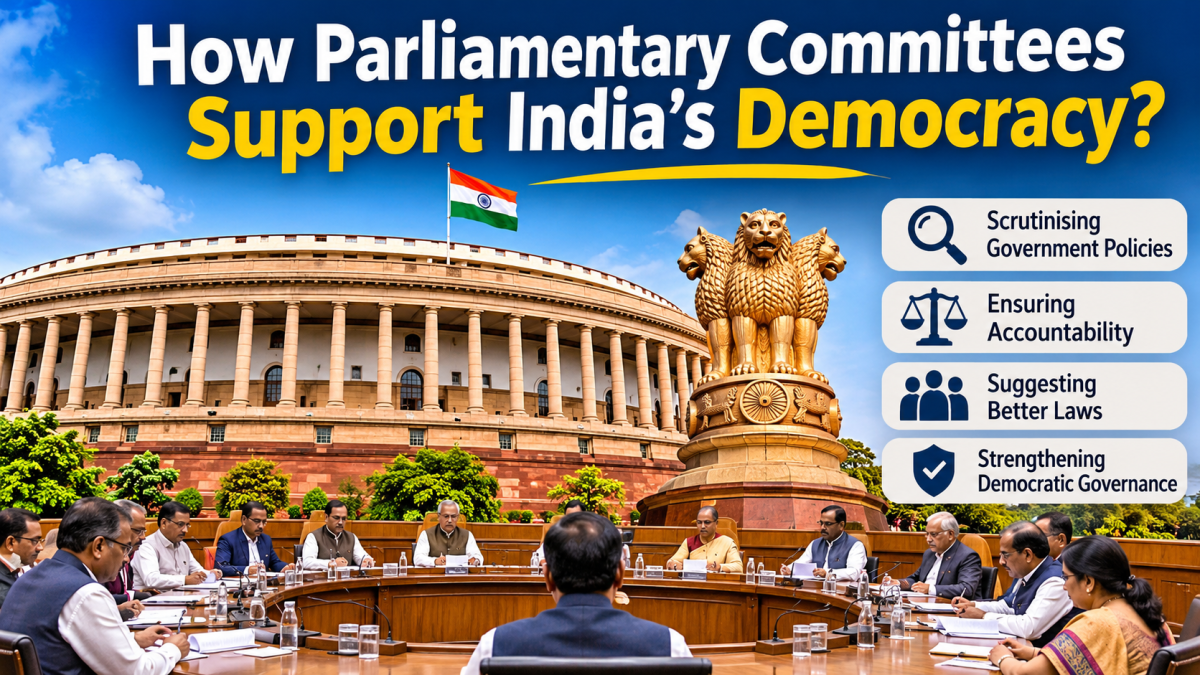
- Parliamentary committees allow MPs an opportunity to study government policies and proposed legislation in detail, and examine public expenditure.
- There are 24 Department related Parliamentary Standing Committees in India.
- Their effectiveness is closely related to the extent of their scrutiny, the reliability of the information placed before them, and the government’s response to their recommendations.
1. Importance of Parliamentary Committees in India
Public interest is usually focused on parliamentary debates on important pieces of legislation, or while discussions are held on major decisions of the government. However, there are a number of parliamentary committees that allow deeper analysis of proposed legislation and other government policies. The work done by these committees is particularly valuable while evaluating proposals that contain a number of complex or financial aspects that merit closer analysis. Among the various committees, Department related Parliamentary Standing Committees form an important link to the examination of the functioning of various government ministries.
Department related Standing Committees
India has 24 Department-related Standing Committees. Each has 31 members . 21 from the Lok Sabha and 10 from the Rajya Sabha. Of these, eight are under the Chairmanship of the Chairman of the Rajya Sabha , and the remainder are under the Speaker of the Lok Sabha.
Their functions include scrutinizing the estimates of ministries and departments and examining bills referred to them.
Also Read: PM Modi and Zelenskyy Discuss India's Possible Role in Black Sea Food Corridor
2. How Committees Examine Government Legislation?
A bill, in the course of its legislative process, may need to be examined by parliamentary committees for a more detailed consideration.
There may be provisions in a bill, which even though not controversial, may require more detailed consideration by Parliament. Often during the general debate on a bill, not all provisions may be examined thoroughly. Parliamentary committees may help scrutinize the bill more closely, identify legal and other problems, if any, and provide suggestions and recommendations to Parliament.
In doing so, the committee may examine not only the provisions of a bill but also the implications and possible consequences of such legislation. For example, a bill on protection of the rights of children may involve examination of issues, challenges and responsibilities of the institutions, the funding required and the possible impact on children and educational institutions.
By conducting detailed research and analysis, a committee can identify obscure provisions of a bill that may raise administrative or legal challenges. Often times, committee recommendations to Parliament serve as advisory roles, and legislative decisions are ultimately determined by Parliament. Not every bill, however, is referred to a committee.
3. Monitoring Public Expenditure
Apart from legislation, it is the duty of parliamentary committees to look into the way in which public funds are allocated and to satisfy themselves that public funds have been expended in accordance with the recommendations of the grants.
Department related committees go into the demands for grants presented by various ministries. This helps the Members of Parliament to examine the financial requirements and estimate the appropriateness of the grants in the light of the functions and programmes of various departments.
The Public Accounts Committee
The Public Accounts Committee is one of the important committees constituted by Parliament to exercise financial control over the government. It studies the expenditure incurred by various ministries of the government and considers the reports presented to the Parliament by the Comptroller and Auditor General of India.
In addition, the committee decides the nature and the extent of explanations to be obtained from the concerned departments of the government in respect of irregularities and lapses observed in the government expenditure.
It is important that the expenditure, which has been sanctioned in the budget, is scrutinized from the point of view of economy, efficiency and effectiveness.
Also Read: Space Security and the New Global Military Race
4. Declining Referrals and the Challenge of Legislative Scrutiny
A major concern regarding parliamentary committees is whether sufficient Bills undergo detailed examination by Parliamentary Committees.
According to PRS Legislative Research, 16 percent of the Bills introduced during the 17th Lok Sabha were referred to committees. During the 14th Lok Sabha and 15th Lok Sabha, 60 percent and 71 percent of the Bills respectively, were referred to parliamentary committees.
Importance of Detailed Examination
Additional time to examine technical aspects may be available to committees during the scrutiny process. This time may also enable consultation with appropriate stakeholders to address concerns with the implementation of the provisions of the bill.
It is important to consider the quality of the parliamentary debate, consultation, and final examination of bills. Not all bills will experience the rigors of detailed examination.
There are challenges committees face, including a lack of time, adequate information, and meaningful participation to do their work. When reports identify administrative or policy related concerns, government departments need to appropriately address the concerns.
5. Public Interest and Democratic Accountability
Committee work is of great importance as it offers insights into how government departments work, and into how the Parliament expends public funds. Further, during the course of policy implementation, concerns may arise that have been documented by parliamentary committees.
Committee reports can help researchers, journalists and civil society stakeholders analyze government decisions and track latest developments in public administration.
Healthcare, education, defense, agriculture, transport and finance touch the life of the common citizen. Closer legislative scrutiny of these and other related areas will help unravel and understand challenges to the effective implementation of policy decisions of the government.
Committee reports and recommendations, when published and placed in the public domain, offer opportunities for citizens to exercise their right to know, to make informed choices and to participate. It also serves to evaluate performance of the governing authority.
The parliament is supreme. The performance of parliamentary committees will greatly depend on the seriousness with which the parliament carries out its responsibilities. Committees perform a critical role of offering opinions and making recommendations, as required, to inform the parliament in taking appropriate decisions.
Sources and Further Reading
1. Digital Sansad – Introduction to Parliamentary Committees: https://sansad.in/ls/committee/introduction
2. Rajya Sabha Secretariat – Parliamentary Committee Functions: https://sansad.in/rs/faq
3. PRS Legislative Research – Functioning of the 17th Lok Sabha: https://prsindia.org/parliamenttrack/vital-stats/functioning-of-the-17th-lok-sabha
4. Digital Sansad – Department-related Standing Committees: https://sansad.in/ls/committee/departmentally-related-standing-committees


Join the Conversation