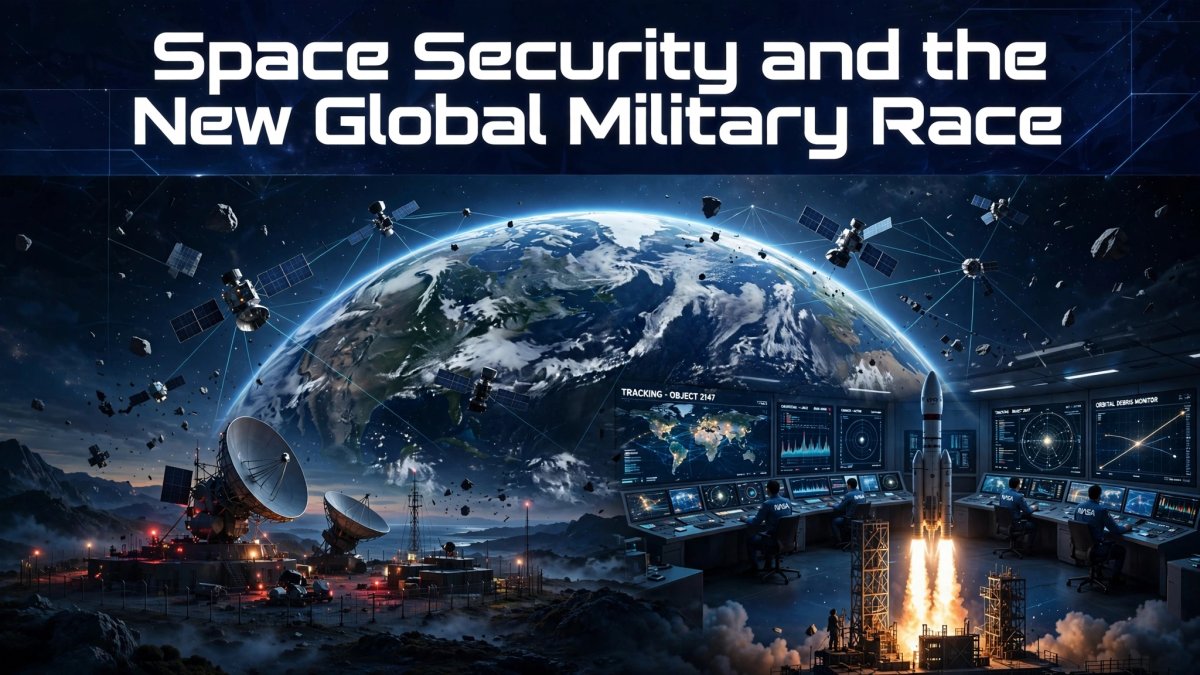
Space Security and the New Global Military Race
Outer space has become an increasingly important arena for international competition, technological development and national security. Satellites support essential services such as telecommunications, navigation, weather forecasting, financial transactions and disaster management. Governments also depend on space-based systems for intelligence, surveillance and strategic communications.
As countries expand their space capabilities, the boundary between civilian exploration and military applications is becoming increasingly significant. The United States, China, Russia and India are strengthening their space programmes while addressing emerging security challenges. Consequently, space security and the militarisation of outer space have become important issues in international relations.
The central question is whether outer space can remain a domain of peaceful cooperation or become another arena of geopolitical competition.
1. Why Space Has Become Strategically Important?
Modern economies and national security systems increasingly depend on satellite infrastructure.
Space-based technologies support several important activities:
• Communication: Satellites provide connectivity to remote regions and support international communication networks.
• Navigation: Satellite navigation systems support transportation, logistics and civilian applications.
• Weather Forecasting: Space-based observations help monitor weather patterns and natural disasters.
• National Security: Governments use satellite information for strategic awareness and monitoring.
• Economic Development: Agriculture, banking, telecommunications and scientific research benefit from space technology.
This growing dependence makes the protection of satellites and related infrastructure an important national priority.
According to NATO, space is now recognised as an operational domain alongside land, air, maritime and cyberspace. Its 2026 assessment highlights the increasing importance of space-based communications, navigation and intelligence for national security.
Source: "NATO – Its Approach to Space" https://www.nato.int/en/what-we-do/deterrence-and-defence/natos-approach-to-space
2. The Growing Competition Among Major Powers
Space competition is increasingly influenced by geopolitical rivalries and national security priorities.
• United States: The United States maintains extensive civilian and defence-related space capabilities. Its Space Force, established in 2019, focuses on organising, training and equipping personnel to protect American interests in the space domain.
• China: China has developed a major space programme covering satellite navigation, lunar exploration, scientific research and national security. Its growing technological capabilities have made it an important competitor in the global space sector.
• Russia: Russia has a long history of space exploration and continues to maintain significant space capabilities. Space security remains an important component of its broader national defence planning.
• India: India has emerged as an important space-faring nation through achievements in satellite technology, launch capabilities, lunar exploration and space-based services. Its growing strategic interests have also increased the importance of protecting national space assets.
Competition among these countries reflects the growing recognition that space capabilities influence economic strength, technological independence and national security.
3. India's Growing Role in Space Security
India's space programme has traditionally focused on scientific research, communication, navigation and development. However, the increasing importance of satellites to national infrastructure has expanded the country's interest in space security.
A significant milestone occurred on 27 March 2019, when India conducted Mission Shakti, demonstrating an anti-satellite capability.
The Indian government described the test as defensive in nature and stated that India remained opposed to the weaponisation of outer space.
India has also developed institutional capabilities to monitor space objects and protect its satellite infrastructure.
The Indian Space Research Organisation (ISRO) plays an important role in civilian space activities, satellite operations and space situational awareness. The Defence Space Agency also contributes to India's defence-related space coordination.
India's approach reflects the need to protect national interests while maintaining its stated commitment to peaceful space activities.
Source: "Government of India – India's Position on Outer Space Security" https://pmindiaun.gov.in/Cdgeneva/statement_content/ODA%2C
4. Space Debris and the Challenge of Orbital Sustainability
One of the most serious challenges facing the international space community is the increasing amount of space debris.
Defunct satellites, discarded rocket components and fragments from previous space activities can remain in orbit for extended periods. These objects create collision risks for operational satellites and spacecraft.
According to the Department of Space, as of March 2026, 129 trackable debris objects originating from Indian satellite missions remained in orbit.
India has introduced the Debris Free Space Mission, announced in 2024, with the objective of achieving zero debris creation by Indian government and private space actors by 2030.
ISRO also released its Indian Space Situational Awareness Report for 2025 in April 2026, outlining measures to improve space-object monitoring and long-term orbital sustainability.
These initiatives demonstrate that space security involves not only national defence but also environmental responsibility and international cooperation.
Sources: "PIB – Space Debris Management" https://www.pib.gov.in/PressReleasePage.aspx? | "ISRO – Indian Space Situational Awareness Report 2025" https://www.isro.gov.in/Indian_Space_Situational_Awareness_Report_2025.html
5. International Treaties and the Regulation of Outer Space
International law provides an important foundation for maintaining peaceful activities in outer space.
The Outer Space Treaty of 1967 is the principal international agreement governing space activities.
It establishes important principles, including:
• Outer space must be used for peaceful purposes and remain open to exploration by all countries.
• No country can claim sovereignty over outer space or celestial bodies.
• Nuclear weapons and other weapons of mass destruction cannot be placed in orbit around Earth.
• Countries are responsible for their national space activities, including those conducted by private organisations.
However, the treaty does not prohibit every military activity in outer space. This distinction remains important in international discussions about space security.
India has signed and ratified several major international space treaties, including the Outer Space Treaty, the Rescue Agreement, the Liability Convention and the Registration Convention.
India also supports negotiations for a legally binding international framework to prevent an arms race in outer space.
Source: "ISRO – International Cooperation and Space Treaties" https://www.isro.gov.in/FAQ_InternationCooperation.html
6. Major Challenges for India's Space Security
Despite considerable progress, India faces several challenges in protecting its growing space infrastructure.
• Increasing Satellite Dependence: Essential services increasingly rely on satellites, making their protection important for economic and national security.
• Space Situational Awareness: Identifying and monitoring objects in orbit requires advanced observation capabilities and international information sharing.
• International Competition: Growing geopolitical tensions create uncertainty about the future security environment in outer space.
• Technological Investment: Developing reliable domestic space technologies requires sustained research, funding and skilled professionals.
• Regulatory Coordination: Government agencies and private space companies need clear responsibilities and effective cooperation to maintain space sustainability.
These challenges require a balanced approach combining technological development, institutional preparedness and diplomatic engagement.
7. The Way Forward for India
India needs a long-term strategy that combines national security with peaceful space exploration.
• Strengthen Space Situational Awareness: Expand monitoring capabilities to improve the protection of satellites and other space assets.
• Invest in Indigenous Technology: Encourage domestic research and technological development to reduce external dependence.
• Improve Institutional Coordination: Strengthen cooperation between ISRO, defence institutions and private space companies.
• Promote International Cooperation: Participate actively in international discussions on responsible space behaviour.
• Prioritise Space Sustainability: Continue efforts to minimise orbital debris and promote responsible satellite operations.
• Develop Skilled Professionals: Expand education and research opportunities in space science, satellite technology and space policy.
Conclusion
Space is no longer limited to scientific exploration. It has become an essential part of modern economies, international relations and national security.
The growing competition among major powers demonstrates the strategic importance of satellite infrastructure and space-based technologies. For India, protecting its national space assets while maintaining its commitment to peaceful exploration will remain an important policy priority.
International treaties, technological cooperation and responsible space behaviour are essential to preventing unnecessary conflict and preserving the long-term sustainability of outer space.
The future of space security will depend not only on technological strength but also on the ability of nations to cooperate, establish international rules and protect outer space as a shared environment.
Sources and Further Reading
1. "NATO – Its Approach to Space" https://www.nato.int/en/what-we-do/deterrence-and-defence/natos-approach-to-space
2. "ISRO – Indian Space Situational Awareness Report 2025" https://www.isro.gov.in/Indian_Space_Situational_Awareness_Report_2025.html
3. "PIB – Space Debris Management" https://www.pib.gov.in/PressReleasePage.aspx
4. "Government of India – Outer Space Security" https://pmindiaun.gov.in/Cdgeneva/statement_content/ODA%2C
5. "ISRO – International Cooperation and Space Treaties" https://www.isro.gov.in/FAQ_InternationCooperation.html
6. "United Nations Office for Outer Space Affairs" https://www.unoosa.org/


Join the Conversation