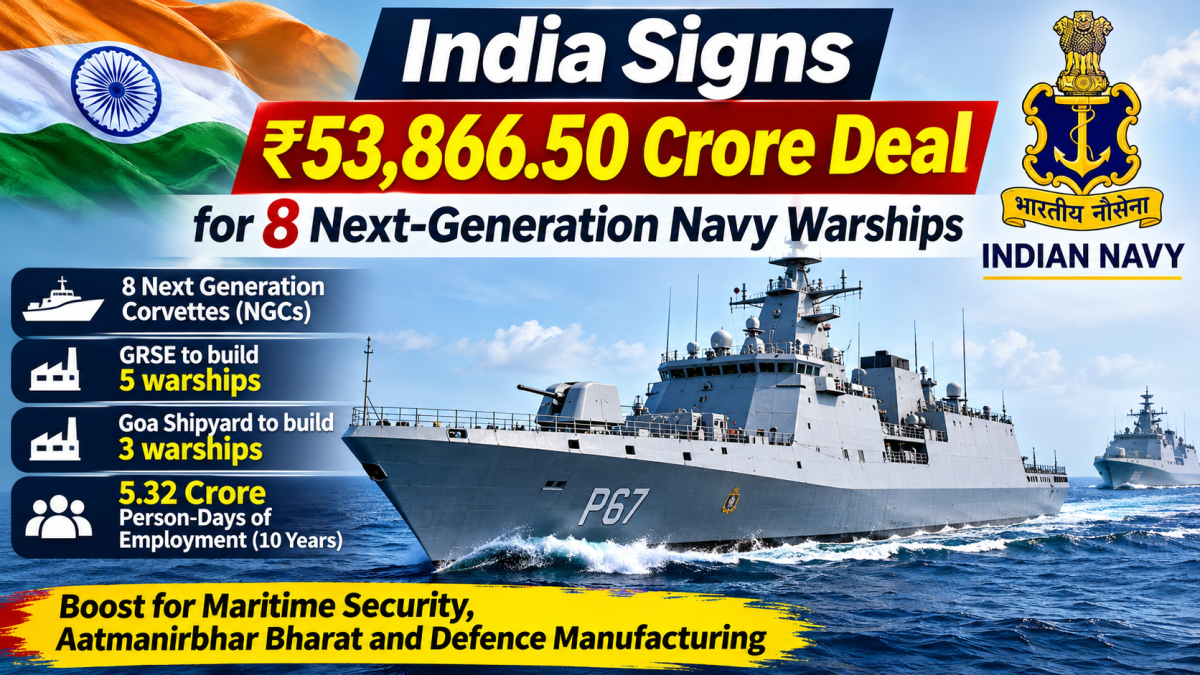
India has signed a major ₹53,866.50 crore defence contract to build eight new warships for the Indian Navy, marking another important step in the country's efforts to strengthen maritime security and develop its own warship manufacturing capabilities. Under the agreement, GRSE will construct five vessels and Goa Shipyard Limited will build the remaining three.
India is investing heavily in its maritime security, and the latest agreement for eight new naval warships is an important part of that effort.
The Ministry of Defence has signed contracts worth ₹53,866.50 crore with Garden Reach Shipbuilders & Engineers Limited (GRSE) and Goa Shipyard Limited (GSL) for the construction of eight Next Generation Corvettes (NGCs) for the Indian Navy.
The contracts were signed on November 2, 2026, at Kartavya Bhawan-2 in New Delhi in the presence of Defence Secretary Rajesh Kumar Singh.
Under the agreement, Kolkata-based GRSE will build five corvettes, while Goa Shipyard Limited will construct the remaining three.
What makes this project particularly important is that the ships will be designed indigenously by the Indian Navy and constructed by Indian defence public sector shipyards selected through a competitive process.
The Defence Ministry described the agreement as a significant milestone in India's indigenous warship design and construction capabilities.
According to the official announcement by the Ministry of Defence, the vessels will feature advanced missiles, weapons and sensor systems, allowing them to undertake operations across air, surface and underwater domains.
But the significance of this agreement goes beyond the number of ships being built. It also concerns India's ability to design, manufacture and maintain sophisticated naval platforms within the country.
Also Read: Centre Weighs FASTag Toll Exemption for Military Vehicles
₹53,866.50 Crore Navy Deal: Who Will Build India's Eight New Warships?
The government has divided the construction programme between two major defence shipyards, both of which play an important role in India's domestic naval manufacturing industry.
Here is how the contract has been allocated:
| Indian shipyard | Location | Warships |
|---|---|---|
| Garden Reach Shipbuilders & Engineers (GRSE) | Kolkata, West Bengal | 5 |
| Goa Shipyard Limited (GSL) | Goa | 3 |
| Total | 8 |
GRSE will undertake the largest share of the project, constructing five of the eight vessels. The remaining three will be manufactured by Goa Shipyard Limited.
The contracts were awarded through a competitive selection process, with both companies entrusted with the construction of ships designed by the Indian Navy.
The arrangement also gives two domestic shipyards an opportunity to expand their capabilities in advanced naval manufacturing.
The Indian Express reported on the contract signing and confirmed the allocation of five vessels to GRSE and three to Goa Shipyard.
What Are Next Generation Corvettes, and Why Does the Navy Need Them?
A warship does not necessarily need to be as large as an aircraft carrier or destroyer to play an important role in maritime security.
Corvettes are relatively smaller naval combat vessels designed to perform specialised missions, particularly in coastal and near-sea environments. Depending on their equipment, they can undertake surveillance, patrol, anti-surface and anti-submarine warfare operations.
The eight new Indian Navy corvettes are being developed as multi-role platforms rather than vessels restricted to a single operational purpose.
According to the Defence Ministry, they will have advanced missiles, weapons and sensor suites capable of supporting operations in three main domains:
Air operations: Their weapons and sensor systems will support the detection and response to aerial threats.
Surface warfare: The vessels will be capable of undertaking operations against hostile surface ships and other maritime threats.
Sub-surface warfare: Their equipment will support the detection and engagement of underwater threats, including submarines.
The Navy will also use the vessels for maritime surveillance, coastal defence, littoral combat operations and the protection of important trade routes.
These capabilities are particularly relevant to a country such as India, whose economic and strategic interests are closely connected to the sea.
Why Is India Investing in New Navy Warships?
India's maritime responsibilities extend well beyond protecting its coastline.
The Indian Ocean connects some of the world's busiest commercial shipping routes. Energy supplies, manufactured goods and other essential commodities move through these waters every day.
Any disruption to important shipping routes can create consequences for international trade and economic activity.
For India, maintaining a capable navy is therefore not simply about having more warships. It is also about protecting commercial interests, monitoring maritime activity and responding to potential security threats.
The eight Next Generation Corvettes are intended to strengthen several aspects of these responsibilities.
Protecting India's maritime trade routes
India depends significantly on maritime transportation for international trade.
Petroleum products, industrial materials and numerous other commodities enter and leave the country through shipping routes.
The Ministry of Defence has specifically identified safeguarding maritime trade routes as one of the important roles of the new vessels.
Their induction is expected to strengthen the Indian Navy's maritime presence and surveillance capabilities.
Strengthening anti-submarine warfare
Submarines are among the most difficult naval platforms to detect because they can operate underwater for extended periods.
Anti-submarine warfare therefore requires specialised sensors, equipment and weapons.
The new corvettes are being developed with capabilities to undertake such operations, adding another dimension to the Indian Navy's underwater surveillance and defence capabilities.
Improving coastal and littoral defence
India has a long coastline, alongside strategically important ports, naval installations and commercial infrastructure.
Monitoring coastal waters and responding to potential threats require vessels capable of operating effectively in these environments.
The new corvettes are expected to contribute to coastal defence, littoral combat and maritime surveillance missions.
A Big Step Towards Aatmanirbhar Bharat in Defence Manufacturing
One of the most interesting aspects of this ₹53,866.50 crore agreement is its emphasis on indigenous warship design.
The ships will be designed by the Indian Navy and constructed by domestic defence public sector shipyards selected through a competitive process.
This is an important step because modern warship construction involves much more than assembling a vessel. It requires sophisticated engineering, electronics, weapons integration, radar systems, sensors and specialised marine equipment.
India's ability to develop these capabilities domestically can strengthen its long-term defence manufacturing ecosystem.
The Defence Ministry has also highlighted the use of Made-in-India materials and equipment, indigenous technologies and Indian technical expertise.
The project is expected to encourage cooperation among:
-
Defence public sector shipyards.
-
Private shipbuilding companies.
-
Domestic equipment manufacturers.
-
Engineering and technology companies.
-
Micro, Small and Medium Enterprises (MSMEs).
The participation of domestic companies is particularly important because the construction of eight advanced warships will require a large industrial supply chain.
The agreement therefore fits into India's wider Aatmanirbhar Bharat and Make in India initiatives, which seek to expand domestic capabilities in strategically important sectors.
Eight Warships Could Generate 5.32 Crore Person-Days of Employment
The project is also expected to have an impact beyond the defence sector.
The construction of eight naval vessels requires a wide range of workers, engineers, technicians, manufacturers and supporting businesses.
According to the Ministry of Defence, the programme is expected to generate approximately 72 lakh person-days of employment in shipyards and another 460 lakh person-days in ancillary industries and MSMEs over the next ten years.
The estimated employment contribution is:
| Sector | Estimated employment |
|---|---|
| Shipyards | 72 lakh person-days |
| Ancillary industries and MSMEs | 460 lakh person-days |
| Total | 532 lakh person-days |
This represents approximately 5.32 crore person-days of employment over a decade.
An important distinction is that person-days do not mean 5.32 crore permanent jobs or separate individuals employed. They represent the cumulative number of working days expected to be generated through the project.
The additional industrial activity could benefit businesses involved in engineering, metal fabrication, electronics, equipment manufacturing, logistics and other specialised services.
For MSMEs, participation in defence manufacturing supply chains could also create opportunities to expand their technical capabilities and business operations.
These figures come from the Defence Ministry's official contract announcement.
When Will the Indian Navy Receive Its First New Corvette?
The contract signing is an important milestone, but building advanced warships is a complex process that takes several years.
Construction involves detailed engineering, hull fabrication, installation of propulsion systems, weapons integration, sensor installation and extensive testing before a vessel can enter operational service.
According to a report published by The New Indian Express on November 2, 2026, the first corvette is expected to be delivered by 2030.
The Ministry of Defence's contract announcement did not provide a complete delivery schedule for all eight vessels.
Further details about construction milestones and individual delivery dates are expected to become clearer as the programme progresses.
Why This Deal Matters for India's Defence Industry
For years, India has been working to expand its domestic defence manufacturing capabilities and reduce reliance on foreign suppliers in important strategic sectors.
Warship manufacturing is one area where the development of indigenous technology, engineering skills and industrial capacity can have long-term benefits.
The new corvette programme brings together the Indian Navy's design requirements and the manufacturing capabilities of two domestic shipyards.
It also creates opportunities for a wider group of Indian companies to participate in supplying equipment, materials and specialised services.
The benefits will not be measured only by the number of vessels delivered. The development of domestic expertise, the growth of supporting industries and the ability to maintain these ships over their service lives will also matter.
The programme is therefore an important test of India's ability to translate defence investment into long-term industrial and technological capability.
What Comes Next for the Indian Navy?
The signing of the ₹53,866.50 crore agreement marks the beginning of a major construction programme.
Over the coming years, GRSE and Goa Shipyard Limited will undertake the task of building eight warships designed to strengthen the Indian Navy's capabilities across multiple maritime domains.
The vessels are expected to contribute to anti-submarine warfare, maritime surveillance, coastal defence and the protection of trade routes.
At the same time, the project will bring work to Indian shipyards and supporting industries, with the Defence Ministry projecting substantial employment in the sector over the next decade.
For India, the larger objective is clear: strengthening naval capabilities while developing more of the technology, expertise and industrial capacity needed to build advanced warships at home.
The ₹53,866.50 crore agreement is not just about adding eight vessels to the Indian Navy. It is also about strengthening India's ability to design, build and support its own warships while expanding the country's domestic defence manufacturing industry.
Frequently Asked Questions (FAQs)
1. How much is India's new Indian Navy warship deal worth?
The Ministry of Defence has signed contracts worth ₹53,866.50 crore for the construction of eight Next Generation Corvettes for the Indian Navy.
2. Which companies will build the eight new Navy warships?
Garden Reach Shipbuilders & Engineers Limited (GRSE) will construct five vessels, while Goa Shipyard Limited (GSL) will construct the remaining three.
3. What are Next Generation Corvettes?
Next Generation Corvettes are multi-role naval combat vessels designed to operate across air, surface and sub-surface domains. Their roles include maritime surveillance, coastal defence, anti-surface warfare and anti-submarine warfare.
4. Why does the Indian Navy need new corvettes?
The vessels are intended to improve the Navy's ability to protect maritime trade routes, monitor coastal waters, respond to naval threats and conduct anti-submarine and anti-surface operations.
5. How many jobs will the eight-warship project create?
The Defence Ministry estimates 72 lakh person-days of employment in shipyards and 460 lakh person-days in ancillary industries and MSMEs over ten years. These are cumulative workdays, not permanent job counts.
6. When will the first new corvette be delivered?
The New Indian Express reported that the first vessel is expected by 2030. The Defence Ministry's official announcement does not specify the full delivery schedule.
7. Is the new warship project part of Make in India?
Yes. The vessels will be designed indigenously by the Indian Navy and constructed by Indian defence public sector shipyards. The Ministry also emphasises indigenous technologies, materials and equipment.
8. Who signed the new Navy warship contracts?
The Ministry of Defence signed the contracts with GRSE and Goa Shipyard Limited on November 2, 2026, in New Delhi in the presence of Defence Secretary Rajesh Kumar Singh.
Sources: Ministry of Defence – Official Contract Announcement | The Indian Express – Navy Warship Deal | The New Indian Express – Construction and Delivery Details.

Join the Conversation