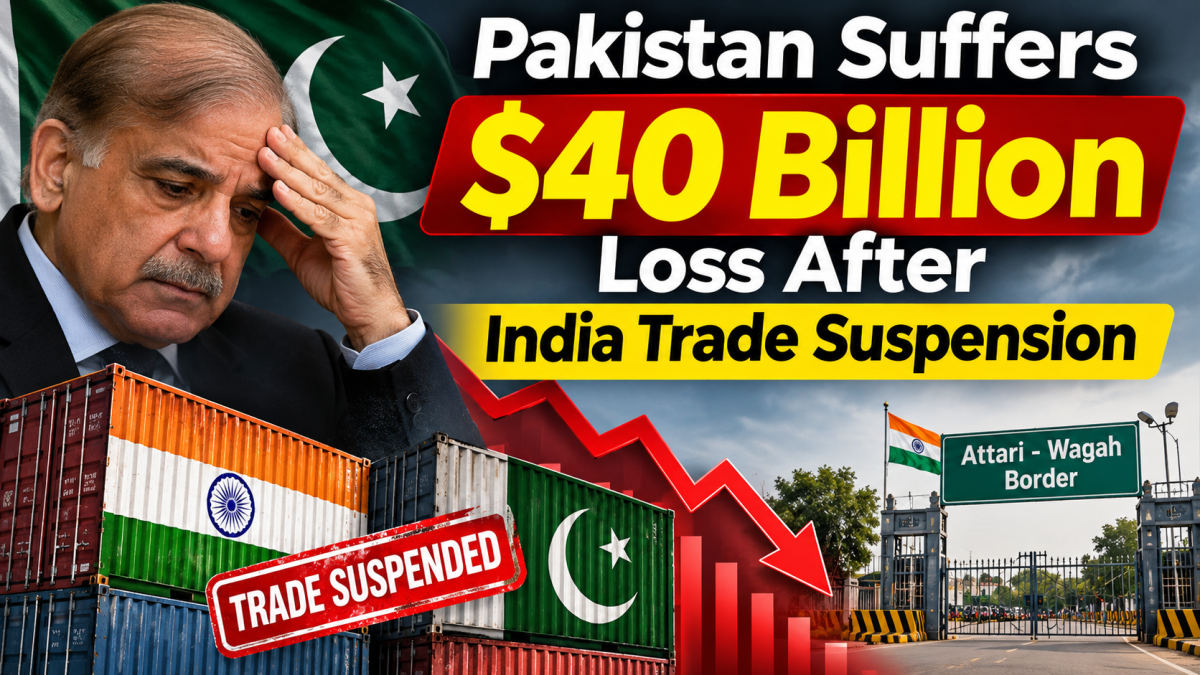
Pak-India Business Council chairman Noor Muhammad Qasuri says prolonged trade restrictions have increased costs for Pakistani industries, particularly pharmaceuticals and textiles. However, the $40 billion estimate has not been accompanied by a publicly disclosed calculation.
Pakistan has suffered an estimated US$40 billion in economic losses since trade with India was suspended in 2019, according to Noor Muhammad Qasuri, chairman of the Pak-India Business Council (PIBC).
Qasuri has urged New Delhi and Islamabad to restore commercial relations, arguing that renewed trade could reduce import costs, strengthen industrial activity and create opportunities for investment and tourism.
The statement, reported by the Press Trust of India (PTI) on Monday, has brought renewed attention to the economic consequences of the prolonged deterioration in India-Pakistan trade relations.
However, the US$40 billion figure is an estimate attributed to the business council chairman. The report does not provide a detailed calculation or an independently audited assessment establishing the amount.
Also Read: India's Neighbourhood Policy and Regional Security Challenges
Why Pakistan's business sector is raising concerns
According to Qasuri, the absence of regular trade with India has forced Pakistani businesses to obtain essential raw materials and industrial products from more distant markets.
He argued that longer supply routes have increased transportation expenses, freight charges and delivery times, creating additional pressure on businesses that previously had access to geographically closer Indian suppliers.
The pharmaceutical industry is among the sectors he identified as particularly affected.
Qasuri said access to pharmaceutical raw materials from India could help Pakistan's pharmaceutical industry save between US$2 billion and US$3 billion annually.
He also highlighted the difficulties facing Pakistan's textile industry. According to his statement, declining domestic cotton production has forced textile manufacturers to source cotton from countries including Brazil, Egypt, China and the United States.
He estimated that these sourcing difficulties had resulted in additional expenditure of approximately US$5 billion for the textile sector.
These sector-specific figures are also claims made by Qasuri and should not be interpreted as independently verified government estimates.
Apart from pharmaceuticals and textiles, he identified sugar, fertilisers, cement, petroleum products, iron and steel, vegetables and heavy machinery as other categories in which closer trade with India could potentially reduce procurement and transportation costs.
What India's official trade data reveals
While the US$40 billion estimate has attracted attention, India's official trade statistics provide important context about the scale of commercial relations between the two countries.
In a written reply to Rajya Sabha Unstarred Question No. 1487 on 1 August 2025, the Ministry of Commerce and Industry presented bilateral trade figures compiled by the Directorate General of Commercial Intelligence and Statistics (DGCIS).
The figures show that India-Pakistan trade fluctuated considerably between the financial years 2020–21 and 2024–25.
| Financial year | Total bilateral trade |
|---|---|
| 2020–21 | US$329.26 million |
| 2021–22 | US$516.36 million |
| 2022–23 | US$647.21 million |
| 2023–24 | US$1,191.73 million |
| 2024–25 | US$558.24 million |
The same parliamentary response showed that Pakistan accounted for just 0.05% of India's total international trade in FY 2024–25.
Its share had reached 0.11% in FY 2023–24 before declining to 0.05% in the following financial year.
These figures describe India's recorded bilateral trade, rather than the wider economic losses estimated by the Pakistani business council chairman.
Bilateral trade fell sharply after the 2025 restrictions
Trade between the neighbours experienced another major disruption following the Pahalgam terror attack in April 2025.
On 24 April 2025, India closed passenger and goods movement through the Integrated Check Post at Attari.
Subsequently, on 2 May 2025, the Directorate General of Foreign Trade (DGFT) issued Notification No. 06/2025–26, prohibiting the direct or indirect import and transit of goods originating in or exported from Pakistan.
Pakistan subsequently issued its own trade-related restrictions on 4 May 2025, including restrictions on the movement of Indian-origin goods through its territory.
The impact on recorded bilateral trade was visible in the figures presented to Parliament.
According to the government's data, total India-Pakistan trade during May and June declined from US$103.45 million in 2024 to US$13.17 million in the corresponding period of 2025.
This represented a decline of approximately 87%.
The Ministry of Commerce and Industry also observed that the impact of the restrictions on India's overall trade was negligible, given the relatively small volume and share of bilateral commerce.
India's import prohibition remains in force
The restrictions have continued to receive enforcement attention in 2026.
The World Trade Organization's quantitative restrictions database lists India's prohibition on imports and transit of products from Pakistan as in force from 30 June 2026.
In October 2026, India's Directorate of Revenue Intelligence (DRI) reported multiple enforcement operations involving attempts to bring Pakistan-origin goods into India through third countries.
On 14 October, the DRI announced the detection of 295 containers carrying approximately 7,311 metric tonnes of Pakistan-origin industrial and Himalayan rock salt. The consignments had allegedly been routed through Colombo, Sri Lanka, using fabricated certificates of origin and invoices.
On 23 October, the government announced another enforcement operation involving approximately 25,000 kilograms of Pakistan-origin watermelon seeds allegedly routed through Dubai and declared as UAE-origin goods.
These developments demonstrate that restrictions on Pakistani-origin goods remain an active issue in India's trade-enforcement framework.
Could restoring trade reduce costs for Pakistan?
Qasuri believes that renewed commercial relations could offer economic benefits to both countries.
He argued that access to geographically closer suppliers could help Pakistani businesses reduce freight expenses, shorten delivery times and obtain essential industrial inputs at more competitive costs.
He also referred to potential opportunities in tourism, investment and regional economic cooperation.
However, any restoration of trade would involve broader diplomatic and political considerations, alongside questions of security, trade policy and economic cooperation.
For Pakistan, the potential savings described by the business council chief are particularly relevant to industries dependent on imported raw materials. For India, the official figures show that Pakistan has historically represented a small share of its overall international trade.
Is the US$40 billion estimate independently verified?
The US$40 billion figure should be understood in its proper context.
It is an estimate presented by the chairman of the Pak-India Business Council, not a confirmed figure published by India's Ministry of Commerce or an independently audited calculation of Pakistan's national economic losses.
It is also important to distinguish between the value of direct bilateral trade, additional costs incurred by industries, and wider economic opportunities that may have been lost because of restricted commercial relations.
These are different economic measurements and should not be treated as interchangeable.
A detailed breakdown covering the methodology, time period, sector-wise losses and assumptions would be necessary to independently assess the US$40 billion estimate.
Nevertheless, the statement highlights how prolonged restrictions on commercial relations can affect supply chains, industrial procurement and the economic relationship between neighbouring countries.
The central question is therefore not simply how much trade has been lost, but how much additional economic activity and industrial efficiency may have been affected by the absence of normal commercial relations.


Join the Conversation