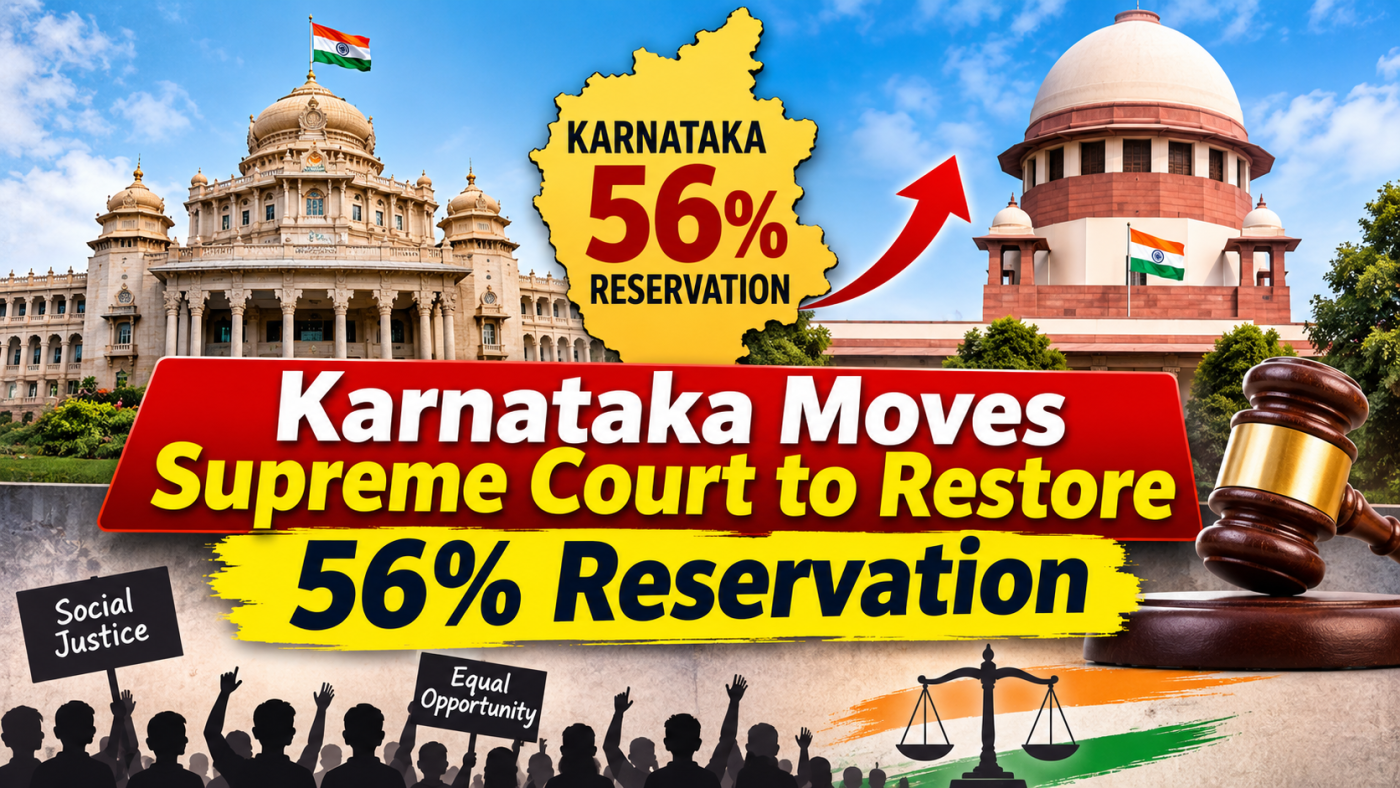
The Karnataka government has approached the Supreme Court challenging a High Court ruling that struck down the state's enhanced reservation framework, reopening a major constitutional debate over affirmative action, social representation and the 50% reservation ceiling.
BENGALURU, November 12, 2026: The Karnataka government has moved the Supreme Court of India seeking to restore its 56% reservation framework for Scheduled Castes (SC), Scheduled Tribes (ST) and Other Backward Classes (OBC). The move comes after the Karnataka High Court, on October 12, struck down provisions of a state law that had increased reservation for SCs and STs in educational institutions and government employment.
The state government has filed a Special Leave Petition (SLP) challenging the High Court's decision, seeking legal relief for the enhanced quota. The development has brought renewed attention to one of India's most debated constitutional questions: how far can state governments expand reservation policies while remaining within the constitutional framework governing equality and representation?
According to a statement issued by the Chief Minister's Office on November 11, the appeal was approved following a Cabinet decision on October 15 and a subsequent Government Order dated October 27. The state is seeking to defend the enhanced reservation structure against the High Court's findings.
Also Read: How Parliamentary Committees Support India's Democracy?
How Karnataka's Reservation Reached 56%
The controversy centres on the Karnataka Scheduled Castes and Scheduled Tribes (Reservation of Seats in Educational Institutions and of Appointments or Posts in the Services under the State) Act, 2022.
The legislation increased the reservation for Scheduled Castes from 15% to 17% and for Scheduled Tribes from 3% to 7%. The existing 32% allocation for Other Backward Classes remained unchanged.
The resulting reservation structure was:
-
Scheduled Castes (SC): Increased from 15% to 17%.
-
Scheduled Tribes (ST): Increased from 3% to 7%.
-
Other Backward Classes (OBC): Remained at 32%.
-
Total reservation: Increased from 50% to 56%.
The additional six percentage points therefore came entirely from the revised SC and ST allocations.
The legislation followed recommendations from a commission headed by retired Karnataka High Court judge Justice H.N. Nagamohan Das. Appointed in 2019, the commission examined the population and representation of SC and ST communities and submitted its recommendations in July 2020.
The law was introduced through an ordinance on October 23, 2022, with effect from November 1, 2022. It was subsequently replaced by legislation that received the Governor's assent on January 11, 2023.
The state government argued that the enhancement was necessary to address the gap between the population of SC and ST communities and their representation in education and public employment.
Why Did the Karnataka High Court Strike Down the Law?
On October 12, 2026, a division bench of Chief Justice Vibhu Bakhru and Justice K.S. Hemalekha of the Karnataka High Court invalidated the provisions responsible for increasing the reservation beyond 50%.
The court held that the enhanced quota violated constitutional guarantees of equality under Articles 14, 15 and 16.
A central issue in the judgment was the 50% reservation ceiling associated with the Supreme Court's landmark 1992 ruling in Indra Sawhney v. Union of India.
Although the Supreme Court has recognised that extraordinary circumstances may justify crossing the 50% threshold, the Karnataka High Court concluded that the state had not established the exceptional circumstances necessary to justify the increase.
The judges also examined the basis on which the Nagamohan Das Commission had recommended the revised percentages.
One important distinction in the judgment concerned the difference between population-based representation and adequate representation. The court observed that the Constitution does not automatically require reservation in proportion to a community's share of the population.
It also questioned the commission's reliance on older employment data and the absence of a sufficiently comprehensive assessment comparing the representation of different communities.
Consequently, the court concluded that the state's justification was insufficient to permit the overall reservation to cross the established constitutional threshold.
A Second Constitutional Question: Were the National Commissions Consulted?
Beyond the 50% ceiling, the judgment raised another important procedural issue.
Articles 338(9) and 338A(9) of the Constitution require the government to consult the National Commission for Scheduled Castes and the National Commission for Scheduled Tribes on major policy matters affecting their respective communities.
The High Court noted that Karnataka had not consulted either commission before enacting the legislation.
The state relied on letters sent to the commissions in December 2025 and January 2026. However, the court observed that communication after the enactment of the legislation could not replace meaningful consultation beforehand.
The bench considered this a mandatory constitutional requirement. It ultimately stated that further examination of this challenge was unnecessary after concluding that the provisions already violated constitutional equality guarantees.
This aspect makes the case significant beyond the numerical question of reservation because it also concerns the constitutional procedures that governments must follow when framing major social policies.
Karnataka's Ninth Schedule Demand Returns to Focus
The dispute also brings renewed attention to Karnataka's demand for placing the enhanced reservation law in the Ninth Schedule of the Constitution.
The Ninth Schedule has historically been used to provide additional constitutional protection to certain laws. Karnataka had sought the inclusion of its 2022 reservation legislation to strengthen its legal position.
On December 18, 2025, the Karnataka Legislative Assembly adopted a resolution urging the Union government to include the legislation in the Ninth Schedule.
However, on July 25, 2026, the Union Ministry of Law and Justice informed Parliament that the proposal had been deferred because the legislation was already facing legal challenges before the Karnataka High Court.
With the High Court having now invalidated the enhanced provisions, the state's Supreme Court appeal represents another important step in its effort to defend the reservation framework.
The current Karnataka government has also criticised the previous BJP-led government for failing to secure the requested constitutional protection when the legislation was originally introduced. These are allegations made by the present state government and form part of the political dispute surrounding the law.
What Happens Next?
The matter has now moved to the Supreme Court, where the legal validity of Karnataka's enhanced reservation framework will be contested.
The filing of an appeal does not automatically restore the provisions struck down by the High Court. The Supreme Court will have to consider the state's legal arguments and determine whether the High Court's decision should be upheld, modified or set aside.
The outcome could have implications for reservations in state educational institutions and government recruitment, particularly for candidates belonging to the SC and ST communities.
It may also contribute to the broader constitutional debate over how states should balance affirmative action, adequate representation and equality of opportunity.
For Karnataka, the central question is whether the evidence and constitutional reasoning supporting the enhanced reservation can withstand judicial scrutiny. For the wider country, the case once again places the limits and legal principles governing reservation policies under the spotlight.
The Supreme Court's eventual consideration of the matter will be important in determining the legal future of Karnataka's proposed 56% reservation framework. Until then, the enhanced provisions remain affected by the Karnataka High Court's October 12 judgment.
Sources and references:
-
The Indian Express – Karnataka moves Supreme Court after setback over enhanced SC/ST quotas
-
The News Minute – Karnataka moves Supreme Court to restore enhanced SC/ST quota
-
Press Information Bureau – Union government defers Ninth Schedule proposal, July 25, 2026
-
PRS Legislative Research – Karnataka SC and ST (Reservation) Act, 2022



Join the Conversation