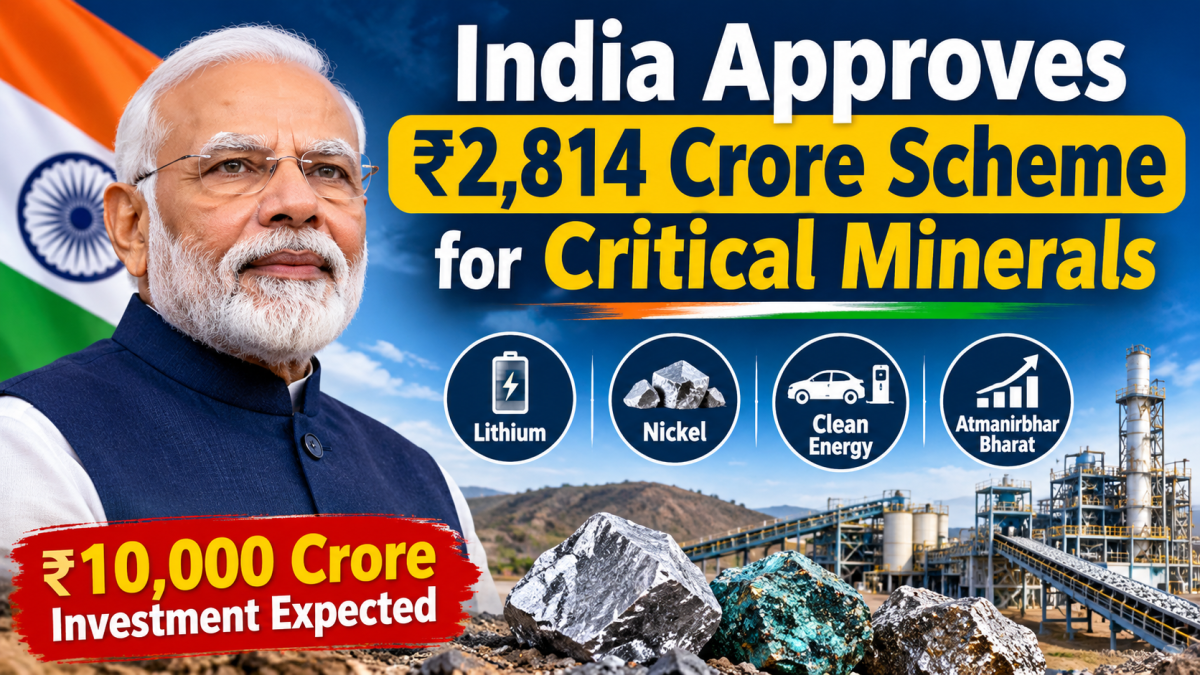
India Approves ₹2,814 Crore Critical Minerals Scheme
India is strengthening its domestic mineral processing capabilities with a ₹2,814 crore investment scheme aimed at reducing import dependence and securing supplies of essential industrial materials. The Union Cabinet, chaired by Prime Minister Narendra Modi, approved the Capex Support Scheme to Promote Critical Mineral Processing on November 4, 2026.
The five-year initiative will operate from FY 2026–27 to FY 2030–31 and support the establishment of four processing plants focused on lithium and nickel. The government expects the scheme to attract approximately ₹10,000 crore in investment and strengthen India's position in emerging industrial supply chains.
1. Four Processing Plants Planned
The scheme aims to establish two lithium processing plants and two nickel processing plants to improve domestic production of high-purity mineral materials.
| Minerals | Plants | Minimum Capacity |
|---|---|---|
| Lithium | 2 | 30,000 tonnes each |
| Nickel | 2 | 50,000 tonnes each |
Lithium facilities will process ores and concentrates, excluding brines, into battery-grade products. Nickel facilities will produce Class-1 nickel or battery-grade nickel sulphate. Cobalt recovery is also expected as a by-product of nickel processing.
2. Government Announces 30% Capital Subsidy
Under the scheme, eligible companies will receive a 30% capital subsidy on qualifying investments made to establish processing facilities.
The maximum financial support has been fixed at:
• ₹500 crore per lithium processing beneficiary.
• ₹900 crore per nickel processing beneficiary.
• ₹2,814 crore total scheme outlay.
The initiative is designed to reduce the high initial investment requirements associated with mineral processing infrastructure and encourage greater private-sector participation.
Beneficiaries will be selected through a two-stage process involving technical qualification and financial bidding. Financial assistance will be released in three instalments linked to project milestones.
3. Why India Needs Domestic Mineral Processing?
Lithium and nickel are important materials for modern industries. They support electric vehicle manufacturing, battery energy storage systems, electronics, speciality steel and other advanced industrial applications.
However, global processing capacity remains concentrated in a limited number of countries. This creates potential risks from geopolitical tensions, international price fluctuations and restrictions on mineral exports.
India currently depends substantially on imports for refined mineral materials. Limited domestic processing infrastructure has also restricted opportunities for greater value addition within the country.
Developing local processing facilities could help strengthen industrial supply chains, reduce external vulnerabilities and support India's manufacturing ambitions.
4. Expected Economic and Strategic Benefits
The government expects the initiative to strengthen domestic manufacturing and attract investment into the critical mineral sector.
Its potential benefits include:
• Investment: Approximately ₹10,000 crore in expected processing-sector investment.
• Industrial development: Increased domestic production of refined mineral materials.
• Import substitution: Reduced dependence on imported high-purity intermediates.
• Employment: New opportunities across processing and associated industries.
• Supply-chain security: Greater resilience against international disruptions.
The initiative also complements the National Critical Mineral Mission, which focuses on strengthening India's broader critical mineral ecosystem, including exploration, mining, recycling and processing.
5. Implementation Will Determine Its Success
Despite its financial incentives, the scheme will face challenges involving advanced processing technology, access to raw materials, project financing and environmental compliance.
Establishing processing capacity alone will not guarantee self-reliance. Consistent mineral supplies, technological development and commercially viable operations will remain essential.
The successful commissioning of all four facilities will therefore be an important measure of the scheme's effectiveness.
Conclusion
The ₹2,814 crore CAPEX Support Scheme marks a significant policy step towards strengthening India's domestic critical mineral processing industry. Its long-term impact will depend on investment participation, timely implementation and the ability to establish competitive processing infrastructure.
By improving domestic capabilities in lithium and nickel processing, India aims to strengthen its industrial supply chains and reduce dependence on foreign sources of refined critical minerals.
Sources and Further Reading
1.. Business Standard – Critical Mineral Processing Scheme
2. DD India – Domestic Lithium and Nickel Processing



Join the Conversation