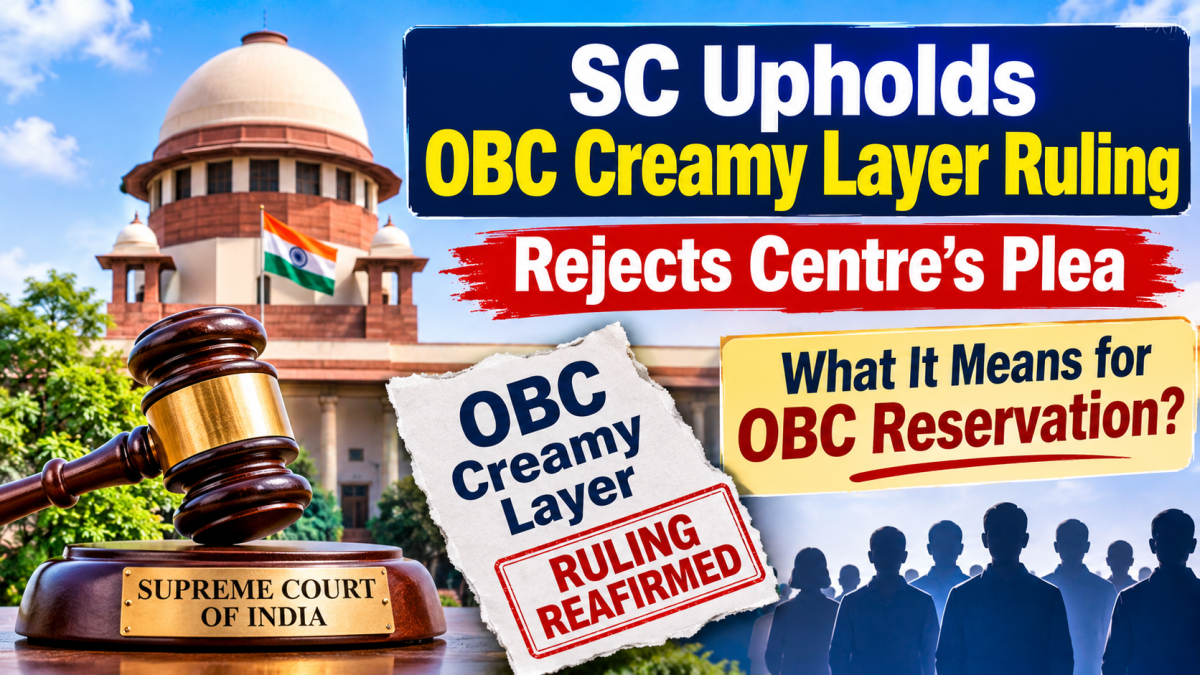
The Supreme Court of India has reaffirmed its landmark ruling on the Other Backward Classes (OBC) creamy layer criteria, declining the Centre's request to defer its implementation and grant two years to establish a uniform policy for determining the status of parents employed in public sector undertakings (PSUs), banks and other organisations.
In an important order delivered on November 6, 2026, a bench of Justices Pamidighantam Sri Narasimha and R. Mahadevan clarified how its March 11 judgment should be implemented. The court also ruled that the earlier interpretation must apply to the pending service allocation of candidates selected through the UPSC Civil Services Examination (CSE) 2025.
The decision brings fresh attention to the long-standing issue of whether the salary earned by parents working in PSUs and private companies can, by itself, make their children ineligible for OBC reservation benefits.
While the Supreme Court has protected completed appointments from being reopened automatically, it has made clear that the legal principles established in its earlier judgment must guide subsequent selections and appointments.
What Is the Supreme Court's Latest OBC Creamy Layer Ruling?
The latest development relates to the Centre's applications seeking clarification of the Supreme Court's March 11, 2026 judgment in Union of India v. Rohith Nathan and Others.
The original case concerned OBC candidates who had cleared civil services examinations but were denied reservation benefits because the Department of Personnel and Training (DoPT) treated their parents' salaries from PSU and private-sector employment as a basis for classifying them under the creamy layer.
The government had relied on a 2004 clarification to the existing 1993 Office Memorandum (OM) while determining their eligibility.
The candidates challenged this interpretation, arguing that the government could not apply a different salary-based test to PSU and private-sector employees when the existing rules did not impose the same treatment on similarly placed government employees.
On March 11, the Supreme Court dismissed the Centre's appeals and upheld the candidates' claims. It held that a parent's salary income alone cannot determine an OBC candidate's creamy layer status. The status and category of the parent's post must also be considered.
The November 6 order has now clarified the implementation and scope of that decision.
Why Did the Centre Approach the Supreme Court Again?
Following the March judgment, the Centre approached the Supreme Court seeking clarification on its implementation.
The government raised concerns about the possible impact on completed recruitment processes, service allocations, seniority positions and admissions to educational institutions.
It also pointed out that the final result of the Civil Services Examination 2025 had been declared on March 6, just five days before the Supreme Court delivered its earlier judgment. However, service allocation for the successful candidates was still pending.
The Centre sought permission to complete the allocation process using the creamy layer assessment principles that were being applied before March 11.
It also requested that the court restrict the retrospective application of its earlier judgment and allow two years to establish equivalence between posts in PSUs, banks, private organisations and government services.
However, the Supreme Court found no convincing or reasonable justification for delaying implementation of its earlier ruling.
The court declined to grant the requested two-year period for establishing equivalence and extended the time for compliance with its March judgment by only two additional months.
What Does the OBC Creamy Layer Rule Say About Parental Salary?
To understand the importance of the decision, it is necessary to examine two government documents.
1. Office Memorandum of September 8, 1993
The 1993 Office Memorandum establishes the framework for identifying the creamy layer among OBCs.
It provides for exclusion based on the social and official status of parents in specified categories. It also contains an income and wealth test under Category VI.
Importantly, when equivalence between posts in PSUs or other organisations and government services has not been established, the income and wealth test applies. Under this test, salary income and agricultural income are not included in the calculation of income from other sources.
2. Clarification Letter of October 14, 2004
The 2004 clarification introduced a different approach for employees working in organisations where equivalence of posts with government services had not been determined.
Its Paragraph 9 provided for the separate assessment of parental salary income and income from other sources. This created a situation in which children of PSU and private-sector employees could be classified as creamy layer on the basis of salary income alone.
The Supreme Court found that this interpretation could not override the original 1993 Office Memorandum or introduce a new substantive condition.
The court held that the status and category of the post held by parents are essential considerations and that mechanical exclusion based solely on salary income is legally unsustainable.
What Did the Supreme Court Decide on November 6, 2026?
The latest order provides several important clarifications.
Completed appointments will not be reopened automatically
The Supreme Court clarified that its March 11 judgment does not direct a general revision of earlier selections, appointments, service allocations or seniority positions that had already been settled.
The benefit granted in the original cases cannot automatically be used to disturb the existing positions of other candidates.
The ruling will apply to UPSC CSE 2025 service allocation
This is one of the most significant parts of the latest decision.
Although the CSE 2025 results were declared on March 6, 2026, the service allocation process had not been completed.
The court directed that the creamy layer principles established in its March 11 judgment must apply while allocating services to OBC candidates selected through this examination.
This means the Centre cannot rely on the earlier interpretation of parental salary income to defer the application of the Supreme Court's ruling to this pending process.
Pending cases can be examined on their individual merits
The court clarified that candidates who believe they are similarly placed and whose claims are pending before courts, tribunals or other competent authorities may have their cases considered individually.
However, the latest judgment does not automatically grant reservation benefits to every candidate who was previously classified under the creamy layer.
The Centre can frame a new policy
The government remains free to formulate an appropriate policy on reservation and creamy layer identification. However, any such policy must comply with the Constitution and the principles laid down by the Supreme Court.
The court also declined to prescribe a specific deadline for establishing equivalence between different categories of posts.
Will the OBC Creamy Layer Ruling Benefit All OBC Candidates?
No. The decision should not be interpreted as automatically removing the creamy layer restriction for all OBC candidates.
The case primarily concerns the interpretation of parental employment status and salary income, particularly where parents work in PSUs, banks, private organisations and similar institutions whose posts have not been formally assessed for equivalence with government positions.
The Supreme Court has clarified that salary income alone cannot be used as a mechanical basis for exclusion under the applicable framework.
The existing creamy layer criteria and other eligibility requirements continue to matter.
Candidates must still satisfy the relevant conditions for obtaining OBC Non-Creamy Layer status. The judgment does not automatically make every OBC candidate eligible for reservation benefits.
What Happens Next?
Following the November 6 order, the Centre will have to proceed with implementing the Supreme Court's March 11 judgment within the additional two-month period granted by the court.
The clarification is also important for the pending service allocation of UPSC CSE 2025 candidates.
Meanwhile, the government can formulate a policy for determining equivalence between posts in government services, PSUs, banks and other organisations. Any new framework must follow the constitutional principles established by the Supreme Court.
The court's decision also draws a clear distinction between applying a binding legal principle in future and reopening completed recruitment processes.
Frequently Asked Questions (FAQs)
1. What did the Supreme Court rule on OBC creamy layer status?
The Supreme Court held that parental salary income alone cannot determine an OBC candidate's creamy layer status. The status and category of the parent's post must also be considered under the applicable criteria.
2. When did the Supreme Court reaffirm its OBC creamy layer judgment?
The Supreme Court reaffirmed and clarified its earlier ruling on November 6, 2026.
3. Can PSU employees' salaries be used to deny OBC reservation?
Salary income alone cannot be used mechanically to exclude a candidate. Where equivalence of posts has not been established, the applicable income and wealth test under the 1993 Office Memorandum must be followed, which excludes salary and agricultural income from its calculation.
4. Will the ruling apply to UPSC Civil Services Examination 2025 candidates?
Yes. The Supreme Court specifically directed that its March 11, 2026 interpretation must govern service allocation for OBC candidates selected through CSE 2025 because the allocation process was still pending.
5. Will previously completed appointments be reopened?
No. The November 6 order clarifies that the March judgment does not automatically reopen completed selections, appointments or settled seniority positions.
6. Did the Supreme Court give the Centre two years to implement the ruling?
No. The court declined to grant the requested two-year period for establishing equivalence of posts. It extended the compliance period under the March judgment by two months.
Conclusion
The Supreme Court's November 6 decision has reinforced the legal position on OBC creamy layer determination, particularly for families of employees working in PSUs, banks and private-sector organisations.
By refusing to delay the implementation of its earlier judgment, the court has clarified that parental salary cannot be treated as the sole determining factor when assessing OBC Non-Creamy Layer eligibility under the applicable framework.
The decision is particularly relevant for UPSC Civil Services Examination 2025 candidates, whose pending service allocations must follow the principles established in the March ruling.
At the same time, the court has protected completed appointments and clarified that the judgment does not automatically reopen earlier recruitment processes.
The next important step will be the government's implementation of the directions and any future policy it develops for determining equivalence of posts. The November 6 ruling therefore provides greater clarity on the legal framework while leaving policy formulation to the government within constitutional limits.
Also Read: The Tragic Death of Nisha Bhagat: The Tribal Leader


Join the Conversation