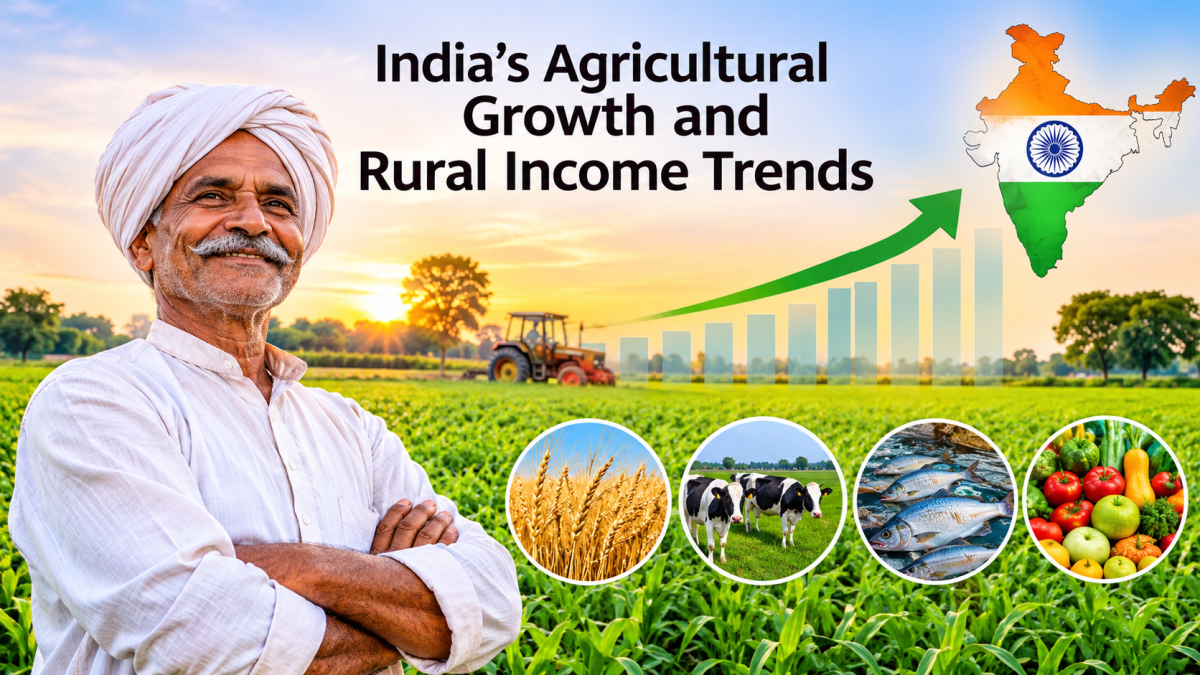
India's agricultural sector remains a fundamental component of the national economy, supporting rural livelihoods, food security, employment and industrial supply chains. Although India's economy has increasingly shifted towards manufacturing and services, agriculture continues to play a significant role in economic development. Its contribution extends beyond crop production to livestock, dairy, fisheries, horticulture and agricultural trade.
Recent economic data indicates that India's agricultural output has expanded considerably over the past decade. However, growth in agricultural production and Gross Value Added (GVA) does not automatically translate into equivalent improvements in farmers' incomes.
1. Agriculture's Contribution to India's Economy
According to the Ministry of Statistics and Programme Implementation (MoSPI), the sector's GVA increased from approximately ₹15.02 lakh crore in 2011–12 to ₹48.78 lakh crore in 2023–24 , measured at current prices.
The sector accounted for approximately 17.8% of India's total GVA in 2023–24 . Its relative contribution has declined over time as manufacturing and services have expanded, although its overall economic value has increased.
This reflects a structural transformation in the Indian economy
2. Growth in Agricultural Production
India has recorded considerable improvements in foodgrain production over the past decade. Total foodgrain production increased from 251.54 million tonnes in 2015–16 to 357.73 million tonnes in 2024–25
Foodgrain production is an important indicator of agricultural output and domestic food availability .
Several factors have contributed to this expansion, including improved agricultural practices, irrigation development, better-quality seeds, mechanisation and government-supported agricultural programmes.
Major Agricultural Developments
• Increased foodgrain production.
• Expansion of irrigation infrastructure.
• Greater adoption of agricultural machinery.
• Growth in horticulture and commercial crops.
• Improvements in livestock and fisheries production.
3. Agricultural Income and Rural Livelihoods
Agricultural production and farmers' household income are different economic indicators.
According to the National Statistical Office's 77th Round Situation Assessment Survey, the average monthly income of an agricultural household increased from ₹6,426 in 2012–13 to ₹10,218 in 2018–19
This income included earnings from crop production, livestock, wages, non-farm businesses and leasing out land.
The figures demonstrate an increase in nominal household income . However, they should be interpreted alongside inflation and rising agricultural input costs to understand changes in actual purchasing power.
4. The Growing Importance of Allied Agricultural Sectors
According to the Economic Survey 2025–26, livestock and fisheries recorded stronger growth than the crop sector over the FY2016–FY2025 period.
The livestock sector recorded average annual growth of approximately 7.1% , while fishing and aquaculture grew by approximately 8.8% at constant prices.
These developments indicate the increasing economic importance of diversified agricultural activities .
Key Growth Areas
• Dairy: India continues to maintain its position as the world's largest milk producer.
• Fisheries: Aquaculture and fish production have expanded significantly.
• Horticulture: Fruits, vegetables and commercial horticultural crops contribute to agricultural diversification.
• Poultry: Growing demand for poultry products has expanded the sector's economic importance.
• Government Investment and Agricultural Support
Government expenditure and agricultural development programmes play an important role in supporting rural production and farm households.
Major programmes include:
• PM-KISAN: Provides direct income support to eligible farmer families.
• Pradhan Mantri Fasal Bima Yojana: Provides crop insurance coverage against specified agricultural risks.
• Kisan Credit Card: Facilitates access to institutional agricultural credit.
• Agriculture Infrastructure Fund: Supports investment in agricultural infrastructure.
• e-NAM: Provides an electronic platform for agricultural marketing.
These programmes address different aspects of agricultural development, including financial access, risk management and market integration.
6. Agricultural Exports and India's Position in Global Trade
Agricultural exports represent another important dimension of India's rural economy.
According to the Economic Survey 2025–26, India's agricultural exports increased from approximately US$34.5 billion in FY2020 to US$51.1 billion in FY2025
Export diversification, food processing, quality standards and improved supply-chain infrastructure remain important factors in strengthening India's agricultural trade .
7. Structural Challenges in the Rural Economy
Despite improvements in agricultural production, several structural challenges continue to influence rural economic performance.
Fragmented landholdings limit economies of scale, while dependence on seasonal rainfall creates uncertainty in agricultural output. Rising input costs, storage limitations, inadequate market infrastructure and price fluctuations also affect agricultural profitability.
The difference between agricultural productivity and productivity in other economic sectors remains an important feature of India's economic structure .
Addressing these challenges requires improvements in irrigation, technology adoption, agricultural research, storage infrastructure and access to organised markets.
Conclusion
India's agricultural economy has experienced substantial expansion in output and economic value over the past decade. Growth in foodgrain production, livestock, fisheries and horticulture demonstrates the sector's changing structure and increasing diversification.
Agricultural GVA, production and household income measure different aspects of Economic performance . Higher production alone cannot establish whether farmers are experiencing equivalent improvements in purchasing power or financial security.
The future performance of India's rural economy will depend on productivity improvements, diversified income opportunities, modern infrastructure, accessible agricultural finance and stronger market connections .
Sources and Further Reading
1. "Ministry of Agriculture – Agricultural GVA and Production Statistics" https://www.pib.gov.in/PressReleasePage.aspx?PRID=2237739
2. "Economic Survey 2025–26 – Agriculture and Allied Sectors" https://www.indiabudget.gov.in/economicsurvey/doc/eschapter/echap06.pdf
3. "Ministry of Statistics and Programme Implementation (MoSPI)" https://mospi.gov.in/
4. "Directorate of Economics and Statistics – Agricultural Data" https://desagri.gov.in/
5. "Economic Survey 2025–26 – Government of India" https://www.indiabudget.gov.in/economicsurvey/
6. "Agricultural Household Income Statistics – Government of India" https://sansad.in/getFile/loksabhaquestions/annex/187/AU2955_6r2jzR.pdf?


Join the Conversation