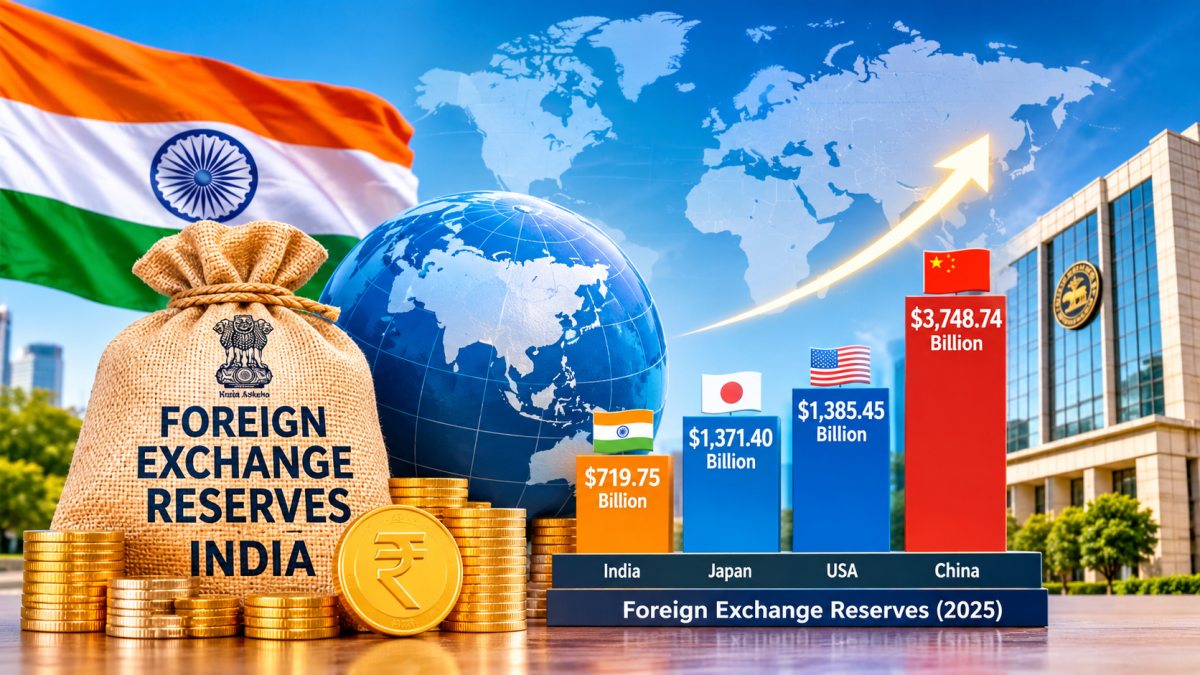
Foreign exchange reserves are among the most important indicators of a country's economic strength and financial stability. They enable central banks to manage international payments, support currency stability, meet external obligations and respond to global economic uncertainties. For India, maintaining adequate foreign exchange reserves is particularly important because of its dependence on international trade, energy imports and foreign investment.
Over the past decade, India has significantly strengthened its foreign exchange position, establishing itself as one of the world's major reserve-holding economies. However, comparisons with China, the United States, Japan and Switzerland reveal considerable differences in reserve accumulation, economic structures and international financial positions.
1. Understanding Foreign Exchange Reserves
Foreign exchange reserves are international financial assets held by a country's central bank or monetary authority. They provide financial protection against external economic pressures and help maintain confidence in the domestic economy.
The major components include: • Foreign Currency Assets: Holdings of foreign currencies and foreign government securities, generally denominated in major international currencies.
• Gold Reserves: Gold maintained by central banks as part of their international reserve assets.
• Special Drawing Rights (SDRs): International reserve assets allocated by the International Monetary Fund (IMF).
• Reserve Position in the IMF: A country's reserve-related financial position with the International Monetary Fund.
These assets collectively strengthen a country's capacity to manage international financial obligations and respond to economic uncertainty.
2. India's Foreign Exchange Reserves
India's foreign exchange reserves have expanded considerably, reflecting changes in its external financial position and the Reserve Bank of India's reserve management strategy.
According to the Reserve Bank of India, India's foreign exchange reserves stood at approximately $719.75 billion as of October 23, 2026.
The weekly data released on October 30, 2026, showed a decline of approximately $1.27 billion compared with the previous reporting week. This represented the seventh consecutive weekly decline.
Major Components of India's Reserves
The RBI reported the following composition:
| Reserve Components | Value |
|---|---|
| Foreign Currency Assets | $593.205 billion |
| Gold Reserves | $103.150 billion |
| Special Drawing Rights | $18.605 billion |
| Reserve Position in IMF | $4.787 billion |
| Total Reserves | $719.748 billion |
Foreign currency assets constitute the largest portion of India's reserves. Gold represents another significant component, providing diversification within the country's international reserve portfolio.
The recent decline was primarily associated with a reduction in the valuation of gold holdings, while foreign currency assets recorded an increase.
3. India Compared with Major Economies
Comparing foreign exchange reserves across major economies provides an understanding of their respective positions in the international financial system.
According to the World Bank's 2025 total reserves data, the leading economies maintain substantially different reserve holdings.
Comparative Data
The following figures represent total reserves, including gold, in current US dollars.
| Country | Reserves (2025) |
| China | $3,748.74 Billion |
| United States | $1,385.45 Billion |
| Japan | $1,371.40 Billion |
| Switzerland | $1,075.68 Billion |
| India | $700.07 Billion |
| Germany | $572.20 Billion |
| Saudi Arabia | $505.16 Billion |
| South Korea | $436.57 Billion |
| Brazil | $358.51 Billion |
| United Kingdom | $214.36 Billion |
Source: World Bank, Total Reserves Including Gold, 2025.
China maintains a substantial lead over other major economies, with reserves exceeding $3.7 trillion. The United States and Japan follow, while India occupies an important position among the world's leading reserve holders.
India's 2025 reserve figure places it ahead of Germany, Saudi Arabia, South Korea and Brazil in this comparison.
Data clarification: These are annual 2025 figures. India's $719.75 billion figure mentioned earlier is a separate weekly observation from October 23, 2026. The two datasets should not be treated as measurements from the same reporting period.
4. Why China's Foreign Exchange Reserves Are Significantly Higher?
China's position as the world's largest foreign exchange reserve holder reflects its extensive manufacturing sector, international trade relationships and historical accumulation of foreign assets.
Its export-oriented economy has generated substantial foreign currency earnings over several decades. International investment flows and its position in global manufacturing have also influenced its reserve accumulation.
India follows a different economic structure. Although the country has expanded its services exports, manufacturing capabilities and international trade relationships, its import requirements and external payment obligations influence its reserve position.
The comparison demonstrates that foreign exchange reserves are influenced by several factors, including trade balances, capital movements, exchange rate policies and central bank decisions.
5. The United States and Japan in the Global Reserve Landscape
The United States and Japan maintain significant international reserve assets, although their economic positions differ.
The US dollar occupies the leading position in the international monetary system. It is widely used in international trade, financial transactions and official foreign exchange reserves.
Japan's reserve position reflects its international investment relationships, export-oriented industries and financial connections with global markets.
India, meanwhile, must manage its reserves while addressing external payment requirements, exchange rate fluctuations and international capital movements.
These differences demonstrate why reserve figures should be examined alongside broader economic indicators rather than treated as independent measures of economic strength.
6. Why Foreign Exchange Reserves Matter for India?
Foreign exchange reserves play several important roles in India's economic management.
• Currency Stability: Adequate reserves allow the RBI to intervene in foreign exchange markets when necessary to address excessive volatility in the rupee.
• Import Security: India depends significantly on imported crude oil, natural gas, electronics and industrial inputs. Reserves strengthen its ability to meet international payment obligations.
• External Debt Management: Reserves provide a financial cushion against external debt repayment pressures and changing international credit conditions.
• Investor Confidence: A substantial reserve position can strengthen international confidence in India's ability to manage external financial risks.
• Protection Against Global Shocks: Geopolitical tensions, international financial crises, sudden capital outflows and commodity price increases can place pressure on a country's external financial position.
7. Challenges in Maintaining Adequate Reserves
Despite India's considerable reserve holdings, maintaining an appropriate reserve level remains an important economic challenge.
Rising crude oil prices can increase India's import expenditure and create additional demand for foreign currency. Similarly, international interest rate movements and changes in foreign investment flows can influence the country's external financial position.
Another important consideration is the management of reserve assets. Central banks must balance liquidity, safety and returns while maintaining sufficient resources to address potential external financial pressures.
Furthermore, a large reserve figure alone does not guarantee economic stability. Import requirements, short-term external debt, exchange rate movements and the overall balance of payments must also be considered.
8. India's Future Reserve Strategy
India's future reserve strategy will depend on economic growth, export competitiveness, international investment flows and external payment requirements.
Strengthening domestic manufacturing, expanding merchandise exports, improving energy security and attracting stable foreign investment could support India's external financial position.
The RBI's reserve management approach will remain important in addressing international financial volatility.
Rather than focusing exclusively on achieving a particular reserve figure, India must ensure that its reserves remain adequate, diversified and effectively managed.
Conclusion
India has established a substantial foreign exchange reserve position among the world's major economies. Its reserves provide an important financial cushion against international economic uncertainty and support confidence in the country's external financial stability.
However, comparisons with China, the United States and Japan demonstrate that differences in economic structures, trade relationships and international financial positions influence reserve accumulation.
For India, the long-term objective should not simply be to increase foreign exchange reserves but to maintain an adequate and effectively managed reserve base that supports economic stability, international confidence and sustainable growth.
Sources and Further Reading
1. Reserve Bank of India – Foreign Exchange Reserves
https://dbie.rbihub.in/tables?table=external_sector.r53_foreign_exchange_reserves_weekly
2. World Bank – Total Reserves Including Gold
https://data.worldbank.org/indicator/FI.RES.TOTL.CD
3. International Monetary Fund – International Financial Statistics
4. Reuters – India's Foreign Exchange Reserves Decline



Join the Conversation