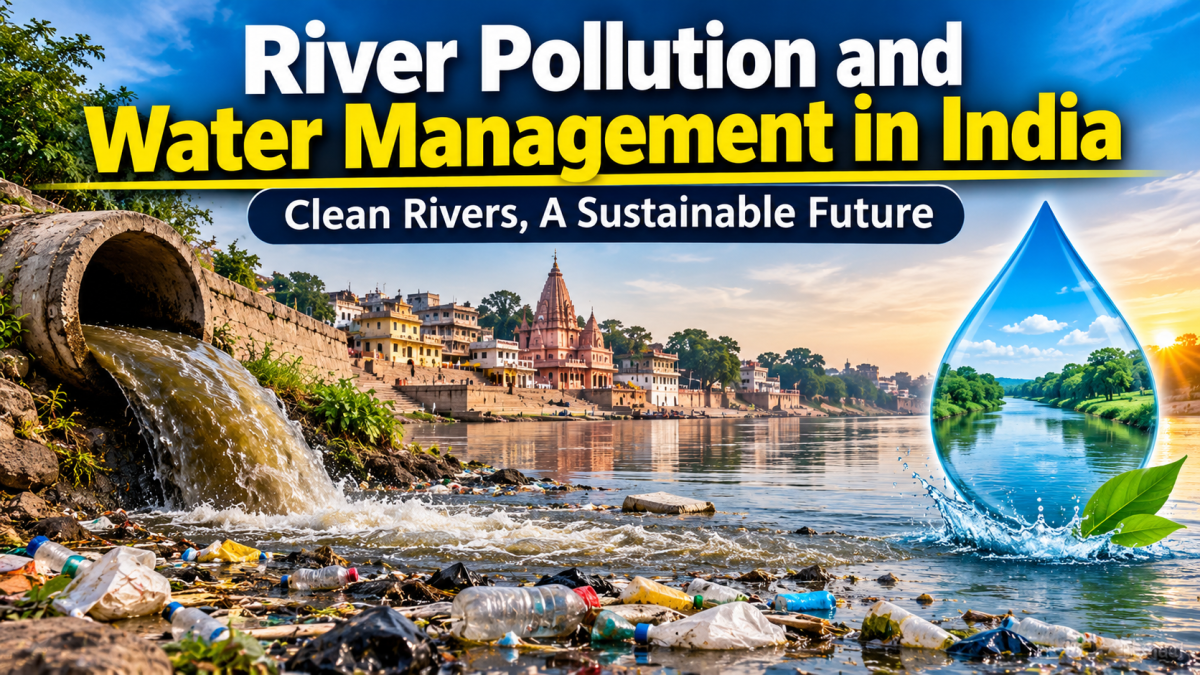
River Pollution and Water Management in India
India's rivers are among the country's most important natural resources, supporting agriculture, industries, drinking water supplies, transportation and millions of livelihoods. From the Ganga and Yamuna to the Godavari, Krishna and Brahmaputra, river systems play a central role in India's economic development and environmental sustainability. However, increasing urbanisation, industrial expansion, population growth and inadequate wastewater management have placed considerable pressure on these freshwater resources.
River pollution and water management in India have therefore become important environmental and public policy challenges. Although the government has introduced several river conservation programmes, persistent sewage discharge, industrial waste and weak implementation continue to affect water quality across different regions.
1. The Scale of River Pollution in India
The Central Pollution Control Board (CPCB) monitors river water quality through the National Water Quality Monitoring Programme.
According to its 2025 assessment, based on water quality data from 2022 and 2023:
• 623 rivers were assessed.
• 271 rivers had identified polluted stretches.
• 296 polluted river stretches were identified across 32 States and Union Territories.
• The number of polluted stretches declined from 351 in 2018 to 296 in 2025.
The reduction indicates progress in pollution-control efforts. However, the presence of hundreds of polluted stretches demonstrates that substantial challenges remain.
It is also important to recognise that the number of polluted stretches is not the same as the number of polluted rivers.
Source: "CPCB – Polluted River Stretches for Restoration of Water Quality, 2025" https://cpcb.nic.in/openpdffile.php?
2. Major Causes of River Pollution
Untreated Domestic Sewage
Domestic wastewater is one of the major contributors to river pollution. Rapid urbanisation has increased sewage generation, while treatment infrastructure has struggled to keep pace in several cities.
When untreated or partially treated sewage enters rivers, it increases organic pollution and bacterial contamination.
Industrial Discharge
Industries such as textiles, chemicals, paper, pharmaceuticals and manufacturing can generate wastewater containing harmful pollutants.
Insufficient treatment and regulatory non-compliance can allow industrial effluents to affect river ecosystems and downstream water users.
Agricultural Runoff
Agricultural activities also contribute to water pollution. Fertilisers, pesticides and other agricultural chemicals can enter rivers through surface runoff, particularly during rainfall.
Solid Waste Disposal
Plastic waste, household garbage and other discarded materials frequently accumulate along riverbanks and enter waterways.
Poor waste management increases pollution and damages aquatic ecosystems.
3. The Ganga and Yamuna Pollution Challenge
The Ganga and Yamuna illustrate the complexity of India's river pollution problem.
The Ganga supports millions of people across several states and has major cultural, ecological and economic importance. Despite substantial government investment in its rejuvenation, sewage treatment and pollution control remain important priorities.
Under the Namami Gange Mission, the government reported that total sewage treatment capacity created had reached 3,977 million litres per day (MLD) by December 2025.
During 2025, 25 sewage treatment plants with a combined capacity of 530 MLD were commissioned and operationalised under the programme.
The Yamuna faces particularly serious pollution pressures around Delhi, where sewage discharge and urban wastewater management remain major concerns.
These examples demonstrate that river conservation requires continuous investment, effective sewage treatment and cooperation between multiple state governments.
Sources: "PIB – Namami Gange Mission Phase II" https://www.pib.gov.in/PressReleasePage.aspx? | "PIB – Pollution in Ganga River" https://www.pib.gov.in/newsite/erelcontent.aspx?
4. Government Initiatives for River Conservation
India has introduced several programmes to address river pollution and improve water management.
Namami Gange Mission
Launched in 2014, the Namami Gange Mission aims to reduce pollution and rejuvenate the Ganga through sewage treatment infrastructure, riverfront development, ecological restoration and public participation.
National River Conservation Plan
The National River Conservation Plan supports pollution-abatement activities in identified river systems through sewage treatment projects and other conservation measures.
National Water Quality Monitoring Programme
The CPCB works with State Pollution Control Boards and Pollution Control Committees to monitor water quality and identify polluted river stretches.
Jal Jeevan Mission
Although primarily focused on providing rural household tap-water connections, the Jal Jeevan Mission is relevant to broader water security and sustainable water management.
These initiatives provide an important policy framework, but their success depends on effective implementation, maintenance and monitoring.
5. Economic and Environmental Consequences
River pollution creates consequences that extend beyond environmental damage.
• Public Health: Contaminated water can increase exposure to waterborne diseases and affect communities dependent on river water.
• Agriculture: Polluted irrigation water can affect soil quality, agricultural productivity and food safety.
• Fisheries: Deteriorating water quality threatens aquatic biodiversity and the livelihoods of fishing communities.
• Industrial Costs: Businesses may face higher water-treatment expenses and increased operational risks.
• Ecosystem Damage: Pollution can reduce dissolved oxygen, disturb aquatic habitats and threaten freshwater species.
River pollution is therefore not simply an environmental problem. It also affects economic development, public health and social welfare.
6. Why India's Water Management System Faces Challenges?
Despite government programmes, several structural problems continue to affect river conservation.
• Insufficient Sewage Treatment: Treatment capacity and actual wastewater generation remain mismatched in several urban areas.
• Infrastructure Maintenance: Building treatment plants is not enough. Their effective operation and maintenance are equally important.
• Interstate Coordination: Rivers cross administrative boundaries, requiring cooperation between multiple states.
• Industrial Compliance: Effective monitoring and enforcement are necessary to prevent untreated industrial discharge.
• Urban Planning: Rapid urban expansion increases pressure on drainage systems, riverbanks and wastewater infrastructure.
Addressing these issues requires stronger institutional accountability and long-term planning.
7. Policy Priorities for Cleaner Rivers
India needs a comprehensive approach that combines infrastructure development, environmental regulation and public participation.
• Expand Sewage Treatment: Increase treatment capacity in rapidly growing urban areas and ensure existing facilities operate effectively.
• Strengthen Industrial Monitoring: Improve compliance monitoring and enforce wastewater-treatment standards.
• Improve Solid Waste Management: Prevent plastic and household waste from entering rivers and drainage systems.
• Restore River Ecosystems: Protect wetlands, floodplains and natural river channels.
• Strengthen Interstate Cooperation: Develop coordinated river-management strategies between states sharing river basins.
• Increase Public Participation: Encourage communities, educational institutions and local organisations to participate in river conservation.
• Improve Water Quality Reporting: Make monitoring information accessible and strengthen independent assessment of conservation outcomes.
Conclusion
River pollution remains one of India's significant environmental and development challenges. The decline in identified polluted river stretches from 351 in 2018 to 296 in 2025 suggests that conservation efforts are producing measurable improvements. Nevertheless, hundreds of polluted stretches demonstrate that the problem is far from resolved.
Government initiatives such as Namami Gange and the National River Conservation Plan have strengthened India's approach to water management. However, long-term success requires more than financial investment and infrastructure construction. Effective wastewater treatment, industrial accountability, scientific monitoring and interstate cooperation are equally important.
India's future water security depends not only on conserving its rivers but also on ensuring that pollution control becomes a continuous public policy priority.
Sources and Further Reading
1. "Central Pollution Control Board – Polluted River Stretches Report 2025" https://cpcb.nic.in/openpdffile.php?
2. "PIB – River Rejuvenation, March 2026" https://www.pib.gov.in/PressReleasePage.aspx?
3. "PIB – Namami Gange Mission Phase II" https://www.pib.gov.in/PressReleasePage.aspx?
4. "PIB – Pollution in Ganga River" https://www.pib.gov.in/newsite/erelcontent.aspx?
5. "National Mission for Clean Ganga" https://nmcg.nic.in/
6. "Ministry of Jal Shakti" https://jalshakti-dowr.gov.in/

Join the Conversation