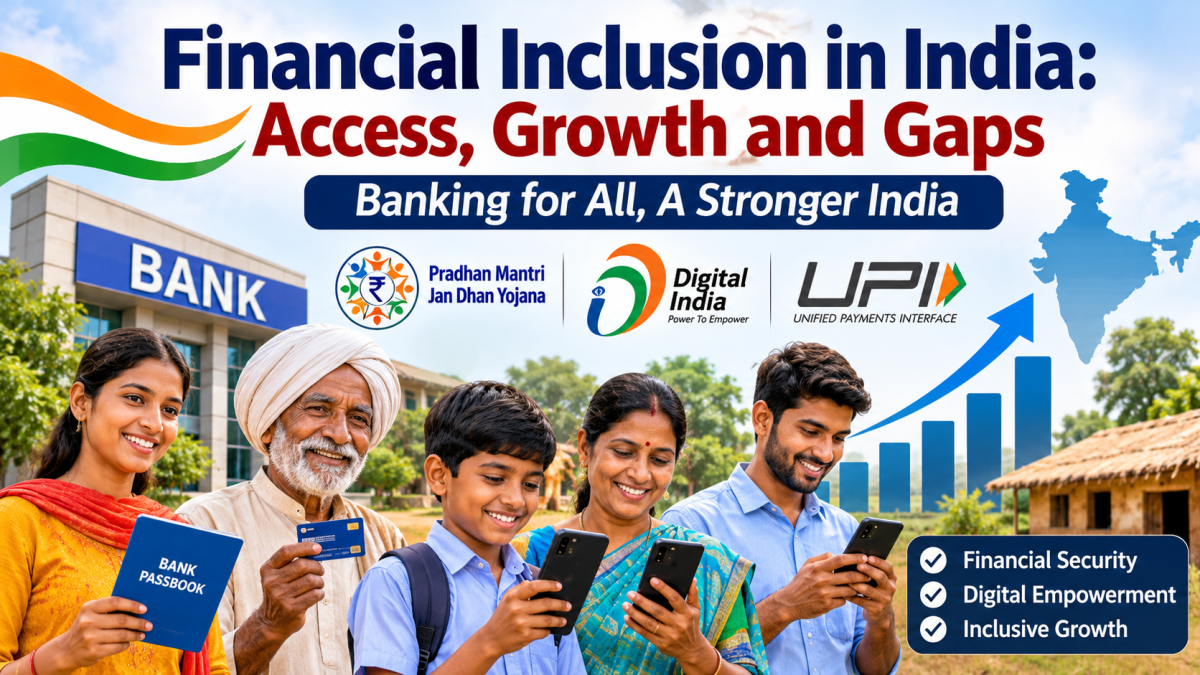
Financial Inclusion in India: Access, Growth and Gaps
Financial inclusion in India has emerged as a significant pillar of the country's economic development strategy, focusing on providing affordable and accessible financial services to individuals, households and businesses across different economic backgrounds. Access to banking facilities, savings accounts, institutional credit, insurance, pension schemes and digital payment systems plays an important role in strengthening financial security and encouraging wider economic participation. For decades, sections of India's rural population, low-income households, small farmers and informal workers faced difficulties accessing formal financial institutions due to geographical barriers, limited banking infrastructure, inadequate documentation and financial illiteracy.
Recognising these challenges, the Government of India and the Reserve Bank of India have introduced several initiatives to expand financial accessibility and strengthen the formal banking system. Programmes such as the Pradhan Mantri Jan Dhan Yojana, Digital India, Direct Benefit Transfer and various social security schemes have contributed to expanding access to financial services. The growth of digital payment infrastructure, particularly the Unified Payments Interface (UPI), has further transformed how individuals and businesses conduct financial transactions.
However, the expansion of banking access does not automatically ensure meaningful financial participation. Challenges involving inactive bank accounts, limited financial awareness, unequal digital connectivity, access to affordable institutional credit and cybersecurity continue to influence the effectiveness of financial inclusion initiatives. Therefore, India's financial inclusion strategy must focus not only on bringing people into the formal banking system but also on ensuring that financial services are affordable, reliable, secure and regularly accessible. Examining the progress, government initiatives and remaining challenges provides a clearer understanding of financial inclusion's role in India's long-term economic development.
1. Jan Dhan Yojana: Expanding Banking Access
The Pradhan Mantri Jan Dhan Yojana (PMJDY), launched on 28 August 2014, aims to provide basic banking services to previously unbanked citizens.
According to the Department of Financial Services, as of 28 October 2026:
• 59.67 crore total beneficiaries.
• ₹3.21 lakh crore in account deposits.
• 33.28 crore female beneficiaries.
• 46.31 crore accounts in rural and semi-urban areas.
These figures demonstrate the expansion of formal banking access, particularly among rural households and women.
However, account ownership alone does not guarantee regular financial participation.
2. Digital Banking and Financial Inclusion
Digital payment infrastructure has changed how individuals access financial services.
The Unified Payments Interface (UPI), developed by the National Payments Corporation of India, has made instant digital transactions accessible to individuals and businesses.
Key developments include:
• Mobile-based banking services.
• QR-code payment facilities.
• Digital transactions for small businesses.
• Direct Benefit Transfer through bank accounts.
• Greater access to financial services beyond traditional bank branches.
The JAM Trinity (Jan Dhan, Aadhaar and Mobile) has also supported the delivery of government benefits through formal banking channels.
Nevertheless, digital literacy, internet connectivity and cybersecurity remain important concerns.
3. Government Schemes Supporting Financial Security
India's financial inclusion framework extends beyond bank accounts.
| Government Scheme | Primary Objective |
|---|---|
| PM Jeevan Jyoti Bima Yojana | Life insurance |
| PM Suraksha Bima Yojana | Accident insurance |
| Atal Pension Yojana | Pension security |
| PM Mudra Yojana | Institutional credit for micro-enterprises |
These programmes aim to improve financial protection, retirement security and access to institutional finance.
Their effectiveness also depends on public awareness, accessibility and the ability of beneficiaries to use the services.
4. RBI's Financial Inclusion Index
The Reserve Bank of India measures financial inclusion through its Financial Inclusion Index (FI-Index).
The index evaluates three major dimensions:
• Access: Availability of financial services.
• Usage: Actual utilisation of financial products.
• Quality: Suitability and effectiveness of services.
According to the RBI's July 2026 announcement, the Financial Inclusion Index reached 70.0 in March 2026, compared with 67.0 in March 2025.
The increase indicates improvements across all three dimensions, with usage contributing significantly to the latest growth.
The RBI's National Strategy for Financial Inclusion 2025–30 also emphasises financial literacy, consumer protection and effective access to financial services.
5. Major Challenges
Despite expanding banking infrastructure, several issues require attention.
• Financial literacy: Limited awareness of banking, insurance and credit facilities can prevent individuals from making informed financial decisions.
• Digital divide: Unequal access to smartphones, internet connectivity and digital education affects financial participation.
• Credit accessibility: Small businesses, farmers and informal workers may face difficulties obtaining institutional credit.
• Cybersecurity: Digital financial fraud and unauthorised transactions create risks for inexperienced users.
• Inactive accounts: Opening accounts does not necessarily translate into regular savings or meaningful financial activity.
6. Policy Priorities for the Future
India's financial inclusion strategy requires greater emphasis on effective financial participation rather than account-opening numbers alone.
Important priorities include:
• Expanding financial literacy programmes.
• Strengthening rural banking infrastructure.
• Improving access to affordable institutional credit.
• Enhancing digital payment security.
• Simplifying grievance redressal mechanisms.
• Strengthening consumer awareness and protection.
The National Strategy for Financial Inclusion 2025–30 provides a framework for coordinating these priorities among financial institutions, regulators and government departments.
Conclusion
Financial inclusion in India has expanded through banking reforms, digital infrastructure and social security initiatives. PMJDY and the RBI's Financial Inclusion Index demonstrate the scale of this transformation. However, the next phase requires more than increasing the number of bank accounts. Regular usage, responsible lending, financial literacy and consumer protection will determine whether financial access translates into meaningful economic participation.
Sources and Further Reading
1. Pradhan Mantri Jan Dhan Yojana (PMJDY) – Official Dashboard
2. Reserve Bank of India – Financial Inclusion Index
https://www.rbi.org.in/scripts/BS_PressReleaseDisplay.aspx
3. Reserve Bank of India – National Strategy for Financial Inclusion 2025–30
https://www.rbi.org.in/Scripts/PublicationReportDetails.aspx?
4. Department of Financial Services – Ministry of Finance
https://financialservices.gov.in/financial-inclusion-fi
5. Reserve Bank of India – Annual Reports
https://www.rbi.org.in/Scripts/AnnualReportPublications.aspx



Join the Conversation