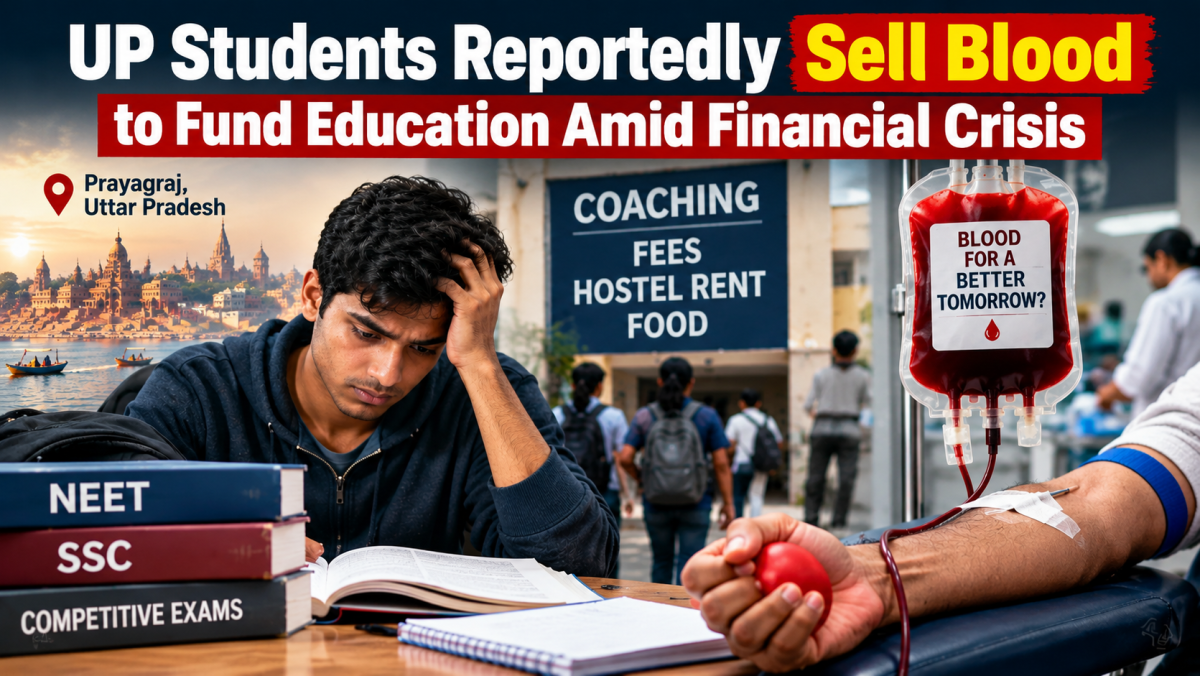
Reports of students in Prayagraj allegedly selling their blood to cover educational and living expenses have raised serious concerns about financial hardship, competitive-examination preparation and student welfare in Uttar Pradesh. An undercover investigation published by Dainik Bhaskar on October 26 reported accounts from students who said they were struggling to pay for coaching, hostel accommodation, food and other essential expenses.
According to the investigation, some students preparing for examinations such as the National Eligibility cum Entrance Test (NEET) and Staff Selection Commission (SSC) recruitment examinations reportedly turned to payment-linked blood collection to meet their financial needs. The report also raised concerns about intermediaries allegedly arranging transactions between students and people seeking blood.
The allegations have brought renewed attention to the economic pressures faced by students from low-income families who move away from home to pursue competitive examinations. However, the reported accounts, the frequency of blood collection and the alleged involvement of intermediaries require appropriate independent verification.
The central concern is not simply how students are raising money, but why some young people may be facing such difficult choices to continue their education.
Also Read: Ladakh to Open First Government Medical College in 2027–28
What Did the Investigation Report About Students Selling Blood?
Dainik Bhaskar's investigation focused on Prayagraj, a major educational centre where students travel from different parts of Uttar Pradesh and neighbouring states to prepare for competitive examinations.
As described in the investigation, undercover reporters approached students near the Allahabad Medical Association (AMA) Blood Bank in the Rajapur area while posing as relatives of patients who needed blood. The report described conversations with four students and presented their accounts of financial difficulties.
The students reportedly described challenges involving hostel payments, coaching fees, family responsibilities and the cost of continuing their preparation.
Students Reportedly Struggling to Pay Hostel and Coaching Fees
One student preparing for SSC examinations reportedly said that he had been unable to pay his hostel fees for two months. He described coming from a farming family whose income was insufficient to cover household expenses and the additional cost of living and studying in Prayagraj.
Another account described a student who reportedly sought money for coaching fees after the family struggled to support his preparation. The investigation also featured a NEET aspirant who said his family had taken on financial burdens to support his education.
These accounts, as presented in the report, illustrate the pressures that can arise when families with limited incomes attempt to finance competitive-examination preparation away from home.
The investigation reported that some students claimed to have arranged blood collection more than once in a month. However, the reported frequency and the precise medical procedures involved have not been independently established in the sources reviewed for this article.
Allegations of Payments and Intermediaries
The investigation also raised questions about intermediaries allegedly connecting people who needed blood with students willing to provide it in exchange for money.
According to the report, an undercover interaction involved a proposed payment of approximately ₹5,000 for a unit of blood, with a processing charge reportedly reducing the amount that a donor would receive.
Such figures and descriptions should be understood as claims reported from the investigation, rather than independently verified evidence of a wider network.
The report suggested that intermediaries might operate around blood collection facilities. Determining whether individual facilities, intermediaries or other parties violated applicable rules would require evidence and investigation by the relevant authorities.
The distinction matters: allegations about individuals should not automatically be interpreted as proof of wrongdoing by an entire institution or healthcare system.
Why Are Educational Expenses a Serious Concern for Students?
For students preparing for NEET, SSC and other competitive examinations, the cost of education often extends far beyond tuition or examination fees.
Young people who move to another city may need to pay rent, hostel fees, food, transportation, books, internet charges and coaching expenses while preparing for examinations that offer no guarantee of success.
When household incomes are limited, these recurring costs can become difficult to manage.
1. The Cost of Competitive-Examination Preparation
Students preparing for competitive examinations may spend months or years studying before securing admission or employment. During that period, they may depend on their families for financial support without earning an income themselves.
Private coaching can add another substantial expense, particularly for families already managing agricultural uncertainty, irregular employment or other household responsibilities.
Students who cannot afford paid coaching may also need access to suitable study materials, reliable internet connections, libraries and other learning resources.
2. Accommodation, Food and Daily Living
For students living away from their families, basic living expenses are essential to their ability to study.
Hostel rent, mess charges, transport and everyday necessities continue regardless of whether a student is making academic progress. Falling behind on payments can create the additional risk of losing accommodation or having to interrupt preparation.
Financial assistance that covers tuition alone may therefore be insufficient for students whose biggest difficulties involve the total cost of living and studying in another city.
3. Pressure on Families With Limited Incomes
The accounts described in the investigation point to another challenge: the financial burden placed on families that are determined to support their children's education but have limited resources.
Some parents may borrow money, sell assets or make substantial sacrifices to finance coaching and accommodation. Students may consequently feel responsible not only for their own expenses but also for reducing the burden on their families.
These circumstances can create considerable emotional pressure. Students should be able to seek financial help without shame, discrimination or fear that asking for assistance will undermine their academic ambitions.
Is Selling Blood for Money Permitted in India?
The allegations also raise an important question about blood-transfusion safety and the rules governing blood donation in India.
The Directorate General of Health Services (DGHS), under the Union Ministry of Health and Family Welfare, states that professional blood donation was banned following a landmark Supreme Court judgment, with the ban taking effect in 1998. India's blood-transfusion framework promotes voluntary, non-remunerated blood donation and the use of licensed blood centres. DGHS: Blood Transfusion Services.
This framework is intended to protect both donors and recipients and to support a safe, reliable blood supply.
It is important to distinguish between voluntary blood donation, which helps patients and hospitals, and the alleged payment arrangements described in the investigation. Approved processing charges at a blood centre are also not the same thing as paying an individual to donate blood.
Whether a particular transaction breached applicable requirements depends on the actual circumstances and evidence. The specific allegations in Prayagraj therefore warrant examination by the appropriate health and administrative authorities rather than assumptions about individual donors or blood centres.
Health Risks Require Proper Medical Assessment
Blood collection is a medical procedure and should take place under appropriate clinical supervision. Donor eligibility, the type of donation and the permitted interval between procedures must be assessed according to applicable medical standards.
The reported claims of repeated blood collection are particularly concerning because the investigation does not, by itself, establish each student's medical condition, the exact procedure performed or whether the required safeguards were followed.
Potentially unsafe or repeated collection should be evaluated by qualified medical professionals. Authorities should also establish whether any students experienced health complications or faced pressure to participate in payment-linked arrangements.
Students experiencing severe financial hardship should not have to choose between continuing their studies and protecting their health.
What Does the Case Reveal About Student Welfare?
Although the individual allegations require verification, the reported circumstances highlight broader questions about educational affordability and the accessibility of student support.
A student may be academically capable and highly motivated but still struggle to continue studying because of rent, food, coaching or other expenses. In such cases, the lack of timely financial assistance can affect attendance, preparation and the ability to remain in education.
Scholarships and Financial Assistance Need to Reach Students
Scholarships, fee concessions and other forms of need-based assistance can help reduce the burden on students and their families. Their effectiveness, however, depends on whether eligible students can identify, access and receive the support they need.
Educational institutions and relevant government departments could strengthen support by:
-
Making scholarship eligibility criteria and application procedures easier to understand.
-
Improving awareness of legitimate financial assistance programmes.
-
Reviewing whether support reaches students who struggle with accommodation and essential living costs.
-
Providing clear information about fee concessions, emergency assistance and other available services.
-
Establishing confidential channels where students can report financial difficulties without fear of humiliation.
These measures would not resolve every financial challenge. They could, however, help identify vulnerable students before their circumstances become more difficult.
Affordable Coaching and Accommodation Matter
Competitive-examination preparation can involve substantial costs, particularly when students must relocate to education centres.
Access to affordable accommodation, public libraries, reliable learning resources and reasonably priced educational services may help reduce the financial pressure on families.
Government-supported coaching initiatives and other forms of assistance can also help, provided eligible students understand the requirements and are able to access the opportunities available to them.
A more accessible system would allow students to devote more time to studying instead of constantly trying to find money for essential expenses.
What Should Authorities Do Next?
The reported allegations call for a response that combines independent fact-finding, medical safeguards and practical assistance for students.
Establish the Facts
Relevant authorities should examine credible accounts of payment-linked blood collection and determine whether any applicable rules have been violated. This should include reviewing the alleged role of intermediaries and establishing the circumstances in which blood was collected.
The inquiry should distinguish between verified evidence, individual accounts and claims that remain unconfirmed.
Protect Students Facing Financial Hardship
Students who come forward should be treated with dignity and given appropriate access to medical assessment and welfare assistance where necessary. Their personal information should be protected, and they should not be stigmatised merely because they are experiencing financial difficulties.
Where students need support, authorities and educational institutions should help connect them with legitimate assistance programmes.
Strengthen Oversight of Blood Collection
Health authorities should examine credible allegations of unsafe collection practices, improper payment arrangements or other violations. Licensed facilities must comply with the applicable standards governing donor assessment, collection, testing and blood safety.
Any action should be based on evidence and should hold responsible parties accountable where violations are established.
Review the Support Available to Competitive-Examination Aspirants
The reported circumstances also offer an opportunity to examine whether existing welfare arrangements are sufficient for students from economically disadvantaged backgrounds.
The relevant question is not only whether scholarships and coaching programmes exist, but whether they provide practical support at the point when students need it.
Timely assistance with education costs, accommodation and other essentials could help prevent financial distress from interrupting students' preparation.
What Is Confirmed and What Still Needs Verification?
The distinction between the published investigation and independently established facts is essential to responsible reporting.
Reported by Dainik Bhaskar: An undercover investigation published on October 26, 2026, described conversations with students near the AMA Blood Bank in Prayagraj who reportedly discussed using blood collection to raise money for educational and living expenses.
Claims requiring further verification: The total number of students involved, the claim that the practice is widespread across Uttar Pradesh, the frequency of the reported procedures, the precise payment arrangements and the extent of any intermediary network.
The broader issue: The investigation has brought attention to the financial pressures students may experience while preparing for competitive examinations. Its allegations warrant serious examination, but they should not be treated as a substitute for an independent investigation or official findings.
The reports discussed in this article largely trace back to the same Dainik Bhaskar investigation. Their appearance on multiple websites should therefore not be mistaken for independent corroboration of every allegation.
Conclusion
Reports that students in Prayagraj may be selling their blood to fund education have raised important questions about student welfare, the cost of competitive-examination preparation and the protection of vulnerable young people.
Accounts published by Dainik Bhaskar describe students struggling to pay coaching fees, hostel expenses and other essential costs while pursuing their academic ambitions. The investigation also raised concerns about repeated blood collection and alleged payment arrangements. Those specific claims require independent verification and, where appropriate, examination by health and administrative authorities.
The response should address both the immediate allegations and the wider circumstances that may leave students struggling to meet basic educational expenses. Investigating unsafe or improper practices, protecting students' health and connecting financially vulnerable students with legitimate assistance are all important steps.
Education should give young people an opportunity to improve their futures, regardless of their family's financial circumstances. No student should feel that risking their health is the only way to continue studying.
Ensuring access to timely financial support, affordable learning opportunities and safe medical practices is essential to protecting students' dignity, well-being and future prospects.
Sources and Further Reading
-
Dainik Bhaskar — Undercover investigation into students reportedly selling blood to fund education — Original report dated October 26, 2026.
-
Achira News — Students Sell Blood to Fund Education Amid Crisis in Uttar Pradesh — Reproduction of the Dainik Bhaskar report.
-
Directorate General of Health Services — Blood Transfusion Services — Official information on India's blood-transfusion framework and the promotion of voluntary, non-remunerated blood donation.


Join the Conversation