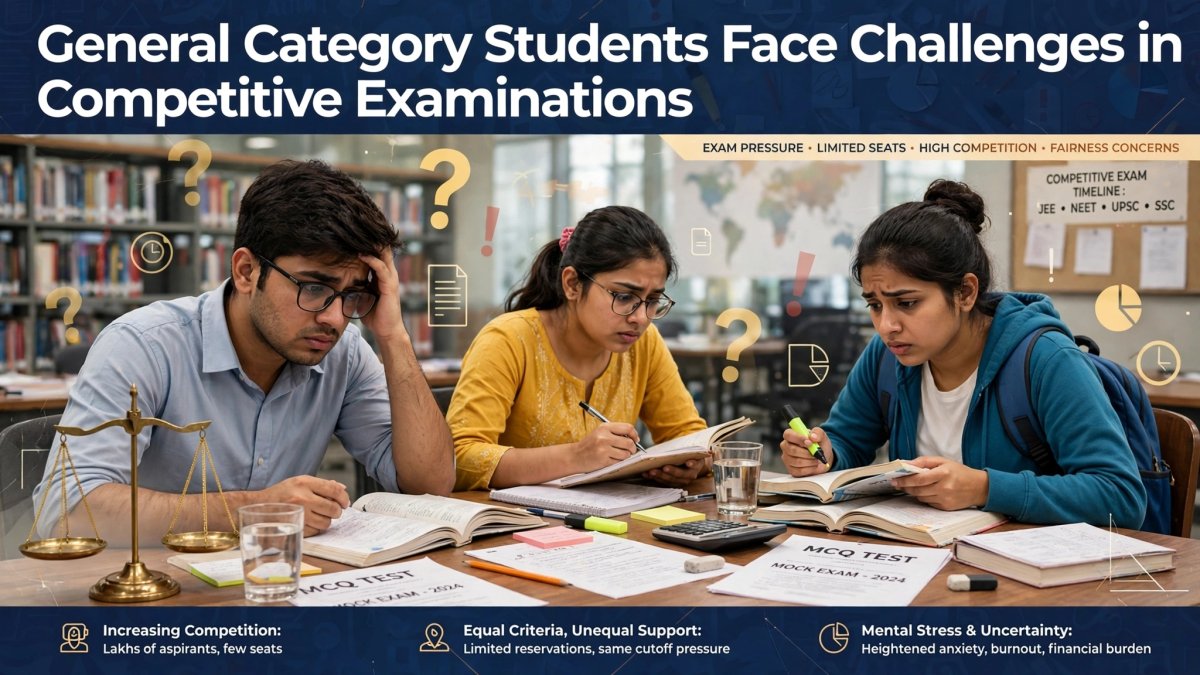
General Category Students Face Barriers in Competitive Exams
India’s competitive examination system plays a significant role in determining access to higher education, professional courses and government employment. Millions of students prepare for examinations such as NEET, JEE and the UPSC Civil Services Examination, hoping to build better futures. However, students from economically weaker families often struggle to afford private coaching, repeated examination attempts and extended periods without employment.
For economically disadvantaged General Category students, concerns about affordability, financial assistance and competition for limited opportunities have become important subjects of public debate. Recent discussions about government-supported coaching schemes have also raised questions about eligibility and equal access to educational resources. Understanding these challenges requires examining both practical difficulties and the constitutional principles underlying India’s reservation system.
1. The Financial Burden of Competitive Examination Preparation
Competitive examination preparation requires more than academic ability. Students may need textbooks, digital learning resources, accommodation, transport, examination fees and coaching. These expenses can place considerable pressure on families with limited incomes.
Expensive Coaching and Study Materials
Private coaching can be unaffordable for families already struggling with household expenses. Students without reliable internet access, updated study materials or suitable study spaces may face additional obstacles. Although free online resources are available, students may still need structured guidance, academic support and opportunities to practise examination questions.
Accommodation and Living Expenses
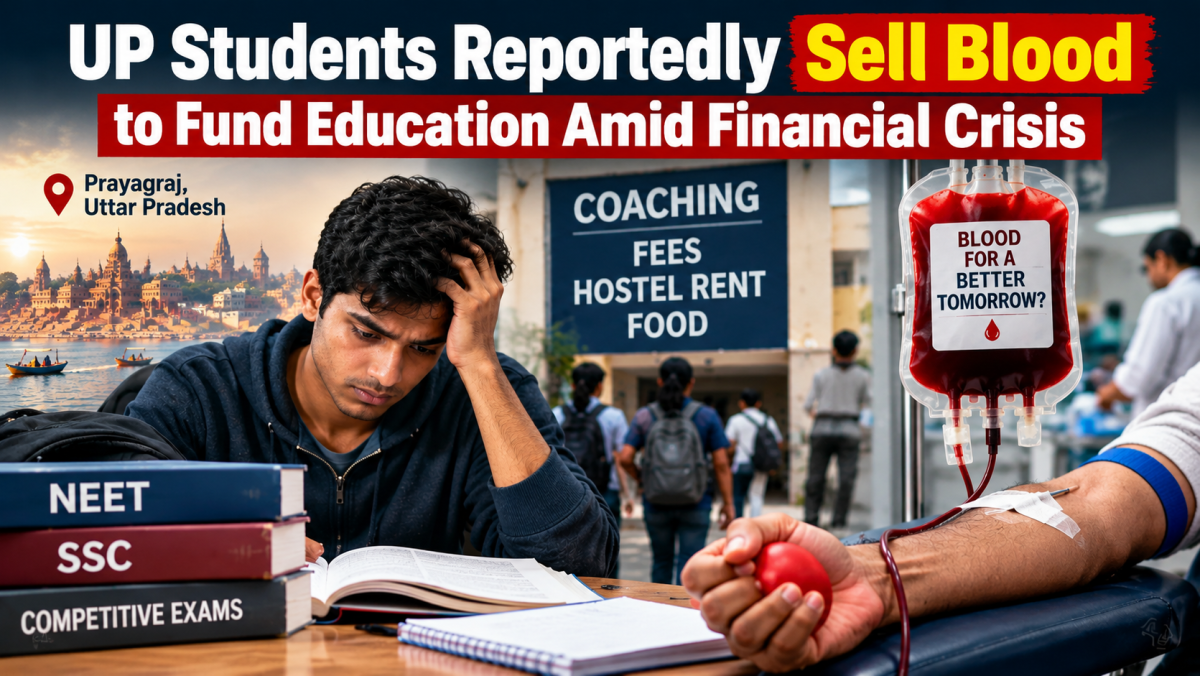
Students who move to major cities for preparation must also pay rent, food and transportation expenses. Affordable accommodation, public libraries and government-supported coaching facilities could help reduce these financial barriers.
Pressure to Earn Early
Some students cannot afford to spend several years preparing without contributing to their family’s income. They may have to balance employment with preparation or reconsider their educational plans. Financial circumstances can therefore influence both access to resources and the time available for studying.
2. Competition for Government Jobs and Educational Seats
Government employment and admission to prestigious institutions attract large numbers of applicants because they offer valuable career opportunities. However, limited vacancies and seats make competition intense.
Limited Seats and Vacancies
General Category students frequently raise concerns about available opportunities. Candidates may spend years preparing without securing admission to their preferred institution or obtaining a government position.
A meaningful assessment requires examination-specific data, including applicant numbers, vacancies, seats, cut-off marks and category-wise outcomes. Reliable statistics can help distinguish individual experiences from broader trends.
Understanding Unreserved Opportunities
General Category and unreserved category are not always interchangeable terms. In many recruitment and admission processes, unreserved seats are open to eligible candidates from different communities according to the applicable selection rules. They are not exclusively reserved for General Category candidates.
Clear communication about these rules can help students understand the selection process and reduce misconceptions.
3. Reservation Policy and Equal Opportunity
Reservation is an important part of India’s education and employment policies. It seeks to address forms of disadvantage and underrepresentation recognised by the constitutional framework. However, questions remain about how economically disadvantaged students from different backgrounds can receive appropriate support.
Economic Disadvantage and Educational Access
Some General Category students argue that families experiencing serious financial hardship should receive greater assistance, particularly for coaching, scholarships and educational expenses.
Others emphasise that caste-based disadvantage cannot always be measured through income alone. Historical exclusion and social discrimination can create barriers that remain relevant even when economic circumstances improve.
Balancing Different Forms of Disadvantage
Economic hardship can restrict access to educational resources, while social disadvantage can create additional barriers that income measurements may not fully capture. These are related but distinct concerns.
A constructive policy discussion should examine both without assuming that one automatically explains or resolves the other. Policies should be evaluated according to their objectives, implementation and measurable outcomes.
4. Understanding the Economically Weaker Sections Reservation
The Economically Weaker Sections (EWS) reservation introduced a constitutional mechanism for providing additional opportunities to eligible economically weaker sections.
Constitutional Provisions for EWS
The Constitution (103rd Amendment) Act, 2019, inserted Articles 15(6) and 16(6), enabling special provisions, including reservation of up to 10% for eligible EWS candidates in education and public employment, subject to the applicable legal framework.
The Supreme Court’s 2022 Judgment
In November 2022, the Supreme Court upheld the constitutional validity of the amendment by a 3–2 majority in Janhit Abhiyan v. Union of India. The judgment remains an important part of the legal background to discussions about economic disadvantage and reservation policy.
Challenges in Accessing EWS Benefits
Students may struggle to understand eligibility requirements, obtain necessary documents or identify relevant assistance programmes. Better public awareness and clearer application procedures could help eligible students access available support.
However, EWS eligibility does not automatically guarantee a scholarship or admission. Applicants must meet the specific requirements of the relevant scheme or institution.
5. Government Coaching Schemes and Eligibility Concerns
Government-supported coaching initiatives can help students access preparation resources, but their eligibility criteria can also raise questions about whether other financially vulnerable students have sufficient alternatives.
Debate Over Access to Free Coaching
A report by ThePrint examined protests by General Category students concerning a coaching initiative associated with the Physics Wallah Foundation. Some students questioned why economically disadvantaged aspirants outside the scheme’s eligible groups could not access the same support.
An India Today report also discussed the controversy surrounding the scheme’s eligibility criteria and concerns raised about access for General Category and EWS students.
These reports document public concerns but do not establish that every General Category student lacks access to assistance or that all government programmes have identical eligibility requirements.
The Need for Transparent Eligibility Criteria
Government schemes often have specific objectives. Programmes intended to address historical social disadvantage may use different eligibility criteria from those providing assistance based on household income.
Nevertheless, policymakers can examine whether financially disadvantaged students who fall outside particular schemes have access to other forms of support. Clear eligibility rules and information about alternative programmes would help students understand their options.
6. Reducing Dependence on Expensive Coaching Centres
The high cost of competitive examination preparation has raised broader questions about school education and the role of private coaching.
Strengthening School Education
ThePrint reported on a government panel examining students’ dependence on coaching centres. Its recommendations included better alignment between school curricula and competitive examinations, stronger classroom teaching and additional academic support within schools.
The reported proposals also highlighted the importance of helping students identify their abilities and explore career pathways earlier.
Making Quality Preparation Accessible
Schools and public institutions could provide practice tests, updated study materials, academic mentoring and additional subject support. Accessible digital resources and public libraries could further assist students who cannot afford private coaching.
Effective implementation would require adequate funding, trained teachers and reliable educational infrastructure. Online resources alone may not be sufficient for students without suitable devices or stable internet connections.
Reducing dependence on expensive private coaching could benefit students across economic backgrounds.
7. Scholarships and Financial Assistance
Scholarships and financial assistance can help students continue their education without placing excessive pressure on their families. However, support depends on the eligibility conditions and availability of individual schemes.
Improving Scholarship Awareness
Some students may be unaware of merit-based scholarships, while others may discover that a programme does not cover their course, institution or financial circumstances. Schools, colleges and government platforms should communicate eligibility requirements clearly.
Simplifying Applications
Governments and educational institutions can simplify application procedures where appropriate and explain how scholarship decisions are made. Regular reviews can help identify eligible students who remain without adequate support.
8. Repeated Attempts and Delayed Employment
Competitive examinations may require several attempts, creating financial and emotional pressure for candidates whose families cannot support extended preparation.
Financial Consequences
Every additional year may involve coaching expenses, examination fees and accommodation costs while delaying entry into employment. Students may have to choose between continuing preparation, accepting available work or pursuing another qualification.
Clear information about examination requirements and realistic career planning can help candidates make informed decisions.
Alternative Career Pathways
Career counselling, affordable preparation resources and transparent recruitment schedules could help students explore different professional opportunities. An examination result should not be treated as a complete measure of a person’s ability or future potential.
9. Reforms for a More Accessible Examination System
Addressing these challenges requires more than debating reservation percentages. The affordability of preparation, availability of financial support and transparency of selection processes also matter.
Expanding Affordable Preparation
Public institutions can strengthen free or low-cost study materials, practice tests, digital learning resources and accessible coaching facilities.
Improving Financial Assistance
Scholarship eligibility and coverage should be reviewed to identify genuine educational needs that remain unmet. Information about assistance should be easy to understand, particularly for families unfamiliar with government schemes.
Strengthening Transparency
Examination authorities should publish accurate information about vacancies, schedules, selection criteria and results. Reliable statistics can improve public understanding and help candidates plan their preparation.
Evaluating Policy Outcomes
Governments and educational institutions should assess whether support programmes improve participation, educational completion and employment outcomes. Evidence-based evaluations can identify gaps and guide future reforms.
Conclusion
The challenges facing General Category students in competitive examinations deserve serious consideration, particularly when financial hardship limits access to coaching, educational resources and sustained preparation. EWS provisions provide a constitutional mechanism for supporting eligible economically weaker sections, but effective implementation and awareness of available assistance remain important.
Public debate surrounding government-supported coaching schemes has highlighted concerns about eligibility and access to educational resources. Reports from ThePrint and India Today document questions raised by students, while reporting on government panel recommendations draws attention to the need to reduce dependence on expensive coaching centres.
Economic disadvantage and social disadvantage are different policy concerns, and addressing one does not automatically eliminate the other. A constructive debate should recognise the objectives of affirmative action while examining gaps in educational affordability and support.
India should work towards ensuring that financial circumstances do not unnecessarily prevent capable students from pursuing education and employment. Accessible scholarships, affordable preparation, transparent selection procedures and evidence-based reforms can help expand opportunity while respecting the constitutional framework.
Sources and Further Reading
1. ThePrint — General Category Students Protest Physics Wallah Coaching Scheme: ‘Exclusion Is Happening’
2. India Today — Government’s Free Coaching Scheme Leaves Out General Category Students, Sparks Debate
3. ThePrint — Government Panel Recommends Measures to Reduce Students’ Dependence on Coaching Centres
Join the Conversation