"Oracle is reportedly planning layoffs that could affect up to 30,000 employees as the company deals with financial pressure from AI data centre investments linked to its partnership with OpenAI."
Does that mean government jobs are also going to DIE?
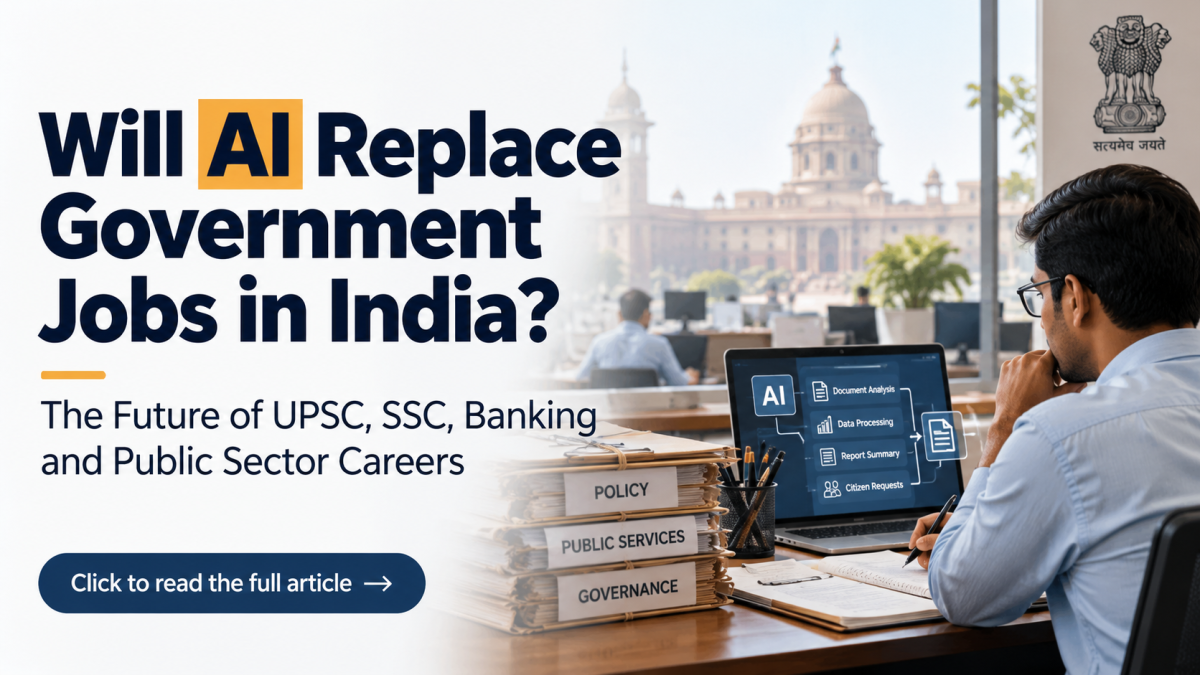
Whole world is changing because of Artificial Intelligence (AI), govt. services are not far away. AI is changing how governments deliver services, process documents, analyse information and make decisions. India is also investing in AI infrastructure and digital governance.
For millions of aspirants preparing for UPSC, SSC, banking, railways and state government examinations, one question matters more than ever: Will AI replace government jobs in India?
1. Why Is AI Becoming Important for Government Jobs?
Governments handle enormous amounts of information every day. They process applications, maintain public records, collect taxes, manage welfare schemes and respond to citizens' complaints.
Many of these activities involve repetitive, rule-based tasks. AI can help automate or accelerate them.
For example, AI systems can assist with:
- Document processing: Reading forms, extracting information and identifying missing documents.
- Public grievance management: Sorting complaints and directing them to the appropriate department.
- Data analysis: Identifying unusual spending patterns, potential fraud and emerging public needs.
- Citizen services: Answering routine questions through chatbots and virtual assistants.
- Translation: Making government information accessible in multiple Indian languages.
These applications could reduce delays and improve efficiency. They could also reduce the need for certain manual tasks. But there is an important distinction: automating a task does not automatically mean eliminating the employee who performs it.
2. Which Government Jobs Are Most at Risk?
Not every government employee performs the same kind of work. Therefore, AI will not affect every position equally.
Jobs and tasks more exposed to automation:
1. Data entry and clerical work
Routine data entry, record classification and document verification are among the tasks AI-powered software can assist with substantially.
2. Basic customer support
Frequently asked questions about pensions, certificates, taxation and welfare schemes can often be handled by automated systems.
3. Routine document processing
Software can help compare records, identify missing information and flag inconsistencies in applications.
4. Basic report preparation
AI can summarise documents, prepare preliminary reports and organise large datasets, reducing the time required for routine administrative work.
These developments may change staffing requirements, recruitment patterns and the responsibilities assigned to existing employees. However, the actual impact will depend on departmental decisions, technology costs, accuracy requirements and government policy. I doubt STENOGRAPHER will safe.
But, what Jobs are harder to replace completely?
Jobs involving complex judgment, accountability, public interaction and physical responsibilities are more difficult to automate fully.
Here are some Examples :
- Civil servants handling complex administrative decisions.
- Police personnel responding to emergencies and investigating crimes.
- Defence personnel operating in unpredictable environments.
- Teachers working directly with students.
- Doctors and public health professionals making sensitive decisions.
- Field officers inspecting sites and addressing local problems.
AI can assist these professionals, but assistance is not the same as replacing their judgment and responsibility.
3. What Does the Government of India Say About AI and Employment?
The government has already acknowledged both the risks and opportunities.
The Economic Survey 2024–25, presented in Parliament on 31 January 2025, discussed AI's potential to increase productivity while also warning about possible labour displacement. It highlighted the importance of preparing workers for an AI-driven economy.
The Survey also emphasised the idea of augmented intelligence, in which humans use AI to improve their capabilities rather than relying entirely on machines.
Meanwhile, a written reply by the Ministry of Labour and Employment in the Rajya Sabha on 19 December 2024 noted that AI may automate some routine jobs while creating opportunities in areas such as data science and data curation.
These statements do not guarantee that government recruitment will remain unchanged. They show that policymakers recognise the need to balance technological progress with employment and skills development.
Sources: Economic Survey 2024–25: AI and employment | Ministry of Labour and Employment: Parliamentary reply
4. Will AI Reduce UPSC, SSC, Banking and Railway Vacancies?
This is probably the most important question for government job aspirants.
AI could help departments process files faster, automate routine administrative work and improve productivity. Over time, some departments might reconsider how many employees they need for particular tasks.
However, it would be misleading to conclude that AI will automatically cause government vacancies to disappear.
Government recruitment depends on several factors:
- The number of sanctioned posts and existing vacancies.
- Retirement, resignations and expansion of public services.
- Government budgets and recruitment policies.
- Demand for healthcare, education, policing and infrastructure.
- New responsibilities created by digital governance.
For example, AI may help a bank process routine customer requests. Yet banks still need people to handle complicated cases, manage relationships, investigate suspicious transactions and ensure regulatory compliance.
Similarly, AI may help civil servants analyse policy data, but governments still require accountable officials to implement laws and make administrative decisions.
The future of government recruitment will depend on policy choices, not technology alone.
5. Could AI Create New Government Careers?
I will say a BIG YES. As governments adopt more advanced technology, they will also need people who can implement, supervise and maintain it.
Potential areas of opportunity include:
- AI and data analytics.
- Cybersecurity and digital forensics.
- Government technology project management.
- Data governance and privacy compliance.
- AI auditing and responsible AI oversight.
- Digital public service delivery.
India's IndiaAI Mission, approved in March 2024, aims to strengthen domestic AI capabilities, computing infrastructure, skills and innovation. These initiatives support the development of a broader AI ecosystem.
6. What Should Government Job Aspirants Do Now?
Should you stop preparing for government examinations and start learning AI? No. That would be an unnecessarily dramatic response to a complicated situation.
Instead, prepare for your chosen examination while developing skills that will remain useful as workplaces change.
Here are five practical steps:
- Continue your examination preparation. Choose a career based on your interests, abilities and goals, not on predictions that every job will disappear.
- Learn basic AI tools. Understand how AI can summarise information, organise research and assist with routine work.
- Strengthen digital literacy. Become comfortable with spreadsheets, online government platforms, data interpretation and digital security.
- Develop analytical and communication skills. Clear writing, critical thinking, ethical judgment and decision-making will remain valuable.
- Verify information before trusting AI. AI systems can produce inaccurate answers. Government employees must understand the information they use and remain accountable for their decisions.
These skills can improve your effectiveness whether you enter public service or pursue another career.
7. The Bigger Question: Can AI Replace the Government Itself?
A government does more than process documents. It enforces laws, protects citizens, resolves disputes, delivers public services and remains accountable to the people.
These responsibilities involve constitutional principles, public trust, ethics and human consequences. Technology can support them, but delegating decisions entirely to an algorithm raises serious questions about fairness, transparency and accountability.
Consider a welfare application rejected by an automated system.
- Who explains the decision?
- Who corrects an error?
- Who ensures that a vulnerable citizen is not unfairly denied assistance?
These questions show why human oversight will remain essential in many public services, even as AI becomes more capable.
The real competition may not be between humans and AI. It may be between people who learn to work effectively with AI and those who ignore how the workplace is changing.



Join the Conversation