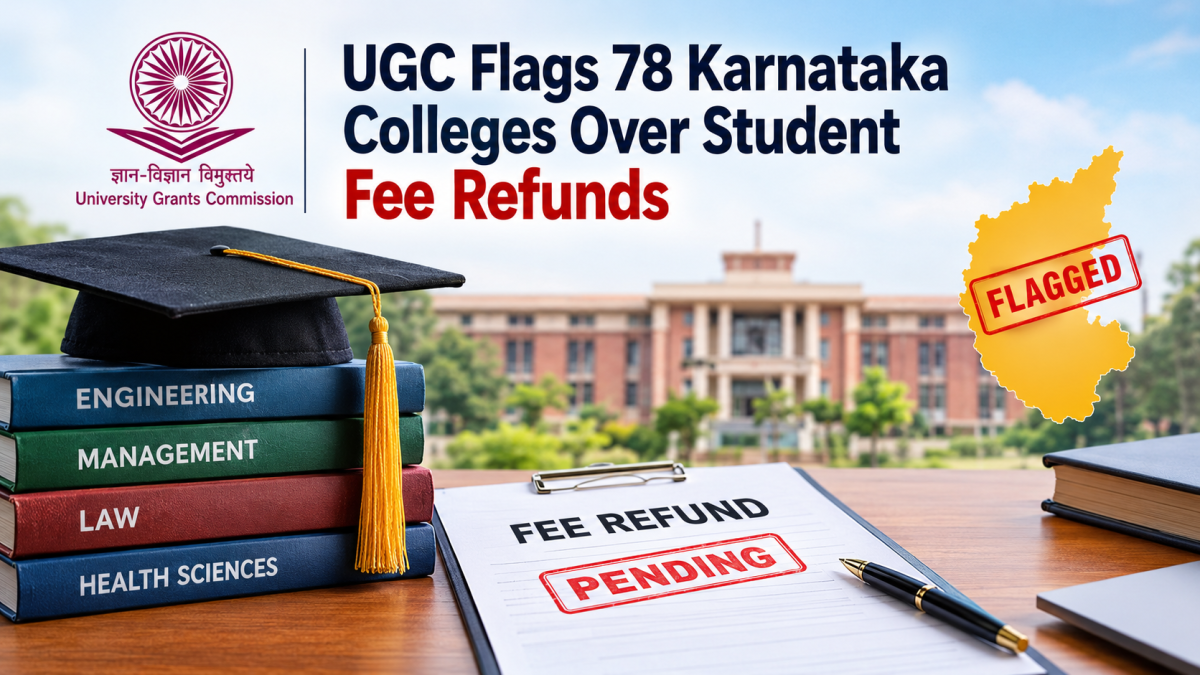
UGC Flags 78 Karnataka Colleges Over Pending Student Fee Refunds
The University Grants Commission (UGC) has flagged 78 colleges and universities in Karnataka over unresolved complaints concerning the refund of admission fees to students who cancelled their admissions. The development has renewed attention on student rights, institutional accountability and the enforcement of regulations governing India's higher education sector.
According to reports published in October 2026, the commission identified 132 unresolved fee-refund complaints from Karnataka. Of these, 110 students reportedly received no refund, while 22 received only partial refunds. The complaints relate to cases recorded between 2020 and 2025.
After repeated communications and consultations with the institutions concerned failed to resolve several grievances, the UGC sought the intervention of the Karnataka Governor's Office to encourage compliance with its fee-refund guidelines.
1. Background of the UGC's Action
The UGC's intervention follows complaints from students who say institutions have failed to return eligible fees after they cancelled their admissions within the prescribed period.
132 Unresolved Complaints Across 78 Institutions
The reported figures highlight the extent of the problem. Among the 132 unresolved complaints, 110 reportedly involve students who have received no refund, while 22 concern cases in which only part of the eligible amount was returned.
The complaints cover different institutions and academic programmes. The UGC has reportedly forwarded grievances to the institutions concerned and conducted follow-up communications and meetings. However, several cases remain unresolved.
Significant Amounts Awaiting Refund
Some individual complaints involve substantial amounts. Reported pending refunds in engineering programmes range from ₹2 lakh to ₹8.3 lakh. Management courses, including MBA, PGDM and BBA programmes, also account for significant claims.
Complaints have additionally been reported in law and allied health sciences. These figures demonstrate how unresolved admission-related financial disputes can affect students and their families.
2. Understanding UGC Fee Refund Guidelines
The UGC has issued several notifications and directions to establish a framework for refunding fees when students withdraw from higher education institutions. These provisions are intended to ensure transparency and prevent institutions from retaining amounts that students are entitled to recover.
The October 2018 Refund Framework
The UGC's October 2018 notification established a refund structure based on when an institution receives a student's withdrawal request in relation to the formally notified last date of admission.
Under this framework, the general refund percentages are:
• 100% refund when withdrawal is requested 15 days or more before the last date of admission.
• 90% refund when withdrawal is requested less than 15 days before that date.
• 80% refund when withdrawal takes place within 15 days after the last date.
• 50% refund when withdrawal takes place more than 15 days but within 30 days after the last date.
• No refund under this framework when withdrawal takes place more than 30 days after the last date.
The applicable notification and academic-year-specific directions must be examined when determining an individual student's entitlement.
Special Directions for the 2024–25 Academic Session
In June 2024, the UGC issued a separate fee-refund policy for the 2024–25 academic session. It provided for full refunds for cancellations or migrations up to September 30, 2024, and permitted a processing deduction of no more than ₹1,000 for withdrawals up to October 31, 2024.
The policy applied to recognised higher education institutions and affiliated colleges. These directions illustrate the commission's efforts to establish consistent financial protections for students.
3. Financial Challenges Faced by Students
Admission-related expenses can represent a substantial commitment for families. Students frequently apply to multiple institutions before making a final decision about their preferred course or university.
The Burden of Delayed Refunds
A student may initially accept admission at one institution while waiting for the results of another application or counselling process. After securing a preferred seat, the student may decide to withdraw from the earlier institution.
When the eligible refund is delayed or withheld, the family may struggle to arrange the money required for the new admission.
For students from financially constrained households, even a partial loss of admission fees can create considerable pressure. Some families may have used savings or borrowed money to meet the initial payment.
Impact on Academic Planning
Unresolved financial disputes can also disrupt educational decisions. Students may face difficulties arranging tuition fees, accommodation and other expenses at their preferred institutions.
The uncertainty surrounding refunds can make the transition between institutions more complicated and place additional pressure on students during an important academic period.
4. Institutional Accountability and Regulatory Oversight
Colleges and universities are expected to follow applicable UGC regulations and maintain transparent admission and financial procedures. Their responsibilities include communicating withdrawal policies clearly and processing eligible refunds within the prescribed framework.
Responsibilities of Higher Education Institutions
Institutions should provide students with clear information about cancellation procedures, applicable deductions and refund timelines.
Where an institution believes that a particular student is not eligible for a refund, it should communicate the reasons and the relevant regulatory provisions. Leaving complaints unanswered undermines transparency and weakens confidence in institutional administration.
The UGC's Regulatory Role
The UGC plays an important role in maintaining standards and promoting accountability across India's higher education system.
Its decision to seek further intervention after repeated communications indicates the challenges involved in securing compliance across multiple institutions.
Regulations can protect students effectively only when institutions implement them consistently and regulatory authorities monitor unresolved grievances.
5. Why Fee Refund Disputes Continue ?
The persistence of complaints raises questions about administrative procedures, institutional practices and the practical enforcement of existing regulations.
Administrative Delays and Communication Gaps
Refund applications may pass through several departments, including admissions, accounts and institutional administration. Poor coordination can delay decisions and leave students uncertain about the status of their applications.
A lack of clear communication can make the process particularly difficult for students who must repeatedly approach institutions for updates.
Financial Concerns of Institutions
Some private institutions argue that late admission cancellations can leave seats vacant and create financial losses. They may find it difficult to identify replacement candidates after admission deadlines have passed.
However, institutional financial concerns must be considered within the applicable regulatory framework. Colleges cannot disregard valid refund requirements solely because a cancellation creates administrative or financial difficulties.
A transparent system should provide clarity for both institutions and students.
6. Reforms Needed to Protect Student Rights
The Karnataka complaints highlight the need for stronger implementation of existing regulations and more accessible grievance-redressal mechanisms.
Time-Bound Refund Procedures
Institutions should establish clear procedures for processing eligible refunds. Students should receive acknowledgement of their applications, information about applicable deductions and updates regarding payment timelines.
Stronger Grievance Redressal Mechanisms
Universities and colleges should maintain accessible complaint systems through which students can report unresolved financial disputes.
Complaints that remain unanswered should be escalated to the appropriate authorities without requiring students to repeatedly approach different departments.
Consistent Regulatory Monitoring
The UGC and relevant state authorities should monitor institutional compliance, review pending complaints and seek explanations where necessary.
Greater transparency in reporting unresolved cases and appropriate action against established non-compliance could strengthen accountability across the sector.
Conclusion : Strengthening Accountability in Higher Education
The UGC's decision to flag 78 Karnataka colleges and universities over 132 unresolved fee-refund complaints has highlighted an important issue within India's higher education system. With 110 students reportedly receiving no refund and another 22 receiving only partial payments, the matter raises concerns about the implementation of student-protection regulations.
Although institutions may face administrative and financial challenges when students withdraw from courses, these concerns must be addressed within the applicable regulatory framework.
The effectiveness of higher education regulation depends not only on the policies issued by authorities but also on their implementation. Timely refunds, transparent procedures and accessible grievance-redressal mechanisms are essential to maintaining trust between students and educational institutions.
Ultimately, protecting students' financial interests is an important part of ensuring fairness, accountability and confidence in India's higher education system.
Sources and Further Reading
1. The Times of India – UGC Flags Karnataka Colleges Over 132 Pending Fee Refund Complaints
2. Economic Times – UGC Flags 78 Karnataka Colleges Over Unresolved Student Fee Refund Complaints
3. The Indian Express – UGC Seeks Governors' Intervention Over Non-Refund of Fees
4. Jagran Josh – UGC Flags 78 Karnataka Colleges Over Pending Fee Refunds
5. University Grants Commission – Fee Refund Policy 2024–25
https://admission.uoc.ac.in/downloads/UGC_Guidelines_Fee_Refund_Policy.pdf
Join the Conversation