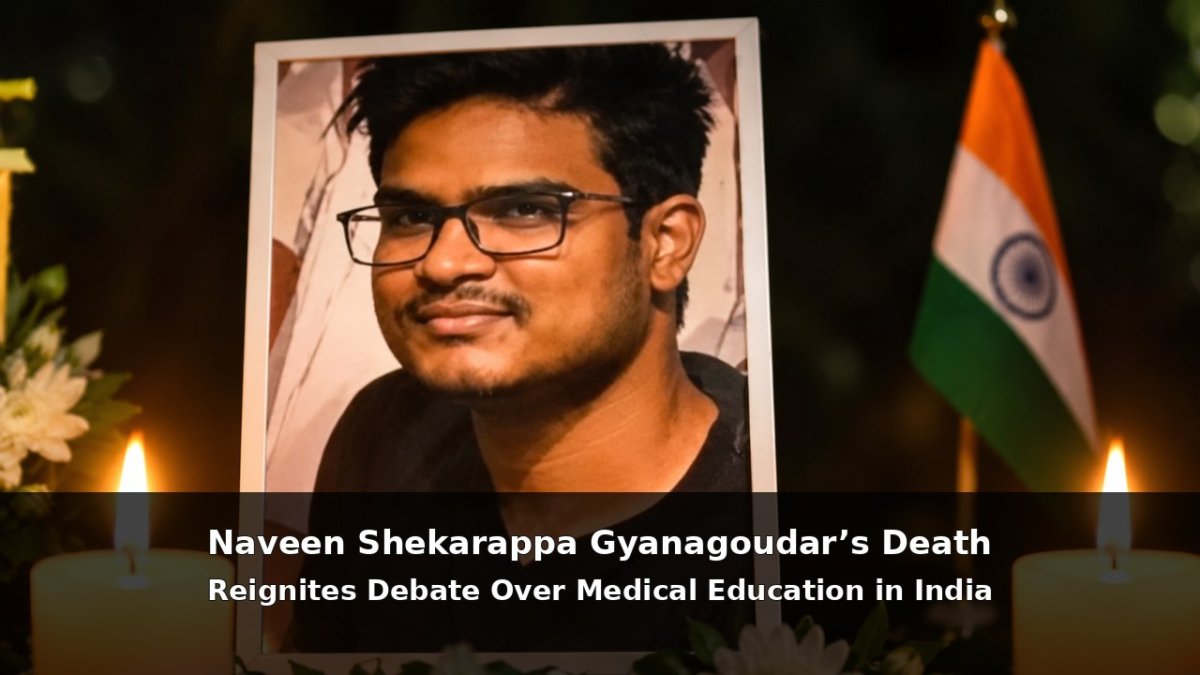
Naveen Shekarappa Gyanagoudar’s Death Exposes the Challenges of Medical Education in India
Naveen Shekarappa Gyanagoudar, a 21-year-old medical student from Karnataka, was killed in Kharkiv, Ukraine, on March 1, 2022, during Russia’s invasion of the country. His death brought international attention to the dangers faced by Indian students studying overseas and reignited a national debate over the accessibility, affordability and fairness of medical education in India.
Naveen was pursuing his MBBS degree at Kharkiv National Medical University. According to contemporary media reports, he had scored 97% in his pre-university examinations but had not secured a medical seat through the Indian admission process. His family subsequently sent him to Ukraine, where medical education appeared to offer a more financially manageable route towards his ambition of becoming a doctor.
The tragedy became particularly controversial after his father, Shekarappa Gyanagoudar, publicly criticised the high cost of medical education and raised concerns about reservation policies. His statements prompted wider discussions about merit, economic disadvantage, entrance examinations and the availability of affordable medical seats.
However, understanding Naveen’s story requires more than political arguments. It demands a closer examination of the circumstances surrounding his education, the pressures facing aspiring doctors and the reforms needed to make professional education more accessible.
The Tragedy That Brought India’s Medical Education System Under Scrutiny
Naveen’s death occurred as fighting intensified in Kharkiv, one of Ukraine’s major cities. Indian students in the city were struggling to find food, safe shelter and secure routes out of the conflict zone.
1. A Promising Student Whose Ambitions Ended in War
Naveen was from Chalageri village in Karnataka’s Haveri district. Reports published on March 1 and 2, 2022, stated that he was a fourth-year medical student who had left a shelter to obtain food when he was caught in the shelling. India’s Ministry of External Affairs confirmed his death.
His family had invested financially and emotionally in his medical education, hoping he would eventually return as a qualified doctor. Instead, a young student pursuing a professional ambition became one of the most widely reported Indian casualties of the invasion.
His death was first and foremost a human tragedy. The education debate that followed should not overshadow the circumstances in which he lost his life or reduce his story to a political argument.
Why Indian Students Look Abroad for Medical Education?
India has a large population of aspiring medical students, and admission to undergraduate medical programmes is highly competitive. Although government medical colleges generally provide comparatively affordable education, securing a seat can be difficult. Private medical colleges offer additional opportunities, but their fees may be beyond the financial reach of many families.
2. High Competition and the NEET Admission Process
Admission to undergraduate medical courses in India is governed by eligibility requirements and the National Eligibility-cum-Entrance Test, commonly known as NEET-UG. Candidates compete for available seats according to examination performance, counselling rules and the applicable admission criteria.
Naveen’s academic record illustrates an important distinction between school performance and medical admission. His father highlighted his son’s reported 97% score in pre-university examinations. However, contemporary reporting stated that Naveen had appeared for NEET but had not achieved the required cutoff.
Strong school results demonstrate academic achievement, but they do not automatically guarantee a medical seat. The entrance examination, candidate rank, applicable admission criteria, counselling process and availability of seats all influence admission outcomes.
This creates a difficult situation for students who perform well academically but cannot obtain an affordable place in a medical college.
3. The Financial Pressure of Private Medical Colleges
The cost of private medical education was a central concern raised by Naveen’s father. In interviews reported by Indian news organisations, he criticised the financial barriers facing families who want their children to pursue medicine.
For many households, the challenge extends beyond tuition fees to accommodation, books, transportation and other educational expenses. Families must assess the entire cost of a medical degree rather than tuition alone.
Studying abroad may appear to offer a more affordable alternative. Nevertheless, students must also consider travel, living expenses, foreign currency fluctuations, university recognition, clinical training and the requirements for practising medicine in India. Overseas education is therefore not automatically cheaper or more suitable for every student.
Reservation, Merit and the Question of Equal Opportunity
Naveen’s death became part of a broader debate about reservation in education after his father attributed his son’s difficulties partly to the existing admission system. His comments attracted political and public attention, particularly because they came at a time of national mourning.
4. Examining the Claims Surrounding Reservation
Reservation policies are intended to address historical social exclusion and persistent inequalities in educational and public opportunities. Supporters argue that such measures are necessary to improve representation for communities that have experienced discrimination. Critics question particular aspects of the system and argue that economic disadvantage among students from non-reserved categories also deserves greater attention.
Naveen’s father expressed his personal criticism of the admission system. However, his account alone cannot establish that reservation was the sole reason his son studied abroad. Reports also stated that Naveen had not met the relevant NEET cutoff.
A careful assessment would require examining his examination performance, admission eligibility, counselling options, available seats and the fees charged by institutions he could realistically have attended.
The debate should therefore move beyond broad accusations. Policymakers must consider how to widen access to quality education while addressing historical disadvantage, financial hardship and the need for transparent admission procedures.
Political Reactions and Public Accountability
Naveen’s death also prompted criticism and discussion concerning the challenges faced by Indian students trapped in Ukraine. Families sought assistance as fighting intensified, while political leaders issued condolences and discussed evacuation efforts.
5. The Controversy Over Studying Medicine Abroad
The public debate intensified after Union Minister Pralhad Joshi made remarks about Indian students who pursue medical education overseas. His comments attracted criticism while thousands of Indian nationals were attempting to leave war-affected areas.
Naveen’s father responded by emphasising that financial limitations, rather than a lack of ambition, had influenced his son’s decision to study abroad. His remarks raised an important policy question: should students have to choose between paying unaffordable fees and pursuing their professional ambitions in another country?
Public officials have a responsibility to address such concerns through evidence-based policy discussions. At the same time, criticism of the education system should distinguish between the difficulties faced by individual families and the broader evidence needed to assess admission policies.
What India Needs to Change?
Naveen’s story highlights several areas in which education policy deserves sustained attention. Meaningful reform requires practical measures rather than temporary public debate following a tragedy.
6. Expanding Affordable Medical Education
Increasing the availability of affordable medical seats should remain an important policy objective. Investment in government medical colleges, teaching hospitals, faculty and clinical infrastructure could expand access while maintaining educational standards.
Private medical institutions also need transparent fee structures and effective regulatory oversight. Students and families should receive clear information about tuition, additional charges and the total cost of completing a degree before making major financial commitments.
Scholarships, need-based assistance and accessible education loans could further support eligible students who face financial difficulties. Such measures would not eliminate competition, but they could reduce the financial barriers that prevent capable students from pursuing medical careers.
7. Improving Guidance for Students Studying Overseas
Students considering foreign medical universities need reliable information about accreditation, course requirements, language of instruction, clinical training and the conditions for obtaining permission to practise in India.
Universities, regulators and government agencies should make this information accessible before students enrol. Families must be able to assess whether a foreign qualification will meet the applicable requirements and whether the total financial commitment is realistic.
The experience of Indian students caught in the Ukraine conflict also underlined the importance of emergency preparedness, timely communication and accessible consular assistance during international crises.
Conclusion
Naveen Shekarappa Gyanagoudar’s death exposed the human consequences of a tragedy that unfolded far beyond India’s borders. It also brought renewed attention to the challenges facing students who aspire to become doctors but encounter intense competition and substantial financial barriers.
His father’s statements raised important questions about affordability and educational opportunity, while the subsequent controversy over reservation demonstrated how quickly individual tragedies can become politically contested.
A constructive response requires factual reporting, transparent admission policies, greater investment in affordable medical education and better guidance for students considering overseas universities. It also requires acknowledging that no single case can, by itself, establish the full impact of a complex policy.
Ultimately, India’s objective should be to create a medical education system in which access to a professional future depends on clear academic standards and fair opportunities, rather than a family’s ability to bear an overwhelming financial burden. That is the wider lesson policymakers should draw from Naveen’s story.
Sources and Further Reading
1. The New Indian Express — Bring My Son’s Body Back, I Want to See Him: Naveen’s Father
2. The Times of India — Doc Dreams Shattered: Indian Student Killed in Ukraine Had Stepped Out to Purchase Food
3. India Today — Report on Naveen’s Death and His Family’s Concerns About Medical Education in India
4. NDTV — Killed Student’s Father Responds to Minister’s ‘Study Medicine Abroad’ Remark
5. Careers360 — Report on Naveen’s Father Raising Concerns About Medical Education Costs and Access
Join the Conversation