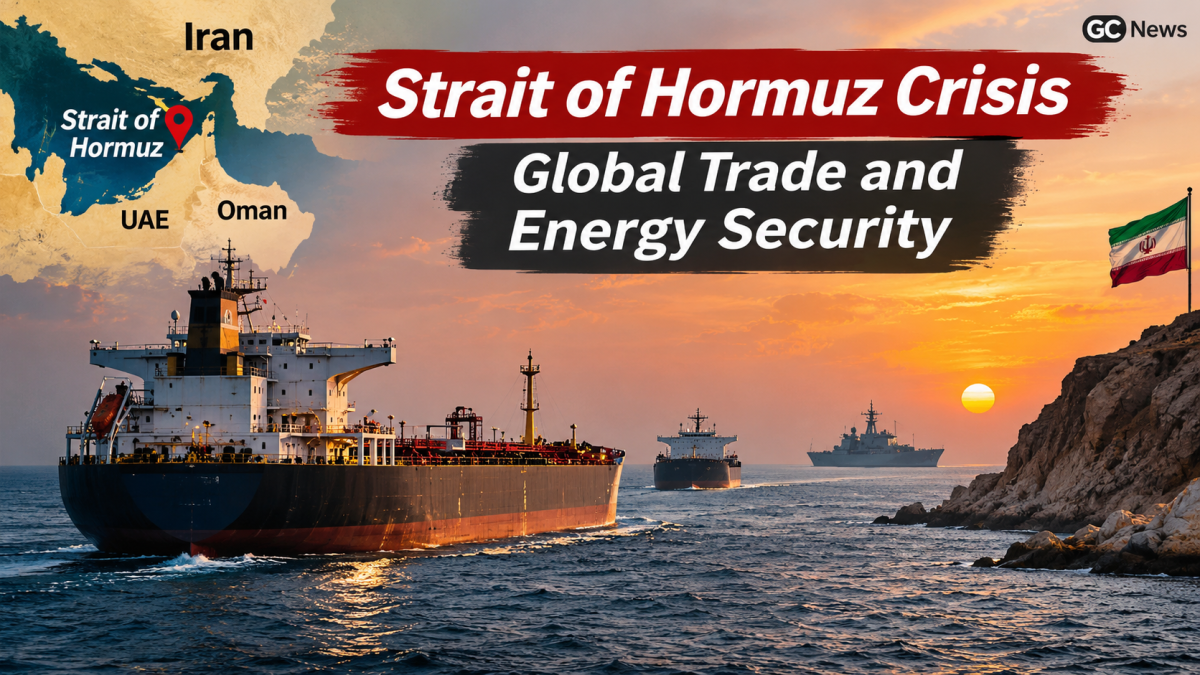
The Strait of Hormuz and the Weaponisation of Global Trade: Can the World Afford Another Energy Crisis?
International Relations | Geopolitics | Energy Security
The world economy depends on thousands of ships moving across oceans every day. They carry the oil that powers factories, the gas that generates electricity, the raw materials used by industries, and the goods that connect distant economies. Yet some of the most important routes for this trade pass through narrow stretches of water where a regional conflict can have consequences far beyond its immediate surroundings.
The Strait of Hormuz is one of those places.
Situated between Iran and the Arabian Peninsula, the strait connects the Persian Gulf with the Gulf of Oman and the wider Arabian Sea. Its geographical importance is difficult to overstate. According to the International Energy Agency (IEA), approximately 20 million barrels of oil and petroleum products passed through the waterway per day on average in 2025, representing around one-quarter of global seaborne oil trade.
When security in this narrow passage deteriorates, the consequences can reach oil markets, shipping companies, governments and ordinary households thousands of kilometres away.
Recent developments have brought that vulnerability into sharp focus. On 23 October 2026, Reuters reported that attacks on commercial shipping in the Strait of Hormuz and surrounding waterways had reached a record level for October, according to data compiled by the Washington Institute for Near East Policy. The Associated Press had also reported on 22 October that Iran claimed seven oil tankers had been attacked or damaged amid fears of renewed fighting. The AP noted that it could not independently confirm Iran's account of those particular incidents.
These reports point to a larger question: when an essential route for global trade becomes part of a geopolitical confrontation, who ultimately pays the price?
The answer extends far beyond the countries directly involved.
Why the Strait of Hormuz Matters to the World
The strategic importance of the Strait of Hormuz begins with geography. It is a narrow maritime passage through which a substantial share of the world's oil supplies and significant volumes of liquefied natural gas must travel to reach international markets.
Major energy exporters, including Saudi Arabia, Iraq, Kuwait, Qatar, the United Arab Emirates and Iran, depend to varying degrees on routes connected to the Persian Gulf. Although some countries have pipelines and alternative export facilities, these cannot easily replace all the volumes that would be affected by a prolonged disruption.
The IEA identifies the strait as one of the world's most critical energy chokepoints. It also notes that most oil moving through the passage is destined for Asian markets.
This matters because modern economies are closely connected through energy prices. A disruption does not have to eliminate global oil supplies entirely to create economic difficulties. Even the possibility of a prolonged interruption can increase uncertainty, raise insurance premiums and push shipping costs higher.
Oil markets respond not only to what is happening today but also to what traders believe might happen tomorrow.
If companies fear that tankers may be attacked or delayed, they may demand higher freight rates to accept the additional risk. Insurers may increase premiums, while shipowners may reconsider whether a particular voyage is commercially viable. These expenses can eventually feed into the price paid by refineries, businesses and consumers.
In other words, a maritime security crisis can become an economic crisis even before the physical supply of oil is completely interrupted.
From Regional Conflict to Global Economic Pressure
The Strait of Hormuz demonstrates how geography can become a source of political leverage.
A country positioned near a strategically important shipping route has the potential to influence the calculations of other states. In a confrontation, threats to shipping can increase the economic costs of continued hostilities and create pressure on governments that depend on uninterrupted trade.
However, using a chokepoint as an instrument of pressure carries serious risks.
Disruptions can affect countries that are not parties to the conflict. Import-dependent economies may face higher energy costs, shipping companies may suffer financial losses, and seafarers may be exposed to serious danger. If uncertainty persists, governments may also face difficult choices over emergency spending, fuel prices and economic support.
The result is a form of economic pressure that spreads across borders.
The problem is particularly difficult because the interests involved do not always align. One government may view maritime pressure as a way to strengthen its negotiating position. Another may consider the same action a threat to freedom of navigation and international economic stability.
Each side may believe that it is responding defensively to the other. Yet the combined effect can be an escalation in which commercial shipping becomes increasingly vulnerable.
This is one reason maritime security cannot be understood simply as a military issue. It is also a question of economic resilience, international law and the ability of governments to manage disputes without making ordinary commerce a target.
The United States, Iran and the Limits of Military Deterrence
The Strait of Hormuz sits at the intersection of regional security and international power politics.
For the United States, protecting maritime movement through the Gulf is closely connected to the security of regional partners, energy markets and international shipping. For Iran, its geographical position near the strait provides strategic significance, particularly during periods of confrontation with Washington and its allies.
These competing interests create a difficult security dilemma.
Military deployments and naval escorts may help deter attacks or protect individual vessels. However, they cannot necessarily eliminate the underlying political disputes. If the confrontation continues, ships may remain exposed to threats even when military forces are present.
The presence of more military assets can also increase the consequences of a miscalculation. An attack on a vessel, an interception or a misunderstanding at sea could trigger retaliation and widen the conflict.
This does not mean that defensive measures are unnecessary. Protecting civilian crews and keeping essential trade moving are legitimate concerns. The challenge is to ensure that such measures contribute to de-escalation rather than becoming part of a cycle of retaliation.
Military deterrence can influence an opponent's decisions, but it cannot by itself establish a durable political settlement.
That requires diplomacy, credible commitments and a willingness to address the concerns sustaining the confrontation.
Why India Cannot Afford to Ignore the Crisis
For India, the security of the Strait of Hormuz is a direct economic and strategic concern.
India is a major energy-importing economy. Its transport system, manufacturing sector, agriculture, electricity production and household consumption are all affected, directly or indirectly, by the cost and availability of energy.
The IEA identifies India among the major Asian destinations for oil moving through the strait. Its analysis also highlights the exposure of South Asian countries to disruptions in regional liquefied natural gas supplies.
A sustained crisis could affect India through several channels.
First, higher energy costs. If global oil prices rise because of supply fears, India's import bill may increase. The extent of the impact would depend on the duration of the disruption, international prices, exchange-rate movements and the availability of alternative supplies.
Second, pressure on households and businesses. Higher energy costs can raise transportation and production expenses. Depending on how these costs are passed through the economy, the effects may be felt in freight charges, manufacturing, agriculture and the prices of everyday goods.
Third, risks to maritime workers. Indian seafarers are an important part of the global maritime workforce. Any escalation that threatens commercial vessels creates a human cost that cannot be measured only in barrels of oil or market prices. The safety of crews must remain a central concern.
Fourth, a test of strategic autonomy. India maintains important relationships with countries across different geopolitical groupings. A prolonged confrontation could require careful diplomatic engagement while New Delhi protects its energy interests, citizens and regional security.
India therefore needs more than short-term crisis management. Diversifying energy suppliers, maintaining adequate emergency preparedness, strengthening maritime monitoring and investing in alternative energy sources can reduce exposure over time.
None of these measures can make India completely immune to a global energy shock. However, they can improve its ability to withstand one.
The wider lesson is that energy security is not only about securing supplies. It is also about reducing the consequences when a major supplier or transportation route becomes vulnerable.
Can Alternative Routes Solve the Problem?
One response to maritime insecurity is to develop alternative transportation routes.
Pipelines that bypass the Strait of Hormuz can help some Gulf producers move crude oil to export terminals outside the Persian Gulf. The IEA identifies existing alternative pipeline capacity in Saudi Arabia and the United Arab Emirates, although the amount of available capacity and the types of energy products that can be transported are limited.
Alternative routes can reduce dependence on a single chokepoint, but they cannot remove the risk entirely.
Pipelines have their own infrastructure, capacity and security requirements. Other shipping routes may involve longer journeys, additional fuel consumption and higher freight costs. Diverting large volumes of energy can also place pressure on ports, storage facilities and transportation networks elsewhere.
For liquefied natural gas, the challenge can be even more difficult because exports depend on specialised liquefaction facilities, tankers and receiving terminals. Existing infrastructure cannot necessarily be expanded quickly enough to replace a major interruption.
There is also a broader problem: maritime trade has several strategically important chokepoints. A disruption in one region can shift traffic towards another, potentially increasing pressure on alternative routes.
The objective, therefore, should not be to assume that every crisis can be solved by finding another route. It should be to create a more resilient network in which disruption at one location does not threaten the stability of the entire system.
That requires investment, international cooperation and realistic planning for emergencies.
International Law and the Protection of Commercial Shipping
The Strait of Hormuz raises an important question about the relationship between national security and international law.
Countries bordering a strategically important waterway have legitimate security concerns. At the same time, international commerce depends on predictable rules governing maritime navigation.
The United Nations Convention on the Law of the Sea (UNCLOS) establishes a framework for navigation through international straits. Its provisions on transit passage address the rights and obligations of ships, aircraft and coastal states in straits covered by that regime.
The convention's Article 44 states that states bordering such straits must not hamper transit passage and must give appropriate notice of dangers to navigation. The precise application of international law depends on the relevant legal circumstances, including the status of the states involved and the applicable rules.
Regardless of the legal arguments surrounding a particular incident, attacks that endanger civilian crews and commercial vessels raise serious concerns for maritime safety and international stability.
International institutions can help by documenting incidents, communicating risks, supporting diplomatic efforts and reinforcing established legal principles. But their influence depends on cooperation from states and the practical ability to implement agreed measures.
The central difficulty is that international rules are most valuable when governments respect them even when political tensions are high.
Without that commitment, commercial shipping becomes increasingly dependent on the military capabilities and calculations of individual states.
Why Diplomacy Matters More Than Ever
There is no simple solution to the Strait of Hormuz crisis. Maritime protection, intelligence-sharing and emergency planning may reduce immediate risks, but they cannot permanently resolve a conflict rooted in wider political and security disputes.
Diplomacy remains essential because it provides a way to reduce tensions without requiring every disagreement to be settled through military confrontation.
Negotiations could address the conditions needed to protect shipping, establish reliable communication channels and reduce the risk of accidental escalation. Regional governments and relevant international institutions can also help support practical arrangements that protect civilian navigation.
Such efforts are unlikely to succeed if they ignore the underlying concerns of the parties involved. Nor can diplomacy work effectively when commitments are repeatedly undermined by attacks or retaliatory actions.
Progress may be slow, and temporary agreements may not resolve every dispute. Nevertheless, a workable reduction in tensions could be more valuable for global economic stability than an open-ended contest of military pressure.
The international community also needs to recognise that the costs of a maritime crisis are distributed unevenly. Wealthier economies may be better positioned to absorb higher prices, while lower-income countries and energy-dependent industries may have fewer options.
Protecting shipping is therefore not simply a matter of preserving commercial profits. It is part of protecting the wider economic conditions on which millions of people depend.
The Bigger Question: Who Controls the World's Economic Lifelines?
The Strait of Hormuz reveals a central contradiction in globalisation.
The world has built an economic system that depends on the continuous movement of energy, goods and raw materials across national borders. Yet many of the routes supporting that system pass through politically sensitive regions where governments may use their geographical position to pursue strategic objectives.
This creates a difficult balance between national power and shared economic interests.
A country may gain short-term leverage by threatening an important trade route, but the wider consequences can include higher prices, weakened investor confidence and pressure on economies far beyond the immediate conflict. The longer disruption continues, the more difficult it may become to separate the political dispute from the economic damage.
For India and other importing economies, the lesson is clear: resilience must become a central part of economic and foreign policy planning.
For major powers, the challenge is to recognise that protecting international commerce requires more than military strength. It requires credible diplomacy, functioning institutions and an understanding that the consequences of escalation rarely remain confined to the battlefield.
And for the international community, the Strait of Hormuz is a reminder that the security of global trade cannot be taken for granted.
Conclusion: The World Needs More Than Open Shipping Lanes
The Strait of Hormuz is a narrow passage, but the interests concentrated around it are enormous. Its security affects energy markets, international trade, regional stability and the economic prospects of countries far beyond the Gulf.
Recent attacks on commercial shipping have highlighted how quickly a regional confrontation can create wider uncertainty. Even when oil continues to move, the risks to crews, the cost of transportation and the fear of further escalation can place pressure on the global economy.
The answer is not to treat every maritime crisis as a problem that military force alone can solve. Nor is it realistic to expect alternative routes to eliminate every vulnerability.
The more durable response is a combination of secure navigation, diversified energy supplies, emergency preparedness, international cooperation and sustained diplomacy.
For India, this means protecting its energy interests while reducing long-term dependence on vulnerable supply routes. For the wider world, it means recognising that the freedom and safety of commercial shipping are shared interests, not merely the concerns of individual governments.
Ultimately, the most important question is not whether the world can survive one more energy crisis. It is whether governments can learn from repeated disruptions and build a system that is less vulnerable to the next one.
Because when a vital trade route becomes a weapon in a geopolitical struggle, the cost is rarely confined to the countries involved. It travels with every tanker delayed, every shipment made more expensive and every household forced to pay more for energy.
The Strait of Hormuz is therefore more than an energy chokepoint. It is a test of whether the international community can protect shared economic interests in an increasingly divided world.
Sources and further reading
The following sources provide the factual foundation and legal context for this article.
-
Reuters — 23 October 2026: Ship attacks in Strait of Hormuz hit record high in October.
https://www.reuters.com/business/energy/ship-attacks-strait-hormuz-hit-record-high-october-2026-10-23/ -
Associated Press — 22 October 2026: Iran says 7 oil tankers were attacked in the Strait of Hormuz as fears grow of a return to war.
https://www.wsaz.com/2026/10/22/iran-says-7-oil-tankers-were-attacked-strait-hormuz-fears-grow-return-war/ -
International Energy Agency (IEA): Strait of Hormuz. Background on oil and liquefied natural gas flows, energy security and alternative export routes.
https://www.iea.org/about/oil-security-and-emergency-ission/strait-of-hormuz -
United Nations: United Nations Convention on the Law of the Sea — Part III: Straits Used for International Navigation.
https://www.un.org/Depts/los/convention_agreements/texts/unclos/part3.htm -
Government of India, Press Information Bureau: Measures to ensure the safety and security of Indian seafarers. Official information on maritime safety measures and advisories.
https://www.pib.gov.in/PressReleasePage.aspx?PRID=2294247&lang=1®=1
Editorial note: This article uses reported events as of 24 October 2026. Allegations about specific attacks are attributed to the relevant reporting, and forecasts about possible economic consequences are presented as analysis rather than established outcomes. Check for subsequent updates before publication.
Join the Conversation