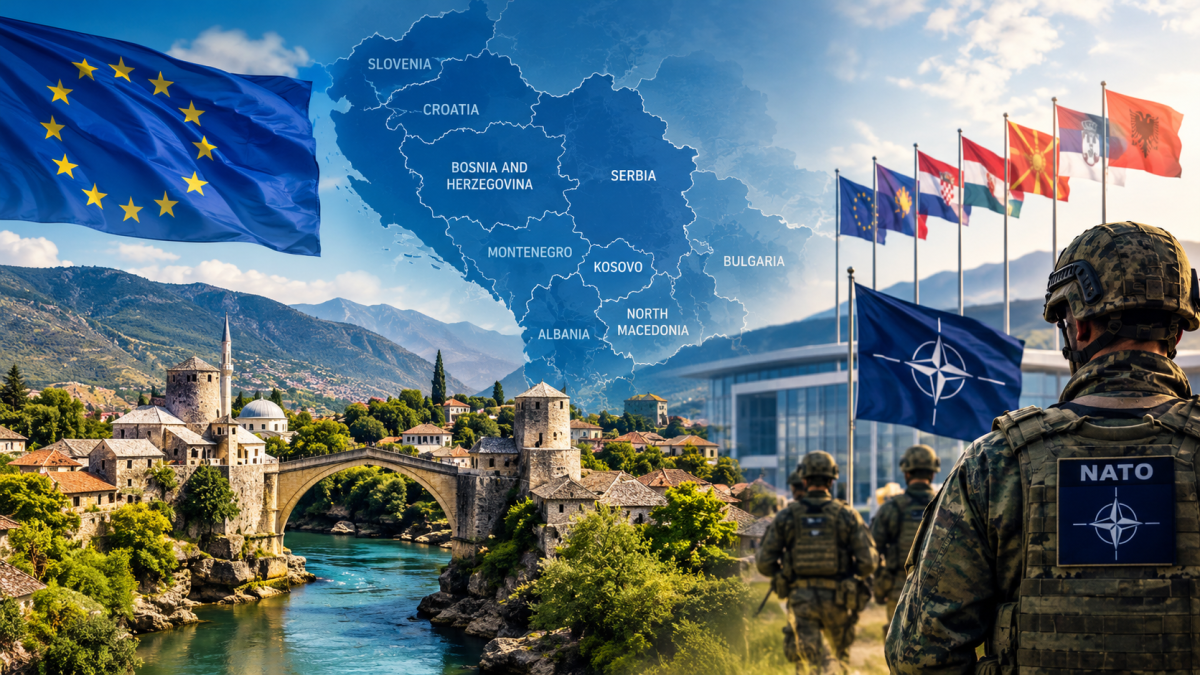
The Balkans and the Continuing Challenges of European Security
The Balkans remains an important region in European geopolitics, connecting Central Europe, the Mediterranean, and southeastern Europe. Its strategic location, complex history, unresolved political disputes, and relationships with major international powers continue to influence the continent’s security environment.
Although the wars of the 1990s transformed the region and led to extensive international peacebuilding efforts, several challenges remain. Disagreements between Serbia and Kosovo, political tensions in Bosnia and Herzegovina, and differing approaches to European integration continue to shape regional relations.
As the European Union (EU) and the North Atlantic Treaty Organization (NATO) work to maintain stability, the Balkans has become an important example of how regional disputes, international diplomacy, and great-power competition intersect in modern geopolitics.
1. The Strategic Importance of the Balkans
The Balkans occupies a significant geographical position between Central Europe, the Adriatic Sea, the Aegean Sea, and the Black Sea region. Its transport routes, energy connections, and proximity to important European markets give it strategic importance.
The region also connects several political and economic spheres. Developments in the Balkans can influence European security, migration routes, infrastructure projects, and relations between Western countries and external powers.
For the European Union, stability in the region is closely linked to its wider security interests. The EU remains the Western Balkans’ principal trading partner and a major source of investment and financial assistance.
2. The Legacy of the Yugoslav Wars
The breakup of Yugoslavia during the 1990s resulted in several armed conflicts, mass displacement, and serious humanitarian consequences. The wars reshaped borders and political institutions while leaving difficult questions concerning reconciliation, accountability, and relations between communities.
International agreements and peacebuilding initiatives helped establish new political arrangements, but the legacy of these conflicts continues to influence regional politics.
• Historical divisions: Memories of the conflicts continue to affect political debates, public attitudes, and relations between communities. Reconciliation and the protection of minority rights remain important for long-term stability.
• Political institutions: Some post-conflict arrangements are complex and can make decision-making difficult. Bosnia and Herzegovina, for example, operates under a constitutional structure established through the Dayton Peace Agreement.
• Regional cooperation: Governments must continue working together on economic development, cross-border infrastructure, organised crime, and other shared challenges.
The region's history demonstrates that peace agreements can end armed conflict, but lasting stability also requires effective institutions, economic opportunities, and sustained diplomatic engagement.
3. Serbia–Kosovo Relations and Regional Stability
Relations between Serbia and Kosovo remain one of the most significant security challenges in the Western Balkans. Kosovo declared independence in 2008, but Serbia does not recognise it as an independent state. International recognition of Kosovo remains divided.
Disagreements over governance, the position of Serb communities in Kosovo, and the implementation of agreements have periodically contributed to tensions.
• Diplomatic negotiations: The European Union facilitates dialogue between Belgrade and Pristina to address outstanding disputes and support the normalisation of relations.
• Security presence: NATO's Kosovo Force (KFOR) continues its peace-support mission under United Nations Security Council Resolution 1244 of 1999. Its responsibilities include contributing to a safe environment and freedom of movement for communities in Kosovo.
• Community rights: Protecting the rights and security of different communities is essential to reducing tensions and building confidence.
• International cooperation: Continued engagement by the EU, NATO, and other international partners can help prevent local disputes from escalating into wider regional crises.
A durable settlement will require sustained negotiations, implementation of existing commitments, and attention to the security concerns of all affected communities.
4. Bosnia and Herzegovina's Political Challenges
Bosnia and Herzegovina remains a central concern in discussions about Balkan stability. Its post-war political system was shaped by the Dayton Peace Agreement, which ended the Bosnian War in 1995 and established a complex framework for governance.
The country's institutional structure reflects the need to accommodate different communities, but it can also produce political deadlock and disagreements over the authority of state institutions.
• Constitutional complexity: The division of responsibilities among different levels of government can make reforms and policy implementation difficult.
• Political disagreements: Disputes over the country's constitutional order, institutional authority, and political direction can create uncertainty.
• International oversight: International actors continue to support the implementation of the peace settlement and the country's stability.
• Security cooperation: EUFOR Operation Althea and NATO's presence in Sarajevo contribute to international efforts to maintain a safe environment and support domestic institutions. NATO and EU military representatives reiterated their commitment to regional stability during a joint visit to Sarajevo and Pristina in April 2026.
The long-term objective is to strengthen accountable institutions, encourage political dialogue, and support a system capable of addressing disputes through established constitutional and democratic processes.
5. The European Union and the Enlargement Process
European Union membership remains an important objective for countries across the Western Balkans, although they differ in their accession progress and reform commitments.
The EU's enlargement policy seeks to encourage democratic governance, judicial independence, economic development, and alignment with European rules. Membership is not automatic; candidate countries must satisfy the relevant political, economic, and legal requirements.
• Institutional reforms: Governments seeking membership are expected to strengthen the rule of law, address corruption, and improve public administration.
• Economic integration: Closer connections with the EU's single market can support investment, trade, and economic convergence.
• Financial assistance: EU programmes provide support for infrastructure, institutional capacity, and socioeconomic development.
• Regional stability: The accession process creates incentives for cooperation and peaceful resolution of disputes.
The EU's Growth Plan for the Western Balkans is designed to deepen economic integration, advance reforms, and support socioeconomic convergence before full membership.
However, the process faces challenges, including domestic political disagreements, reform delays, bilateral disputes, and differing expectations about the pace of enlargement.
6. NATO and the Security Architecture of the Balkans
NATO remains an important actor in the Western Balkans through its membership relationships, security partnerships, and peace-support activities.
Albania, Montenegro, and North Macedonia are NATO members. Other countries in the region have different relationships with the Alliance, reflecting their security policies and political circumstances.
• Kosovo security: KFOR contributes to maintaining a safe and secure environment and works alongside other international and local security actors.
• Bosnia and Herzegovina: NATO supports defence-sector reforms and maintains a headquarters in Sarajevo, which also provides support to the EU-led EUFOR mission.
• Regional cooperation: NATO partnerships help participating countries improve defence institutions, professional standards, and cooperation with international partners.
• Crisis prevention: International security arrangements provide channels for communication and assistance during periods of heightened tension.
NATO and the EU have distinct mandates, but their activities in the Western Balkans can complement each other. Their cooperation is particularly visible through KFOR in Kosovo and EUFOR Althea in Bosnia and Herzegovina.
The effectiveness of this security framework depends not only on international deployments but also on political dialogue, local institutions, and respect for existing agreements.
7. Russia, China, and Other External Powers
The Western Balkans has attracted interest from several external powers because of its geographical location, economic opportunities, and political importance to European security.
Russia maintains historical, cultural, political, and economic ties in parts of the region, particularly with Serbia. China has expanded its economic engagement through infrastructure, trade, and investment. Turkey also maintains diplomatic, cultural, and commercial relationships with several Balkan countries.
• Russian influence: Moscow's relationships in the region are shaped by historical ties, energy links, diplomatic interests, and disagreements over European security.
• Chinese economic engagement: Chinese companies and financial institutions have participated in infrastructure and other investment projects. These relationships raise questions about financing, transparency, and long-term economic dependence.
• Turkish diplomacy: Ankara's regional relationships reflect historical connections, trade interests, cultural ties, and broader foreign-policy objectives.
• Western engagement: The EU and NATO remain central to the region's economic and security relationships, although individual countries pursue different foreign-policy strategies.
These relationships should not be treated as a single contest with identical dynamics in every country. Balkan governments make decisions based on their own domestic priorities, economic needs, and diplomatic interests.
The central challenge is to maintain foreign-policy independence, ensure transparent investment, and avoid allowing external competition to deepen existing regional divisions.
8. Energy Security and Strategic Infrastructure
Energy security has become an increasingly important part of European geopolitics. The Western Balkans depends on a mixture of domestic energy production, imported fuels, electricity networks, and cross-border infrastructure.
Disruptions to energy supplies or excessive dependence on a limited number of suppliers can create economic and political vulnerabilities.
• Diversification: Expanding supply options can reduce exposure to disruptions and improve energy security.
• Regional electricity connections: Stronger cross-border networks can improve reliability and allow countries to exchange electricity more efficiently.
• Renewable energy: Investment in solar, wind, and other low-carbon technologies can diversify energy systems and support environmental objectives.
• Transport infrastructure: Roads, railways, ports, and logistics networks connect the region to European markets and international trade routes.
Infrastructure projects can generate economic benefits, but they also require careful attention to financing, environmental standards, public accountability, and long-term maintenance.
Cooperation on energy and transport can therefore serve as both an economic development strategy and a practical contribution to regional stability.
9. Disinformation, Cybersecurity, and Political Resilience
Modern geopolitical competition extends beyond military deployments and diplomatic negotiations. Disinformation, cyber threats, political polarisation, and interference in public debate can also affect regional security.
The spread of misleading information can intensify existing disputes, undermine confidence in public institutions, and complicate diplomatic efforts.
• Media literacy: Helping citizens assess information sources can reduce the influence of misleading or manipulated content.
• Cybersecurity: Public institutions and essential services need effective measures to protect digital systems and sensitive information.
• Transparent communication: Timely, evidence-based public information can help prevent rumours from escalating during political crises.
• Institutional trust: Independent journalism, accountable government, and effective public services can strengthen resilience against manipulation.
These challenges cannot be addressed through security measures alone. Education, independent institutions, public accountability, and responsible political communication are also important components of a resilient society.
10. The Future of European Security in the Balkans
The future of the Balkans will depend on how regional governments manage political disagreements, pursue economic development, and cooperate with European and international institutions.
EU enlargement could strengthen economic links and encourage reforms, while NATO partnerships and peace-support missions can contribute to security. However, external assistance cannot replace domestic political responsibility or meaningful reconciliation.
Several priorities will shape the region's future:
• Peaceful dispute resolution: Governments should prioritise negotiations and established diplomatic mechanisms over confrontational rhetoric.
• Stronger institutions: Independent courts, accountable public administration, and protection of fundamental rights are essential for stable governance.
• Economic opportunity: Investment, education, infrastructure, and employment can help address socioeconomic pressures and encourage regional cooperation.
• European integration: Credible reforms and consistent accession criteria can strengthen confidence in the EU enlargement process.
• Regional dialogue: Cooperation among neighbouring countries can improve trade, infrastructure, border management, and responses to shared security challenges.
The region's security outlook will remain connected to developments across Europe and the wider international system. Progress is possible, but it will require sustained commitment from both local governments and international partners.
Conclusion
The Balkans remains an important test of Europe's ability to manage unresolved disputes, strengthen democratic institutions, and maintain peace in a region shaped by a difficult history. Serbia–Kosovo relations, political tensions in Bosnia and Herzegovina, energy dependence, and competition among external powers continue to influence regional security.
The EU and NATO play significant roles through diplomacy, economic integration, security partnerships, and peace-support missions. Yet lasting stability ultimately depends on the choices of regional governments and their willingness to protect minority rights, uphold the rule of law, and resolve disagreements peacefully.
A secure and prosperous Balkans would contribute to a more stable Europe. Achieving that goal requires consistent diplomacy, credible reforms, responsible international engagement, and cooperation that places the long-term interests of the region's people at the centre of policymaking.
Sources and Further Reading
1. NATO — "NATO's Role in Kosovo" (https://www.nato.int/en/what-we-do/operations-and-missions/natos-role-in-kosovo)
2. European Council — "Western Balkans" (https://www.consilium.europa.eu/en/topics/western-balkans/)
3. European Commission — "Growth Plan for the Western Balkans" (https://enlargement.ec.europa.eu/enlargement-policy/growth-plan-western-balkans_en)
4. European External Action Service — "EU and NATO Commit to Stability in the Western Balkans" (https://www.eeas.europa.eu/eeas/chairs-eu-and-nato-military-committees-reaffirm-commitment-stability-western-balkans_en)
5. European Parliament Research Service — "EU Enlargement and Security and Defence" (https://eprs.europarl.europa.eu/cms/render/live/en/sites/eprsweb/contents/publications/EPRS/2026/09/EPRS_BRI%282026%29774737.html)
Join the Conversation