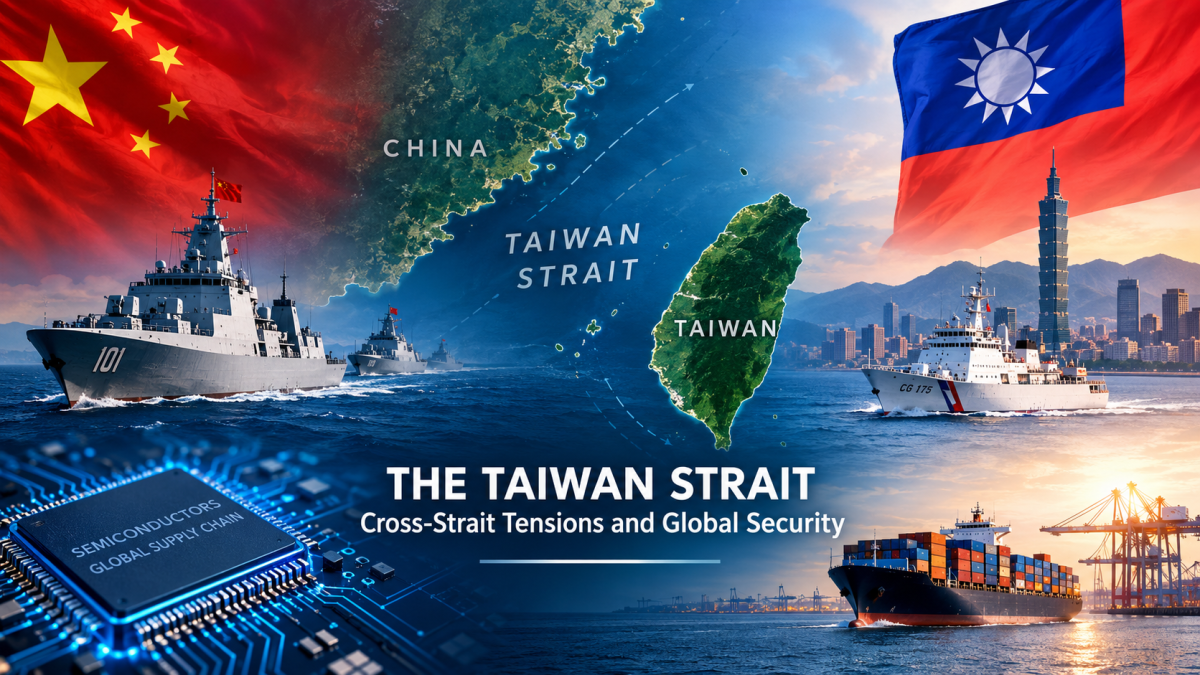
Taiwan Strait Tensions: Why Global Security Is at Stake
Analysis | International Relations | Indo-Pacific
The Taiwan Strait has emerged as one of the most sensitive geopolitical flashpoints in the world. Separating Taiwan from mainland China, this narrow stretch of water sits at the intersection of competing territorial claims, military strategy, global trade and the semiconductor industry. Any serious escalation in the region could extend far beyond East Asia, affecting international markets, technological supply chains and the security calculations of major powers.
Tensions across the strait reflect a fundamental disagreement over Taiwan’s political future. Beijing considers the island part of China and has not ruled out using force to achieve reunification. Taiwan, meanwhile, maintains its own elected government, institutions and armed forces. The United States and other regional powers have important interests in preventing the dispute from escalating into a wider conflict.
Understanding the Taiwan Strait therefore requires looking beyond military manoeuvres. Its future will also depend on diplomacy, political decisions, economic interdependence and the willingness of the parties to manage their differences peacefully.
Why the Taiwan Strait Matters
The Taiwan Strait is more than a geographical boundary. Its location places it close to major East Asian industrial centres and maritime routes linking regional economies with international markets. Instability in the area could affect shipping, manufacturing, investment and the movement of essential goods.
Three interconnected factors make the strait particularly important.
Geography and maritime security: The strait lies between Taiwan and China’s southeastern coast. Its proximity to important commercial routes means that military confrontation, shipping restrictions or heightened security precautions could disrupt maritime activity across the region.
Technology and semiconductors: Taiwan is a major centre of semiconductor manufacturing, an industry essential to modern computing, artificial intelligence, telecommunications, vehicles and consumer electronics. Disruption to production could affect businesses far beyond Asia.
Strategic competition: The region is central to the security policies of China and the United States. It also matters to Japan, the Philippines, South Korea, Australia and other countries concerned about regional stability and the wider balance of power.
These factors reinforce one another. A military crisis could interrupt trade and technology production, while economic uncertainty could increase political pressure on governments already facing difficult security decisions.
Historical Background: How Cross-Strait Divisions Emerged
The roots of the present situation lie in the final stages of the Chinese Civil War.
In 1949, after the Communist Party established the People’s Republic of China on the mainland, the Republic of China government relocated to Taiwan. Since then, Taiwan and mainland China have been governed separately, developing distinct political institutions and systems of government.
Over subsequent decades, Taiwan moved from authoritarian rule towards a competitive democracy. Today, its political leadership is elected, and its government manages the island’s domestic administration, military and economic affairs independently of Beijing.
The People’s Republic of China, established in 1949, has never governed Taiwan. Nevertheless, Beijing maintains that Taiwan is part of China and considers reunification a national objective. It opposes formal Taiwanese independence and has retained the option of using force.
Taiwan’s political parties and population hold differing views about the island’s long-term relationship with mainland China. While views vary over the preferred future arrangement, Taiwan’s existing self-government is central to the political reality of the dispute.
International diplomacy adds another layer of complexity. Most countries maintain formal diplomatic relations with Beijing rather than Taipei, while many also maintain substantial unofficial economic, cultural and other ties with Taiwan.
The result is a longstanding political divide that cannot be understood through competing territorial claims alone. It also involves democratic self-government, questions of identity, national security and sharply different understandings of Taiwan’s future.
China’s Position and Taiwan’s Self-Government
Beijing presents Taiwan as an unresolved issue of sovereignty and national reunification. Chinese leaders argue that the island’s separation is a consequence of history and that reunification is necessary to protect China’s territorial integrity.
China has not renounced the use of force. Its government also objects to foreign military support for Taiwan and to international interactions that it considers an attempt to treat the island as an independent state.
Taiwan, by contrast, has its own elected leadership, administration, armed forces, currency and economic institutions. The government in Taipei does not operate under the authority of the People’s Republic of China.
This difference between Beijing’s sovereignty claim and Taiwan’s practical self-government is at the centre of cross-strait tensions.
The United States and many other governments have developed diplomatic arrangements designed to manage this disagreement without triggering a confrontation. Their policies are not identical, and formal diplomatic recognition of Beijing does not mean that every country interprets Taiwan’s political status in precisely the same way.
For policymakers, the difficulty is finding ways to maintain stability without forcing a resolution through coercion. Beijing seeks progress towards reunification, while Taiwan’s political future remains a matter of intense domestic debate. These competing interests leave limited room for a comprehensive political settlement.
The United States and the Balance of Power
The United States occupies a central position in the Taiwan Strait security equation. Its relationship with Taiwan combines unofficial diplomatic engagement, economic cooperation and support for Taiwan’s defensive capabilities. Washington also maintains formal diplomatic relations with the People’s Republic of China.
US policy is shaped in part by the Taiwan Relations Act, which provides a framework for unofficial relations and support for Taiwan’s ability to maintain a sufficient self-defence capability. The law also establishes a US interest in resisting force or other forms of coercion that could jeopardise Taiwan’s security or social and economic system.
However, the United States does not maintain a conventional mutual-defence treaty with Taiwan. Its approach has long involved strategic ambiguity: Washington seeks to discourage an attack on Taiwan without making an unconditional public commitment to intervene militarily in every possible scenario.
This strategy is intended to influence decisions on both sides. Support for Taiwan’s defensive capabilities is meant to raise the potential cost of coercion, while diplomatic communication and carefully managed policy statements seek to reduce the likelihood of an unnecessary confrontation.
Beijing views US military assistance and closer engagement with Taiwan as interference in its internal affairs. Washington, on the other hand, argues that preventing coercion and preserving regional stability are important international interests.
This creates a difficult balancing act. Excessive pressure could increase the risk of conflict, but an inability to deter the use of force could also undermine regional confidence in existing security arrangements.
Effective diplomacy must complement deterrence by maintaining communication, clarifying intentions and encouraging peaceful management of cross-strait differences.
Military Activity and the Risk of Miscalculation
Military pressure around Taiwan is a major concern because tensions can increase without a formal declaration of war.
Military exercises, aircraft operations, naval deployments and coast guard missions can serve different purposes, including training, surveillance, deterrence and political signalling. Yet when such activities become more frequent or take place near sensitive areas, the possibility of an accident or misinterpretation increases.
One particularly challenging aspect is the use of so-called grey-zone tactics. These involve pressure that falls below the threshold of conventional armed conflict but can gradually alter the security environment. Such activities may involve coast guard vessels, maritime militia, surveillance operations, economic pressure or other forms of coercion.
Taiwan has repeatedly expressed concern about Chinese military and maritime activity near the island. Taipei regards such operations as a growing security challenge, while Beijing maintains that its actions are lawful and linked to its sovereignty claims.
These competing interpretations make the situation difficult to manage. Activities intended as demonstrations of resolve or routine operations can be interpreted by the other side as preparations for escalation.
A serious incident at sea or in the air could quickly become a diplomatic crisis, particularly if governments face domestic pressure to respond firmly. Even if no party initially intends to start a war, limited communication and uncertainty about the other side’s intentions can make escalation harder to control.
Reducing this risk requires functioning communication channels, clear procedures for encounters between military and maritime law-enforcement vessels, and reliable methods for investigating incidents before they become wider confrontations.
Taiwan’s Semiconductors and the Global Economy
Taiwan’s strategic importance extends far beyond its geographical position. Its semiconductor industry plays a significant role in the global technology economy, linking the island to manufacturers, technology companies and consumers across multiple continents.
Semiconductors are essential to smartphones, computers, data centres, telecommunications networks, vehicles and industrial equipment. Advanced chips are also increasingly important to artificial intelligence and high-performance computing.
Taiwan Semiconductor Manufacturing Company (TSMC), headquartered in Taiwan, is one of the world’s leading dedicated semiconductor foundries. Its advanced manufacturing capabilities make the island an important part of the global technology supply chain.
A major crisis in the Taiwan Strait could affect this industrial network through several channels.
Production disruption: Military activity, infrastructure damage, workforce displacement or interruptions to electricity and transport could affect semiconductor manufacturing.
Shipping and logistics: Heightened security risks could complicate the transportation of components, equipment and finished products, increasing costs and delivery times.
Business and financial uncertainty: Investors and manufacturers could reassess their exposure to the region, while businesses dependent on reliable component supplies might face higher costs or production delays.
Pressure on technology supply chains: Disruptions affecting key manufacturers could spread to industries that depend on advanced chips, from consumer electronics and automotive production to cloud computing and artificial intelligence.
The economic consequences would depend on the scale and duration of a crisis, the availability of alternative capacity and the ability of businesses to adjust their operations. They should not be treated as predetermined outcomes, but the interconnected nature of semiconductor production means that the potential risks are substantial.
Governments and companies have been pursuing greater supply-chain resilience by investing in semiconductor manufacturing in additional locations and reassessing dependence on individual production centres. These efforts can reduce certain vulnerabilities, but they cannot provide an immediate replacement for every specialised manufacturing capability concentrated in Taiwan.
Building advanced fabrication facilities requires significant investment, specialised equipment, technical expertise and time. Additional capacity can reduce dependence on a single location, but it cannot quickly eliminate all the risks associated with a disruption in Taiwan.
The economic case for stability is therefore strong. Preventing conflict would protect not only regional commerce but also the continuity of technological production on which many economies depend.
Regional Security: Why Japan, the Philippines and Other Countries Are Concerned
The Taiwan Strait dispute affects countries far beyond the two sides directly involved.
Japan has important security and economic interests in the surrounding region. A major conflict near Taiwan could create serious challenges for maritime activity, regional defence planning and the security of nearby Japanese territory.
The Philippines is geographically close to Taiwan, making developments around the island relevant to its maritime security, emergency planning and wider regional relationships.
South Korea has substantial trade and technology connections across East Asia and must consider the consequences of regional instability for its economy and security. Australia also has an interest in maintaining an Indo-Pacific environment in which maritime routes remain secure and disputes are managed peacefully.
These countries do not necessarily share identical priorities or approaches towards Beijing and Taipei. Their economic relationships with China, domestic political considerations and security arrangements differ. Nevertheless, instability around Taiwan could affect each of them through different combinations of trade disruption, military risk and diplomatic pressure.
Developments around Taiwan also influence discussions among regional partners. Governments may increase diplomatic consultations, review emergency planning or strengthen coordination when tensions rise.
At the same time, regional countries must balance security concerns with their economic relationships. China remains an important trading partner for many economies, making a major confrontation potentially costly for the entire region.
For the wider Indo-Pacific, the challenge is to strengthen communication and preparedness without creating a cycle in which each security measure is interpreted by others as a reason to escalate.
Global Trade and Supply-Chain Resilience
The Taiwan Strait’s importance to global trade is closely linked to the broader network of maritime routes, ports, manufacturing centres and technology suppliers across East Asia.
A serious security crisis could prompt shipping companies to reconsider routes, increase insurance costs and delay deliveries. Manufacturers might experience shortages of essential components, while businesses could face uncertainty over investment, transportation and production schedules.
Financial markets could also respond to heightened geopolitical risk. The extent of any disruption would depend on the nature of the crisis, the duration of restrictions and the reactions of governments and businesses.
These risks demonstrate why supply-chain resilience matters. Companies can diversify suppliers, maintain inventories of essential components and develop alternative logistics arrangements. Governments can encourage investment in additional production capacity and improve coordination with international partners.
Yet resilience should not be confused with complete economic separation. Modern manufacturing depends on specialised skills, cross-border investment and highly interconnected production networks. Attempting to eliminate every international dependency could increase costs without removing all risks.
A more practical strategy combines diversified supply chains with continued economic engagement and contingency planning. These measures can help businesses withstand disruptions while preserving the benefits of international trade.
Ultimately, economic preparedness can reduce the damage caused by a crisis, but it cannot substitute for preventing one.
Diplomacy: The Most Important Path to Preventing Conflict
The political and security differences across the Taiwan Strait are deep-rooted. A comprehensive settlement may remain difficult because the parties disagree over sovereignty, political identity, security and the island’s future.
Nevertheless, conflict prevention does not require all disputed issues to be resolved immediately.
The first priority is maintaining effective communication. Regular official contacts, diplomatic exchanges and crisis-management mechanisms can help governments clarify intentions and respond to incidents before misunderstandings develop into larger confrontations.
Second, practical arrangements for maritime and aerial encounters could reduce the possibility of accidents. Agreed procedures for communication, incident reporting and emergency responses would be particularly valuable during periods of heightened military activity.
Third, all parties have an interest in avoiding actions that sharply increase tensions or attempt to impose a political outcome through force or coercion. Clear communication about policies and intentions can help reduce uncertainty, although it cannot eliminate every strategic disagreement.
Finally, regional and international partners can encourage peaceful engagement while supporting measures that improve regional stability. Their role is most constructive when diplomatic pressure is accompanied by clear communication and a genuine effort to prevent escalation.
The United States has a particularly important responsibility to manage its relationships with both Beijing and Taipei carefully. At the same time, direct communication between the two sides across the strait remains essential. External diplomacy can support the process, but it cannot replace meaningful engagement between the parties themselves.
A durable peace would depend on whether political leaders can manage competing interests without allowing strategic rivalry to overwhelm the incentives for stability.
Conclusion: The Future of the Taiwan Strait Will Shape Global Security
The Taiwan Strait has become a defining challenge for international security because it brings together political sovereignty, military competition, regional diplomacy and the economic importance of advanced technology. The dispute between Beijing and Taipei has consequences that extend well beyond the island, involving the strategic calculations of the United States and the security interests of neighbouring countries.
A serious crisis could disrupt maritime commerce, place global semiconductor supply chains under pressure and increase the risk of confrontation among major powers. The scale of those consequences would depend on how events unfolded, but the potential costs make conflict prevention an international priority.
At the same time, treating war as inevitable would overlook the importance of diplomatic choices. Military preparedness, economic resilience and international partnerships can contribute to deterrence, but they must be accompanied by communication, restraint and practical measures to prevent incidents from escalating.
The central challenge is not simply how governments prepare for a possible conflict. It is whether they can preserve a political environment in which the use of force remains avoidable and disagreements can be managed peacefully.
The future of the Taiwan Strait will depend on the decisions made in Beijing, Taipei, Washington and other regional capitals. Sustained diplomacy, respect for peaceful dispute resolution and efforts to prevent unilateral changes through coercion offer the strongest basis for protecting regional stability and the wider global economy.
Sources and Further Reading
-
Council on Foreign Relations (CFR)
Background on China–Taiwan relations and US policy:
https://www.cfr.org/backgrounders/china-taiwan-relations-tension-us-policy-trump -
Reuters
Reporting on Taiwan’s concerns about Chinese maritime militia and coast guard activity:
https://www.reuters.com/world/china/taiwan-says-china-using-militia-boats-expand-battlefield-preparation-western-2026-10-23/ -
Brookings Institution
Analysis of diplomacy and US management of cross-strait relations:
https://www.brookings.edu/articles/the-role-of-diplomacy-in-us-management-of-cross-strait-relations/ -
Taiwan Ministry of Foreign Affairs
Official information and statements on Taiwan Strait peace and stability:
https://en.mofa.gov.tw/ -
Taiwan Semiconductor Manufacturing Company (TSMC)
Corporate information and annual reports on semiconductor manufacturing and global operations:
https://investor.tsmc.com/english/annual-reports
Join the Conversation