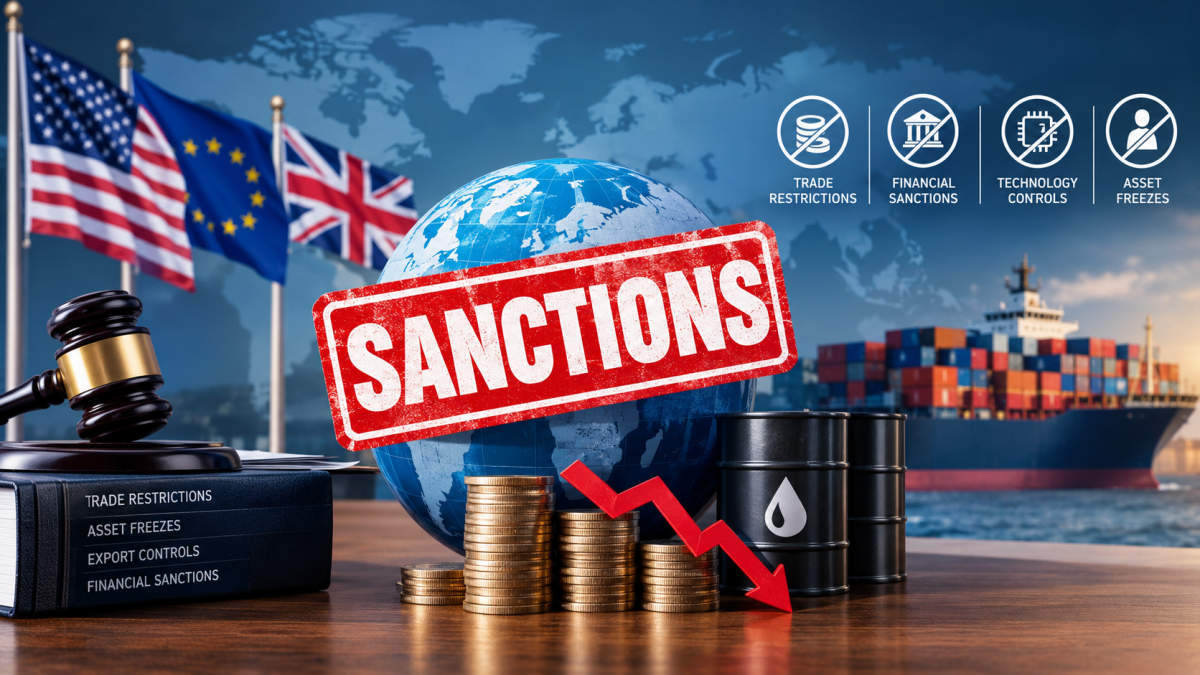
Economic Sanctions: Do They Achieve Their Geopolitical Objectives?
Date: October 25, 2026
Category: Geopolitics and International Relations
Introduction: The Strategic Use of Economic Power
Economic sanctions have become a prominent instrument of contemporary international relations, enabling governments to exert pressure on other states without immediately resorting to military intervention. Through restrictions on international trade, financial transactions, investment, technology transfers, and access to global markets, governments seek to influence political decisions, deter security threats, and defend their strategic interests.
The United States, the European Union, the United Kingdom, and the United Nations have employed sanctions in response to military aggression, nuclear proliferation, human rights violations, and other international security concerns. Their increasing use reflects the growing importance of economic interdependence as a source of both national vulnerability and geopolitical leverage.
However, the effectiveness of economic sanctions remains contested. Supporters consider them an important alternative to military force, capable of imposing financial costs and creating incentives for diplomatic negotiations. Critics argue that sanctions frequently fail to achieve their stated political objectives, encourage targeted governments to develop alternative economic partnerships, and impose significant costs on civilian populations.
Consequently, evaluating economic sanctions requires more than examining their immediate economic impact. Their effectiveness must also be assessed in terms of political outcomes, diplomatic progress, enforcement challenges, and humanitarian consequences.
1. Understanding Economic Sanctions and Their Strategic Objectives
Economic sanctions encompass a range of restrictive measures designed to limit the economic activities of a country, government institution, business, or individual. Their scope and intensity vary according to the objectives of the governments imposing them.
• Financial restrictions: These include freezing designated assets, restricting access to international financial markets, and prohibiting transactions involving specified individuals, institutions, or organisations.
• Trade restrictions: Governments may prohibit the export or import of particular goods, impose sector-specific restrictions, or limit commercial relations with targeted entities.
• Technology and export controls: Restrictions on advanced semiconductors, industrial machinery, aerospace components, and other strategically important technologies can limit access to products relevant to military or industrial development.
• Targeted sanctions: These measures focus on particular officials, businesses, or organisations rather than restricting an entire national economy.
The objectives may include deterring military aggression, limiting nuclear proliferation, disrupting the financing of prohibited activities, and encouraging governments to reconsider disputed policies.
Nevertheless, imposing economic restrictions does not automatically produce political change. A targeted government may experience significant financial difficulties while maintaining the policies that prompted the sanctions. Distinguishing economic pressure from demonstrable political outcomes is therefore essential to any credible assessment.
2. The Strategic Case for Economic Sanctions
A. Restricting Access to Critical Technologies and Resources
One of the principal arguments supporting sanctions is their capacity to restrict access to financial resources, advanced technologies, international investment, and strategically important industrial components.
Export controls, in particular, may increase procurement costs, complicate supply chains, and constrain the development or maintenance of sophisticated military systems. Even when restrictions are circumvented, obtaining alternative supplies may require additional expenditure and create operational difficulties.
A September 2025 assessment by the US Government Accountability Office examined sanctions and export controls imposed on Russia following its full-scale invasion of Ukraine. The report found that export restrictions had hindered Russia's access to important technologies, although they had not completely prevented such access. It also identified shortcomings in measuring the effectiveness of these measures.
The strategic implication is that sanctions may constrain a country's capabilities without necessarily compelling an immediate change in its political behaviour.
Read more: "U.S. Government Accountability Office — Russia Sanctions and Export Controls" (https://reference-url-citation.invalid/0)
B. Creating Leverage for Diplomatic Negotiations
Economic sanctions can also provide governments with leverage during international negotiations. When restrictions impose substantial costs, the prospect of sanctions relief may create incentives for targeted governments to negotiate or reconsider particular policies.
However, the effectiveness of this approach depends on several factors: the severity of the economic pressure, the importance of the disputed issue, the targeted government's political calculations, and the credibility of any offer to remove restrictions.
Sanctions are more likely to contribute to diplomatic progress when their objectives are clearly defined and the conditions for relief are communicated consistently.
Conversely, if the targeted government believes that sanctions will remain regardless of its actions, the incentive to negotiate may weaken. Economic pressure therefore needs to be assessed alongside diplomatic strategy rather than treated as an independent solution.
C. Demonstrating International Opposition
Coordinated sanctions can communicate collective opposition to actions considered contrary to international security or established legal obligations.
When several major economies participate, restrictions may become more difficult to circumvent because targeted entities face fewer alternative markets and financial channels. International coordination can also strengthen the credibility of diplomatic pressure.
Nevertheless, differences among participating countries can undermine implementation. Governments may disagree over the objectives, economic costs, or appropriate duration of restrictions, creating opportunities for sanctions evasion.
3. The Limitations: Why Economic Pressure Does Not Always Deliver Political Change ?
A. Economic Adaptation and Sanctions Evasion
Governments facing sanctions frequently attempt to reduce their exposure by developing alternative supply chains, expanding domestic production, redirecting exports, and establishing commercial relationships with countries that do not participate in the restrictions.
Such adjustments do not necessarily eliminate the costs of sanctions. They may instead increase transaction expenses, reduce efficiency, and create dependence on a narrower group of trading partners. However, they can weaken the intended pressure over time.
A September 2025 study published in the Journal of Public Economics examined Ukraine's economic blockade of the coal-producing Donbas region. The research found that trade rerouting through Russia undermined the blockade's effectiveness and created opportunities for intermediaries.
The findings illustrate a broader challenge: restrictions may fail to achieve their objectives when alternative trading routes remain accessible and enforcement is difficult.
Read more: "Journal of Public Economics — Research on Economic Blockades" (https://reference-url-citation.invalid/1)
B. Domestic Political Resistance
Economic hardship does not automatically translate into public opposition to a targeted government or changes in state policy.
Political leaders may portray sanctions as external interference and use them to reinforce nationalist narratives. They may also shift responsibility for deteriorating economic conditions towards foreign governments.
The political consequences depend on domestic institutions, public perceptions, the distribution of economic costs, and the government's capacity to manage shortages or redirect resources.
Consequently, policymakers cannot assume that increasing economic pressure will necessarily produce greater political concessions. In some circumstances, sustained restrictions may instead deepen hostility between the countries involved.
C. Unclear Objectives and Difficulties in Measuring Success
Sanctions are frequently imposed to achieve several objectives simultaneously, including deterring aggression, restricting military capabilities, encouraging negotiations, and promoting political reform.
These objectives require different indicators of success. Restrictions might reduce access to advanced technology without changing military policy. They might also encourage negotiations without securing a lasting agreement.
Without measurable targets, governments risk evaluating sanctions according to their economic severity rather than their political effectiveness.
A credible assessment should therefore establish the intended outcomes, examine evidence of progress, and consider whether the costs of continuing the measures remain proportionate to their objectives.
4. Case Study: Western Sanctions Against Russia
Following Russia's full-scale invasion of Ukraine in February 2022, the United States, the European Union, the United Kingdom, and other partners introduced extensive financial restrictions, asset freezes, trade measures, and export controls.
These measures sought to increase the economic costs of the invasion, restrict access to strategically important technologies, and constrain resources available to Russia.
The results illustrate both the potential and the limitations of economic sanctions.
The US Government Accountability Office reported in September 2025 that Russia had taken steps to mitigate sanctions-related effects and that its economy had recovered somewhat following an initial decline after the invasion. The assessment also found that restrictions had hindered, but had not eliminated, Russian access to critical technologies.
These findings demonstrate that economic resilience and sanctions-related constraints can coexist. A country may continue conducting substantial economic activity while facing additional procurement costs, technological difficulties, and restrictions affecting particular sectors.
At the same time, the continuation of the war illustrates the limitations of relying on economic pressure alone to achieve a major geopolitical objective.
The Russian case therefore highlights the importance of distinguishing between imposing economic costs, constraining strategic capabilities, and changing a government's political decisions. These are related but separate outcomes.
5. Case Study: Iran and the Challenges of Nuclear Diplomacy
Iran provides another important example of the relationship between economic sanctions and geopolitical objectives.
International restrictions affecting Iran have included measures targeting financial transactions, energy exports, investment, and access to international markets. Governments imposing these restrictions have sought to address concerns surrounding Iran's nuclear programme and other regional security issues.
Supporters argue that sanctions can constrain available resources and create incentives for negotiations. Critics question whether sustained economic pressure can secure durable political concessions, particularly when targeted governments develop alternative economic relationships or interpret restrictions as evidence of continuing hostility.
The humanitarian implications are also significant. Financial restrictions and uncertainty surrounding compliance can complicate otherwise permitted transactions involving essential goods.
Research examining Iran's wheat supply chain has highlighted how sanctions-related financial barriers, commercial risk aversion, and supply-chain disruption can affect humanitarian trade even when formal exemptions exist.
The Iranian experience demonstrates why economic impact should not be confused with diplomatic success. Assessing sanctions requires examining whether restrictions contribute to measurable changes in the targeted policies, whether negotiations make progress, and whether the arrangements produce sustainable outcomes.
6. Humanitarian Consequences: The Costs Beyond Government Institutions
A central criticism of economic sanctions concerns their potential impact on ordinary citizens.
Although sanctions may formally target governments, financial institutions, or strategic industries, their broader economic effects can influence employment, household purchasing power, access to imported goods, and the availability of essential services.
Restrictions affecting international payments can also make it more difficult for businesses and humanitarian organisations to complete transactions, even when those transactions are legally permitted.
A review published in the Journal of Economic Studies in 2024 examined 31 studies investigating the effects of sanctions on living standards. The author reported that 30 studies identified negative effects on outcomes such as income, poverty, inequality, mortality, or human rights.
These findings underline the importance of examining the distribution of sanctions-related costs rather than focusing exclusively on their effects on governments.
Humanitarian exemptions are intended to protect access to food, medicine, and other essential supplies. However, exemptions do not always eliminate practical difficulties arising from payment restrictions, uncertainty about compliance, or the reluctance of financial institutions to process transactions.
The challenge for policymakers is to ensure that measures designed to influence political decisions do not impose disproportionate costs on people who have little influence over those decisions.
7. Improving Sanctions Policy: Accountability, Coordination and Diplomacy
The effectiveness of economic sanctions depends not only on their severity but also on their design, implementation, and relationship with broader diplomatic objectives.
First, establish measurable objectives: Governments should define the political outcomes they seek and identify indicators for assessing progress.
Second, strengthen international coordination: Consistent enforcement among participating countries can reduce opportunities for evasion and improve the credibility of restrictions.
Third, protect humanitarian transactions: Clear exemptions, reliable payment mechanisms, and practical compliance guidance can help maintain access to essential goods.
Fourth, preserve diplomatic channels: Negotiations can clarify the conditions for sanctions relief and establish pathways towards resolving international disputes.
Fifth, review effectiveness regularly: Governments should assess economic effects, political developments, enforcement costs, and humanitarian consequences. Restrictions that fail to advance their objectives should be reconsidered rather than maintained solely because they have already been imposed.
These measures cannot guarantee success. They can, however, improve accountability and help governments determine whether sanctions are contributing to meaningful political outcomes.
Conclusion: Economic Pressure Is a Tool, Not a Guarantee
Economic sanctions remain an important instrument of contemporary geopolitics, providing governments with a means of exerting pressure without immediately resorting to military intervention. They can restrict access to financial resources, advanced technologies, and international markets while signalling opposition to disputed policies.
Nevertheless, their effectiveness varies according to political circumstances, international cooperation, enforcement capacity, and the ability of targeted governments to adapt. The experiences of Russia and Iran demonstrate that sanctions can impose economic constraints without necessarily producing the political outcomes sought by the governments imposing them.
Humanitarian consequences further complicate the assessment. Restrictions intended to influence political leaders may also affect ordinary citizens, businesses, and humanitarian organisations, particularly when financial uncertainty obstructs permitted transactions.
Ultimately, sanctions should not be judged solely by the economic damage they inflict. Their effectiveness must be evaluated against clearly defined political objectives, measurable changes in behaviour, diplomatic progress, and the protection of civilian populations.
The central question is not simply whether economic sanctions impose costs, but whether those costs produce meaningful geopolitical results—and whether those results justify the economic and humanitarian consequences.
Sources and Further Reading
1. https://www.annualreviews.org/content/journals/10.1146/annurev-economics-081623-020909
2. https://www.annualreviews.org/content/journals/10.1146/annurev-polisci-041322-032240
3. https://www.gao.gov/products/gao-25-107079
4. https://www.hrw.org/report/2019/10/29/maximum-pressure/us-economic-sanctions-harm-iranians-right-health
5. https://cepr.org/publications/dp20022
Join the Conversation