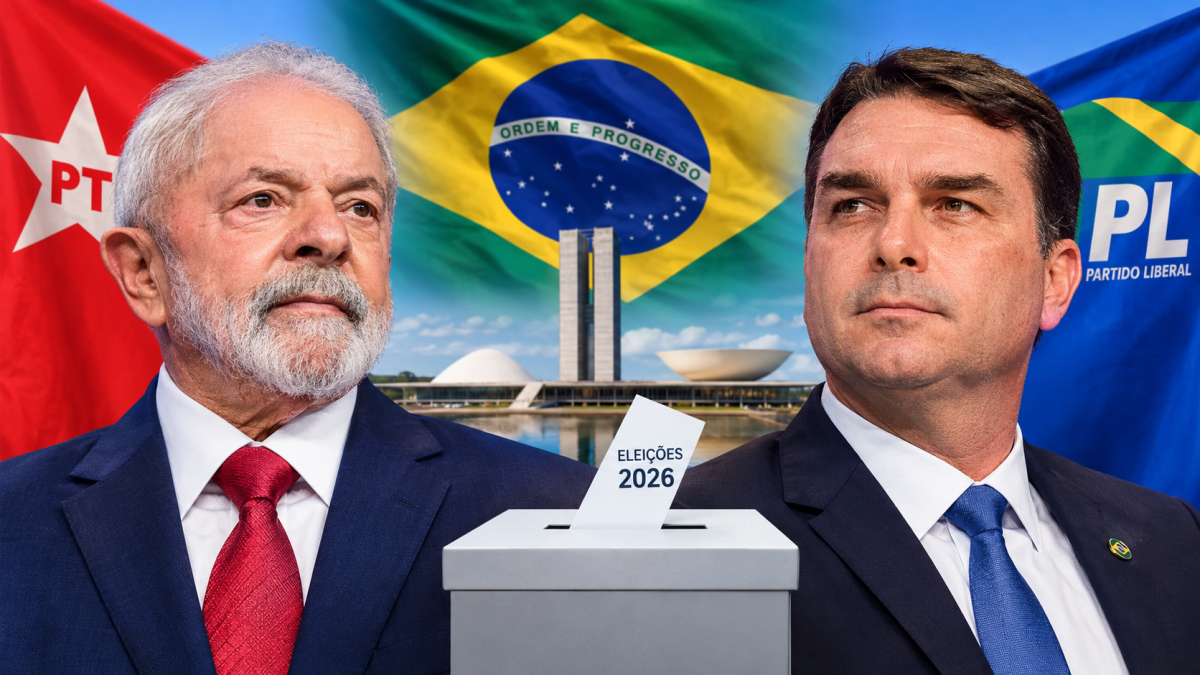
Brazil’s Defining Choice: Lula vs. Flávio Bolsonaro in a Polarized Runoff
Brasília, October 25, 2026: Brazil is holding a closely contested presidential runoff between incumbent President Luiz Inácio Lula da Silva of the Workers’ Party (PT) and Senator Flávio Bolsonaro of the Liberal Party (PL). The election will help determine the political direction of Latin America’s largest economy, with significant implications for its domestic policies, international partnerships, and democratic institutions.
Neither candidate secured an outright majority in the first round on October 4, sending the contest to a decisive second round. The campaign has highlighted deep divisions over economic management, public security, social welfare, environmental protection, and Brazil’s position in an increasingly complex international environment.
1. From First Round to Runoff
The first-round results demonstrated the strength of both candidates and the continuing polarisation of Brazilian politics. Flávio Bolsonaro finished ahead of Lula, but neither secured the majority of valid votes required to win the presidency outright.
According to Brazil’s official election schedule, the second round is taking place on October 25. The contest is expected to attract close attention from voters, political analysts, businesses, and international observers because the result could influence Brazil’s economic priorities and foreign relations.
First-Round Results
Flávio Bolsonaro received approximately 47.03% of valid votes, equivalent to about 56.1 million ballots. Lula followed with 45.16%, or approximately 53.9 million votes.
The remaining candidates divided the votes among several political groups, leaving both finalists with the task of attracting undecided voters and supporters of eliminated candidates.
The runoff has therefore become a contest not only between two political figures but also between competing approaches to economic management, social policy, public security, and international relations.
The Importance of Voter Turnout
Brazil has approximately 159 million registered voters. Voting is compulsory for most citizens aged 18 to 70, although exceptions apply.
Turnout, regional voting patterns, and the ability of each campaign to mobilise its supporters could prove decisive. The final outcome will depend on the valid votes cast nationwide rather than on an electoral-college system.
2. The Presidential Candidates
The runoff presents voters with two candidates whose political backgrounds and policy priorities differ substantially. Lula represents the Workers’ Party’s centre-left political tradition, while Flávio Bolsonaro draws support from conservative voters and those aligned with his father’s political movement.
Luiz Inácio Lula da Silva
Lula, 80, is seeking another presidential term after previously serving as president from 2003 to 2010 and returning to office in 2023.
A former metalworker and trade-union leader, he built his political career around social welfare, workers’ rights, and reducing poverty. His current political agenda emphasises social programmes, environmental protection, and Brazil’s role in international organisations and the Global South.
Supporters credit his political movement with advancing social inclusion and expanding assistance to lower-income households. Critics, however, raise concerns about fiscal policy, public security, governance, and corruption controversies associated with Brazilian politics.
Lula’s campaign has sought to present continuity in social policy and international diplomacy as central reasons for voters to support another term.
Flávio Bolsonaro
Flávio Bolsonaro is a senator representing Rio de Janeiro and the eldest son of former president Jair Bolsonaro. His campaign draws on a conservative political movement that emphasises public security, traditional values, fiscal restraint, and a reduced role for the state in parts of the economy.
He has attempted to appeal to voters seeking a change in government while maintaining support among those who identify with his father's political legacy.
His candidacy also faces scrutiny because of controversies associated with the Bolsonaro political family and concerns raised by opponents about governance and democratic institutions.
The election will test whether Flávio can broaden his support beyond the established conservative electorate and build a sufficiently wide coalition to win the presidency.
3. Polling Landscape on Election Day
Pre-election polling has indicated a close contest, with some surveys showing Flávio Bolsonaro holding a narrow lead and others suggesting that the candidates remain within the margin of error.
A BTG/Nexus survey reported by Folha de S.Paulo on October 24 placed Flávio at 50.5% and Lula at 49.5% of valid votes. The poll's margin of error was two percentage points, meaning the figures did not establish a statistically clear advantage for either candidate.
Why the Race Remains Competitive ?
High rejection levels for both candidates reflect the depth of political division in Brazil. Each campaign has sought to consolidate its core supporters while persuading voters who backed other candidates in the first round.
Regional differences are also important. Lula traditionally receives strong support in the Northeast, while Bolsonaro-aligned candidates have performed well in parts of the South, Southeast, and Center-West.
However, past voting patterns do not guarantee the outcome of a new election. Turnout, local issues, and individual voter decisions can change the final distribution of votes.
Interpreting the Polls
Opinion polls are snapshots of voter preferences at particular points in time. They are not election results and cannot guarantee which candidate will win.
Differences in sampling, survey methods, undecided voters, and turnout assumptions can affect the estimates. In a closely contested election, the official count published by Brazil’s electoral authorities will determine the winner.
4. Campaign Dynamics and Key Issues
The runoff campaign has focused on economic management, public security, social welfare, environmental policy, and the credibility of political institutions. These issues affect both household decisions and Brazil’s longer-term development.
Cost of Living and Economic Management
Household purchasing power remains a significant concern for voters. Inflation, employment, public spending, taxation, and economic growth are central to debates about which candidate can deliver greater economic security.
Lula’s campaign has emphasised social assistance and measures intended to support lower-income households. Flávio Bolsonaro has highlighted fiscal discipline, economic freedom, and a conservative approach to government spending.
The practical effects of either platform will depend on the policies adopted, their implementation, the government's relationship with Congress, and wider economic conditions.
Public Security and Governance
Crime and public safety are major concerns in Brazilian political debate. The candidates differ in their proposed approaches to law enforcement, criminal justice, and the state's response to organised crime.
Supporters of tougher security policies argue that stronger enforcement is necessary to improve public safety. Critics of some hard-line proposals question their likely effectiveness and potential consequences for civil liberties.
The next administration will face the challenge of addressing crime while ensuring that law enforcement operates within constitutional and legal safeguards.
Environmental Protection and the Amazon
The Amazon rainforest remains an important issue for Brazil's domestic and international agenda. Environmental protection affects biodiversity, Indigenous communities, agriculture, energy policy, and Brazil's diplomatic relationships.
Lula has made environmental protection and international climate cooperation central themes of his political agenda. The Bolsonaro political movement has generally placed greater emphasis on economic development, resource use, and national sovereignty.
The next president will have to navigate the relationship between environmental conservation, economic growth, agricultural interests, and the livelihoods of communities across the country.
5. Domestic and Regional Stakes
The election's consequences extend beyond the presidential office. The next administration will need to work with Congress, state governments, businesses, and civil-society organisations to implement its agenda.
Economic Priorities and Public Finances
Brazil faces the challenge of supporting economic growth while managing public finances and addressing inequality. Spending commitments, revenue collection, investment, and confidence in economic policy will influence the government's room for manoeuvre.
Investors and businesses will watch the incoming administration's approach to taxation, regulation, infrastructure, and fiscal planning.
A stable policy environment could support investment, but economic outcomes will also depend on global conditions, commodity prices, productivity, and domestic demand.
Brazil’s International Relationships
Brazil's foreign policy affects its relationships with the United States, China, Europe, and other Latin American countries. It also influences its participation in BRICS and international climate negotiations.
A Lula victory would broadly maintain the direction of his current administration's diplomatic approach. A Flávio Bolsonaro victory could bring changes in Brazil's relationships with major powers and its priorities in international organisations.
The precise effects would depend on the incoming government's policies and its ability to translate campaign commitments into diplomatic and economic agreements.
6. How Election Day Works ?
Brazil's second-round voting is scheduled for October 25, 2026. According to the Superior Electoral Court, voting takes place from 8 a.m. to 5 p.m. Brasília time. Electronic voting systems are used to record ballots and support the national counting process.
Counting and Results
After voting closes, results are transmitted and published progressively by the electoral authorities. Early figures may change as additional polling stations report their results.
Because the presidential contest is decided by the nationwide total of valid votes, the final outcome depends on which candidate receives more than half of the valid votes in the second round.
Blank and null ballots are excluded from the calculation of valid votes.
Electoral Oversight
Brazil's electoral authorities administer the voting process and publish official information about procedures and results. Domestic organisations and international observers may also monitor aspects of the election.
Given the polarised political environment, transparent communication from the authorities and evidence-based reporting will be important in maintaining public confidence in the result.
7. A Nation at a Crossroads
Brazil's 2026 presidential runoff represents a major decision about the country's political direction. Lula and Flávio Bolsonaro offer different approaches to social policy, public security, economic management, environmental protection, and international relations.
Governing a Divided Country
Whichever candidate wins will face the challenge of governing a society divided by political identity and competing expectations. The ability to build working relationships with Congress and state governments will influence whether campaign promises can become effective public policy.
Addressing cost-of-living pressures, inequality, crime, and public-service needs will require more than campaign rhetoric. It will demand practical programmes, accountable institutions, and sustained attention to measurable outcomes.
The Road Ahead
The election's wider significance lies in how Brazil balances its domestic priorities with its responsibilities as a major regional and global power.
The result will shape the country's political leadership for the next four years, but it will not resolve every division within Brazilian society. National cohesion, institutional trust, and economic progress will depend on decisions made well beyond election day.
Conclusion
Brazil's presidential runoff between Luiz Inácio Lula da Silva and Flávio Bolsonaro is a closely watched contest with important implications for the country's economy, political institutions, and international relationships.
The first-round results demonstrated that both candidates command substantial support, while final pre-election polling suggested that the race remained too close to call with confidence. The official count will determine the winner.
Beyond the result, the next administration will face the task of governing a politically divided country, responding to economic and security concerns, and maintaining confidence in democratic institutions. The decisions made after the election will be just as important as the campaign itself.
Sources and Further Reading
-
Associated Press (AP) — Brazil's 2026 Presidential Runoff
Read the AP report -
Agência Brasil — Brazil's 2026 Presidential Runoff Set for October 25
Read the Agência Brasil report -
Tribunal Superior Eleitoral (TSE) — Official 2026 Election Information
Visit Brazil's Superior Electoral Court -
Folha de S.Paulo — BTG/Nexus Final Presidential Poll
Read the BTG/Nexus poll report
Join the Conversation