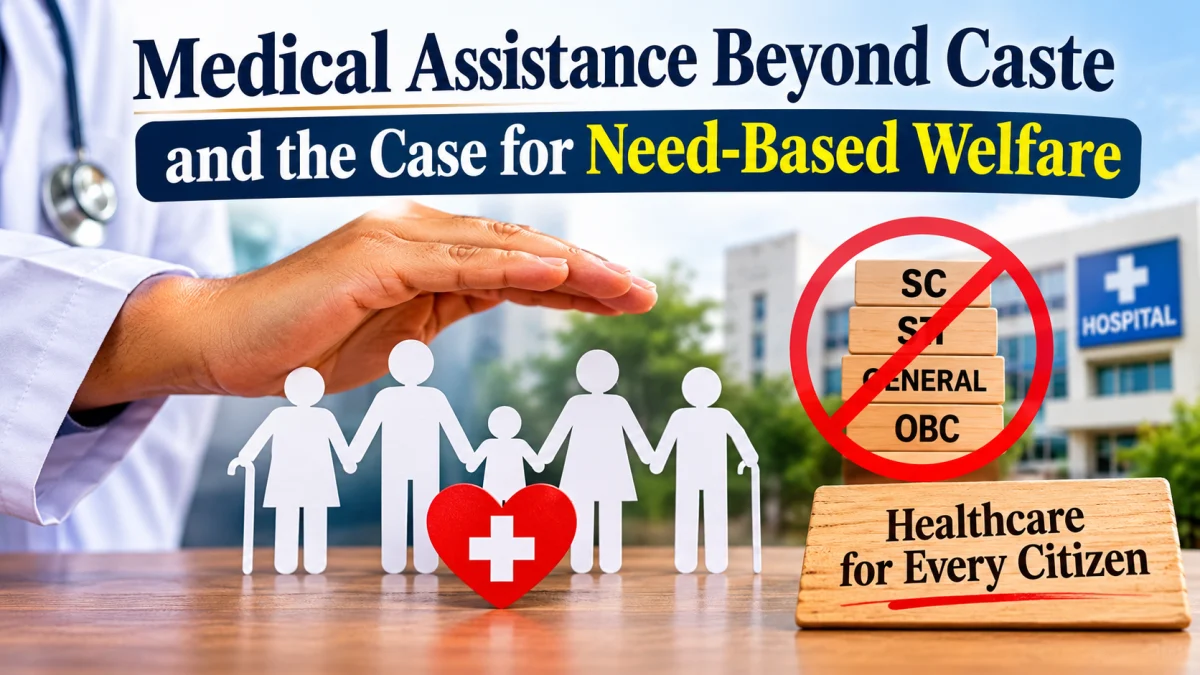
Access to timely medical treatment is a fundamental concern of public welfare. Serious illnesses such as cancer, kidney failure and cardiovascular disease can impose an enormous financial burden on families, particularly those with limited income. Government assistance is essential to ensure that financial hardship does not prevent patients from receiving necessary treatment.
The Dr. Ambedkar Medical Aid Scheme provides financial assistance of up to ₹3.50 lakh to eligible Scheduled Caste (SC) and Scheduled Tribe (ST) patients suffering from serious and life threatening diseases. While supporting economically vulnerable patients is a commendable objective, restricting eligibility to specific caste categories raises an important question about fairness in the distribution of public resources.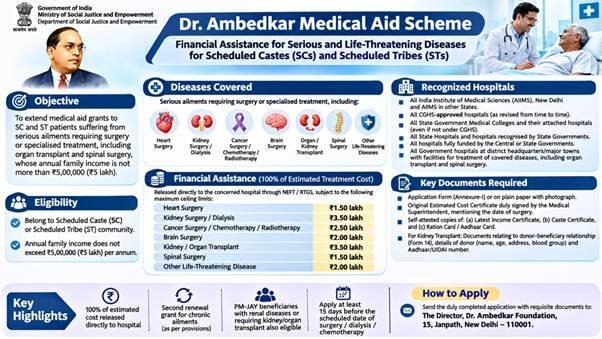
Medical assistance should be guided primarily by financial hardship and medical urgency, rather than caste identity.
1. Medical Emergencies Affect Every Community
A serious illness does not distinguish between caste, religion or social background. The financial consequences of major surgery or prolonged treatment can affect families across India's social and economic spectrum.
The Burden of Expensive Treatment
For a low income family, treatment costing several lakhs of rupees can be financially devastating. Patients may be forced to borrow money, sell assets or depend on relatives to arrange treatment.
A financially vulnerable patient who falls outside the scheme's eligibility criteria may face the same medical and economic difficulties as an eligible beneficiary. Their need for treatment is no less urgent because they belong to another community.
When the objective of public assistance is to reduce medical hardship, every deserving patient should have a fair opportunity to receive support.
2. Financial Vulnerability Should Be the Priority
The scheme's annual family income ceiling of ₹5 lakh recognises the importance of economic circumstances in determining eligibility. However, applying income criteria only to selected caste categories may leave other financially vulnerable patients without access to similar assistance.
A Need Based Medical Assistance System
A more inclusive framework could assess applicants through objective criteria such as family income, medical urgency, estimated treatment expenditure and existing health insurance coverage.
Such a system would allow the government to identify patients facing the greatest financial and medical challenges, irrespective of their caste.
Supporting Disadvantaged Communities
A need based approach does not mean ignoring the historical and economic disadvantages experienced by marginalised communities. Targeted support may be justified where genuine vulnerability requires additional assistance.
However, medical aid intended to address immediate financial hardship should also consider poor patients from other communities. The central objective must be to ensure that no deserving patient is denied essential treatment because of their social identity.
3. Towards Inclusive Public Healthcare
Public expenditure on healthcare should protect human life, reduce avoidable suffering and improve access to essential treatment.
A Common Framework for Medical Assistance
The government could establish a common application system for patients requiring financial assistance for life threatening diseases. Transparent income thresholds, medical assessments and treatment cost verification would help ensure that benefits reach those who genuinely need them.
A common framework could also reduce confusion among applicants and make the allocation of public funds more accountable.
Equal Access to Public Resources
Equal treatment does not necessarily mean providing identical assistance to every person. It means ensuring that eligibility differences are based on relevant factors such as medical urgency and financial vulnerability.
A patient's caste should not be the decisive factor in determining whether they receive assistance for a life threatening illness. A more inclusive, need based system would strengthen public trust and make medical welfare accessible to every deserving citizen.
Sources and Further Reading
1. Press Information Bureau, Ministry of Social Justice and Empowerment — Dr. Ambedkar Medical Aid Scheme Provides Financial Assistance of up to ₹3.50 Lakh to SC and ST Patients for Treatment of Life-Threatening Diseases, 27 November 2026.
https://www.pib.gov.in/PressReleasePage.aspx?PRID=2342749&lang=1®=48
2. Dr. Ambedkar Foundation — Dr. Ambedkar Medical Aid Scheme: Guidelines, Eligibility and Application Details.
https://www.dosje.gov.in/schemes-and-services/dr-ambedkar-medical-aid-scheme



Join the Conversation