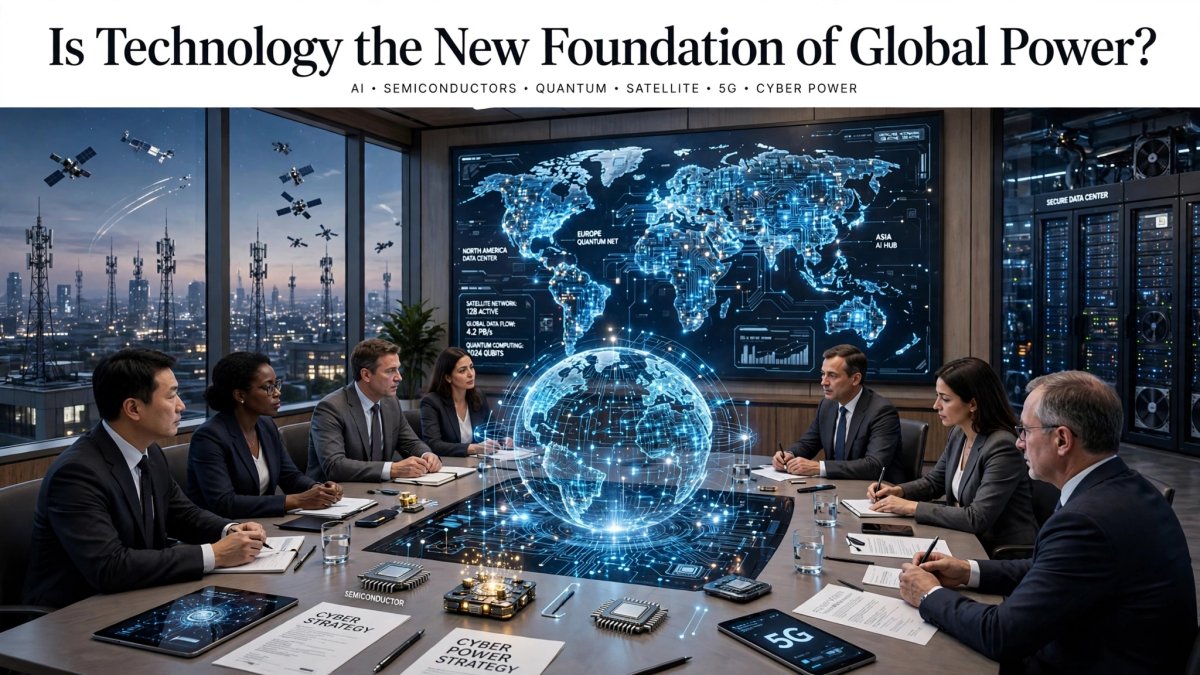
Is Control Over Technology the New Foundation of Global Power?
Global power has traditionally been measured through military strength, economic influence, territorial control and diplomatic reach. However, the rapid development of artificial intelligence, semiconductor manufacturing, digital infrastructure and advanced communication systems is changing the foundations of international competition. Technology is no longer simply an instrument of economic development; it has become an important source of national security, strategic influence and geopolitical leverage.
The competition between the United States and China illustrates this transformation. Both countries recognise that leadership in critical technologies can influence economic growth, military capabilities and international standards. Meanwhile, India, the European Union and other emerging economies are attempting to reduce technological dependencies and strengthen domestic capabilities. This raises an important question: is control over technology becoming the new foundation of global power?
1. The Changing Nature of Global Power
For much of modern history, international influence depended on industrial capacity, natural resources, military strength and financial power. These factors remain important, but technological capabilities increasingly determine how effectively countries can use them.
Digital infrastructure, advanced computing, artificial intelligence and telecommunications networks support essential economic and government functions. Countries that develop these capabilities can strengthen their industries, improve public services and influence international technology standards.
The World Economic Forum has identified artificial intelligence and data infrastructure as central elements of contemporary geopolitical competition. Its analysis highlights how countries are becoming increasingly concerned about dependence on foreign technology providers. ("World Economic Forum" https://www.weforum.org/stories/2025/07/ai-geopolitics-data-centres-technological-rivalry/
2. The United States–China Technology Rivalry
The United States and China are at the centre of global technological competition. Their rivalry extends beyond trade and manufacturing into artificial intelligence, semiconductors, telecommunications and advanced computing.
Competition for Artificial Intelligence Leadership
Artificial intelligence has become a strategic priority because of its potential to transform healthcare, education, manufacturing, finance and public administration. Both countries are investing in research, computing infrastructure and technological innovation.
The competition is not limited to developing sophisticated AI systems. Access to computing power, high-quality data, skilled professionals and advanced semiconductor technology also influences national capabilities.
Semiconductor Manufacturing and Export Controls
Semiconductors are essential components in smartphones, computers, automobiles, communication networks and advanced computing systems. Their manufacturing requires specialised equipment, technical expertise and internationally connected supply chains.
Restrictions on advanced semiconductor exports have become an important instrument of geopolitical competition. Such measures demonstrate how control over critical technologies can influence the industrial development of other countries. ("OECD – Competition in Artificial Intelligence Infrastructure" https://www.oecd.org/en/publications/competition-in-artificial-intelligence-infrastructure_623d1874-en/full-report.html
3. Semiconductors and Global Supply Chain Dependence
The semiconductor industry demonstrates why technological independence has become a national priority. Chip manufacturing is distributed across several economies, with different countries specialising in design, equipment, materials, fabrication and assembly.
Taiwan occupies a particularly significant position in advanced semiconductor manufacturing. This concentration creates economic opportunities but also exposes global industries to geopolitical tensions and supply disruptions.
Consequently, governments are attempting to diversify supply chains and develop domestic manufacturing capabilities. The objective is not necessarily to produce every component independently, but to reduce excessive dependence on a limited number of suppliers.
The European Union's technological sovereignty strategy, announced in June 2026, includes proposals concerning semiconductors, cloud computing, artificial intelligence and open-source technology. It reflects growing concern about strategic dependence in critical digital sectors. ("European Commission – Technology Sovereignty" https://digital-strategy.ec.europa.eu/en/policies/eu-tech-sovereignty
4. Artificial Intelligence and National Security
Artificial intelligence is increasingly connected to national security and economic competitiveness. Governments are examining its applications in public administration, cybersecurity, intelligence analysis, industrial development and defence-related research.
However, technological leadership also introduces important concerns. Data protection, algorithmic accountability, misinformation, privacy and the security of digital systems require effective governance.
The growing influence of private technology companies adds another dimension. Major corporations control important computing platforms, cloud services, software ecosystems and digital infrastructure. Their commercial decisions can have consequences extending beyond national borders.
This raises questions about how governments should balance innovation, private enterprise, public accountability and national security.
5. India's Position in the Global Technology Race
India has an important opportunity to strengthen its position in the international technology landscape. Its expanding digital infrastructure, software industry, engineering workforce and large domestic market provide a foundation for technological development.
Semiconductor Development
India has been pursuing domestic semiconductor manufacturing and attracting investment in the electronics sector. These efforts aim to strengthen industrial capacity, create employment opportunities and reduce dependence on imported components.
In May 2026, NITI Aayog released a ten-year roadmap for India's semiconductor industry, highlighting the strategic importance of semiconductor capabilities for national security, economic resilience and technological competitiveness. ("Press Information Bureau – India's Semiconductor Industry Roadmap" https://www.pib.gov.in/PressReleasePage.aspx?PRID=2266727&lang=1®=3
Artificial Intelligence and Digital Infrastructure
India's digital public infrastructure has expanded through systems supporting digital payments, identity services and online public administration. Further investment in computing infrastructure, research, education and advanced manufacturing could strengthen its technological position.
However, developing a competitive technology ecosystem requires more than attracting investment. Research institutions, skilled professionals, reliable infrastructure and sustained funding are equally important.
6. Technology Companies and the Future of Global Influence
The relationship between governments and technology companies is becoming increasingly important. Private corporations develop many of the platforms and systems that support modern economies, while governments establish regulations and security requirements.
This creates a complex relationship between commercial interests and national priorities. Technology companies operate internationally, but their activities may be affected by domestic laws, export restrictions and geopolitical disagreements.
The Organisation for Economic Co-operation and Development has examined competition in AI infrastructure, particularly the concentration of computing resources and advanced chips. Its research highlights the importance of maintaining competitive markets alongside technological development. ("OECD – Competition in Artificial Intelligence Infrastructure" https://www.oecd.org/en/publications/competition-in-artificial-intelligence-infrastructure_623d1874-en/full-report.html
7. Is Technological Control the Future of Global Power?
Technological leadership is likely to remain an increasingly important element of international influence, but it cannot independently determine a country's global position.
Military capabilities, economic strength, diplomatic relationships, political stability and institutional credibility continue to shape international affairs. Technology strengthens these capabilities rather than replacing them entirely.
There is also a risk that excessive technological competition could fragment global markets, restrict scientific cooperation and increase economic inequalities. Developing countries may find it difficult to compete if access to advanced technologies becomes concentrated among a small number of powerful economies.
International cooperation, transparent standards and resilient supply chains will therefore remain essential.
Conclusion
Control over critical technologies is becoming one of the defining dimensions of modern geopolitics. Competition in artificial intelligence, semiconductor manufacturing, digital infrastructure and advanced computing is influencing national strategies and international relationships.
The United States and China remain central to this competition, while India and other emerging economies are seeking greater technological independence. However, genuine technological strength requires more than controlling production or restricting access. It depends on innovation, education, research, reliable institutions and international cooperation.
Ultimately, technology may become a decisive source of global influence, but the countries that combine innovation with economic resilience, responsible governance and strategic partnerships will be better positioned to shape the future international order.
Sources and Further Reading
1. "World Economic Forum – AI Geopolitics and Data Centres" https://www.weforum.org/stories/2025/07/ai-geopolitics-data-centres-technological-rivalry/
2. "OECD – Competition in Artificial Intelligence Infrastructure" https://www.oecd.org/en/publications/competition-in-artificial-intelligence-infrastructure_623d1874-en/full-report.html
3. "European Commission – Strengthening Europe's Tech Sovereignty" https://digital-strategy.ec.europa.eu/en/policies/eu-tech-sovereignty
4. "Press Information Bureau – India's Semiconductor Industry Roadmap" https://www.pib.gov.in/PressReleasePage.aspx?PRID=2266727&lang=1®=3
5. "European Parliament – The Geopolitics of Technology" https://www.europarl.europa.eu/RegData/etudes/BRIE/2024/762384/EPRS_BRI(2024)762384_EN.pdf


Join the Conversation