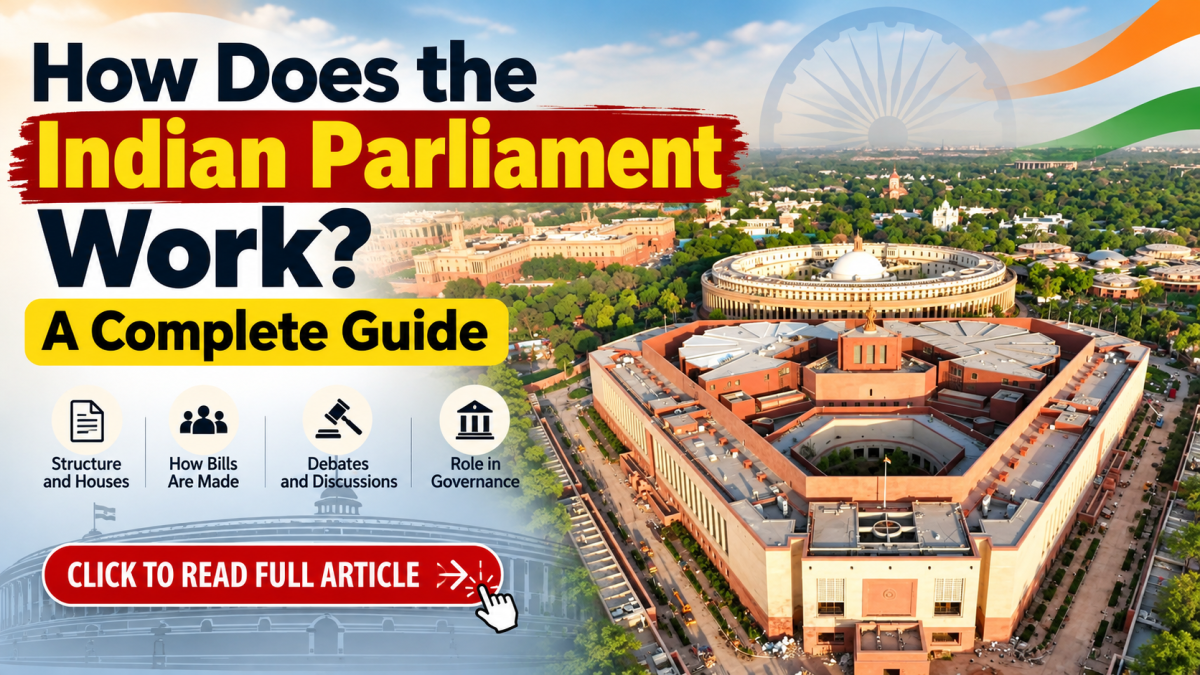
What is the indian Parliament?
India is the World's largest democracy, and parliament plays a cetral role in running the country. It is where elected representative debate public issues, approve governement spending, question ministers and make laws.
What are the Two Houses of Parliament?
The Parliament of India is the supreme legislative body of the country. It consists of the President of India and two houses: the Rajya Sabha (Council of States), the upper house, and the Lok Sabha (House of the People), the lower house. Therefore, India has a bicameral parliamentary system. The Parliament makes laws, passes the national budget, and holds the government accountable. The Prime Minister and the Council of Ministers are responsible for governing the country. The Parliament is located in New Delhi, in a building known as Sansad Bhavan (Parliament House).
sources: Britannica.
Lok Sabha Explained
The Lok Sabha, also known as the House of the People, is the lower house of the Indian Parliament. Its members are directly elected by the citizens of India through general elections, normally held every five years. It represents people from different constituencies across the country.
Term and Dissolution: The normal term of the Lok Sabha is five years. However, it can be dissolved earlier by the President on the advice of the Council of Ministers. During a national emergency, its term may be extended according to constitutional provisions.
Powers and Functions of Lok Sabha
The Lok Sabha has important legislative, financial, and executive powers.
- Legislative Powers: It participates in making laws for the country.
- Financial Powers: Money Bills can be introduced only in the Lok Sabha.
- Control over the Government: It holds the government accountable through questions, debates, and motions.
- No-Confidence Motion: If the Lok Sabha passes a no-confidence motion, the Council of Ministers must resign.
Thus, the Lok Sabha plays a vital role in representing the people and ensuring democratic accountability in India.
Rajya Sabha Explained
The Rajya Sabha, also known as the Council of States, is the upper house of the Indian Parliament. It represents the states and union territories of India.
The Rajya Sabha can have a maximum of 250 members. Of these, up to 238 members represent the states and union territories and are indirectly elected. 12 members are nominated by the President for their special knowledge or practical experience in fields such as literature, science, art, and social service.
Permanent Nature of Rajya Sabha
The Rajya Sabha is a permanent House and cannot be dissolved. Its members serve a term of six years, and one-third of its members retire every two years. New members are elected to fill the vacant seats.
Powers and Functions of Rajya Sabha
The Rajya Sabha performs important legislative and constitutional functions.
-
Legislative Powers: It debates, examines, and reviews bills passed by the Lok Sabha.
-
Federal Representation: It represents the interests of states and union territories at the national level.
-
Special Powers: It can authorise Parliament to make laws on matters in the State List by passing a resolution supported by a two-thirds majority of members present and voting.
-
Constitutional Role: It participates in constitutional amendments and other important parliamentary proceedings.
What are the Main Functions of Parliament?
Powers and Functions of the Indian Parliament
The Parliament of India is the supreme legislative body of the country. The Indian Constitution grants it various powers and functions to ensure effective governance and democratic accountability.
- Legislative Functions
Parliament makes, amends, and repeals laws on matters within its constitutional authority. - Executive Functions
It holds the Council of Ministers accountable through questions, debates, discussions, and motions. - Financial Functions
Parliament approves the Union Budget, authorises taxation, and controls government expenditure. - Constituent Functions
Under Article 368, Parliament has the power to amend the Constitution, subject to the prescribed constitutional procedure. - Judicial Functions
Parliament can initiate the impeachment of the President and participate in the removal of Supreme Court and High Court judges according to constitutional procedures. It can also take action for breach of parliamentary privilege. - Electoral Functions
Elected members of both Houses of Parliament participate in the election of the President, while members of both Houses elect the Vice-President. - Deliberative Functions
Parliament discusses national issues, public concerns, and government policies, helping shape public opinion and policy decisions.
Frequently Asked Questions
| S. No. | Question | Answer |
|---|---|---|
| 1 | What is the maximum strength of the Rajya Sabha? | 250 members. |
| 2 | How many members of the Rajya Sabha are nominated by the President? | 12 members. |
| 3 | What is the term of a Rajya Sabha member? | Six years. |
| 4 | Is the Rajya Sabha a permanent House? | Yes, it cannot be dissolved. |
| 5 | How many Rajya Sabha members retire every two years? | One-third of its members. |
| 6 | Who is the ex-officio Chairman of the Rajya Sabha? | The Vice-President of India. |
| 7 | How is the Deputy Chairman of the Rajya Sabha elected? | By the members of the Rajya Sabha from among themselves. |
| 8 | Who was the first Deputy Chairman of the Rajya Sabha? | Shri S. V. Krishnamoorthy Rao. |
| 9 | What is the quorum required for a Rajya Sabha meeting? | One-tenth of the total membership of the House. |
| 10 | Which state has the highest number of seats in the Rajya Sabha? | Uttar Pradesh, with 31 seats. |
Sources:
Houses of parliament: Houses Of Parliament UK Structure And Functions Guide
Parliament of India: Parliament of India | Location, Seats, History, & Facts | Britannica
Functions of Parliament: Functions of Parliament in India, Legislative, Financial
Questions: Digital Sansad


Join the Conversation