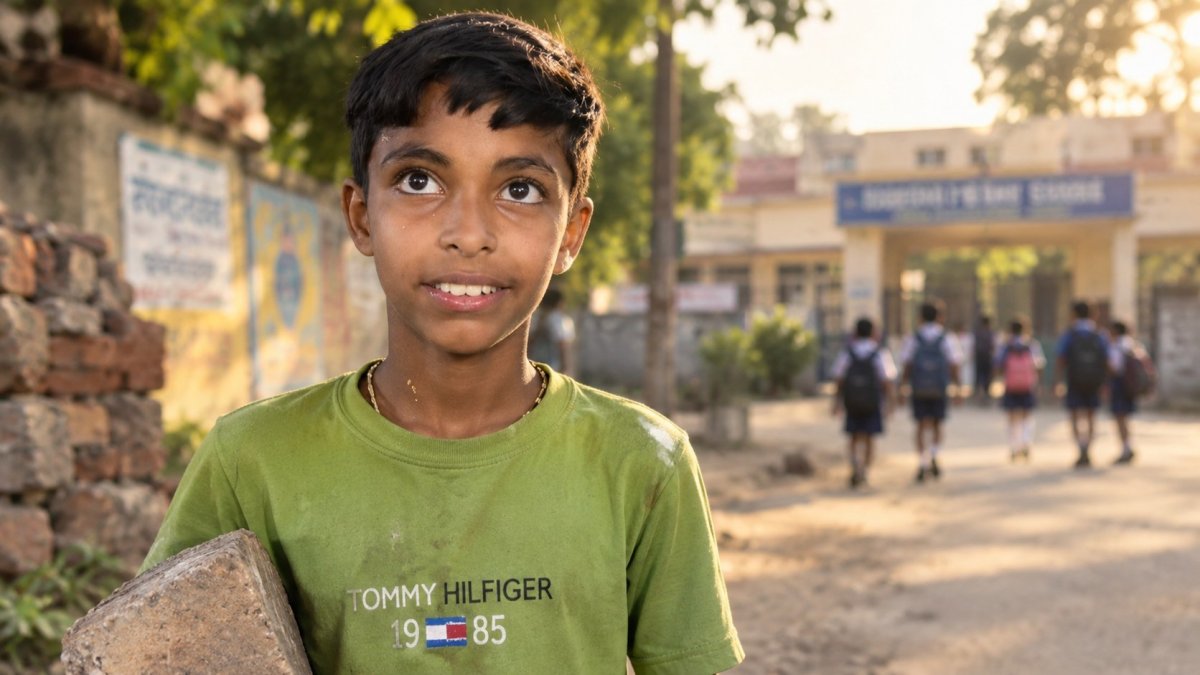
The story of 11-year-old Vaibhav Tiwari raises an uncomfortable question about India's welfare system: Are we doing enough for poor children who do not belong to the categories covered by certain welfare schemes?
At an age when most children are busy with school, homework and games, Vaibhav Tiwari is reportedly working under the scorching sun to help his family survive. The 11-year-old boy from Mathura is facing circumstances no child should have to experience. His father is in a coma, and his mother is unable to leave him because of his condition. With the family facing such a difficult situation, Vaibhav has reportedly taken on the responsibility of supporting his household.
His story is heartbreaking. But beyond the sympathy it naturally evokes, it raises a serious question about the way India approaches poverty and welfare.
What happens when a poor child belongs to the General Category?
It is a question that often gets lost in the larger debate over caste and reservation. India has spent decades trying to address historical discrimination, and there are valid reasons for policies designed to help communities that have faced generations of social exclusion. But acknowledging that reality should not mean ignoring poverty among people from other communities.
A poor child is still poor, regardless of his caste.
If Vaibhav's family is struggling to meet basic needs because of his father's medical condition, the immediate concern should be how to help them. His father's illness does not become less serious because the family belongs to the General Category. His mother's difficulties do not become less real because of their social identity. And the child's need for education does not become less important because of his surname.
Yet the question of whether economically disadvantaged General Category families receive adequate support rarely receives the same attention as many other aspects of the reservation debate.
Poverty Does Not Have a Caste
There is a tendency in public discussions to assume that people belonging to the General Category are automatically privileged. While some families certainly enjoy financial security and social advantages, that cannot be said of everyone.
There are families in this category that struggle to pay rent, afford medical treatment, arrange their children's education and put food on the table. Some live in villages with limited employment opportunities. Others depend on irregular daily wages. When a medical emergency strikes, years of financial struggle can turn into a crisis overnight.
For these families, social identity offers little comfort when they cannot afford their basic necessities.
The problem is not that disadvantaged communities receive assistance. People facing historical discrimination deserve fair opportunities and appropriate protection. The problem arises when policymakers fail to give sufficient attention to economic hardship that exists outside the categories covered by particular programmes.
Why should a family living in severe poverty be overlooked simply because it does not qualify for a specific benefit?
This is not an argument for taking opportunities away from anyone. It is an argument for ensuring that genuine economic hardship is not ignored.
Is the Government Doing Enough?
India has several welfare schemes, but the existence of these schemes does not automatically mean that every struggling family receives the help it needs.
Some programmes have specific eligibility requirements. Others depend on income, household circumstances or other conditions. A family may qualify for one benefit but not another. Some people also struggle to understand application procedures or access the authorities responsible for providing assistance.
This raises an important question: Are the existing arrangements sufficient to protect every child facing serious economic hardship?
In Vaibhav's case, the priority should be to establish what assistance his family can access and ensure that he does not have to sacrifice his education because of circumstances beyond his control.
More broadly, the government needs to examine whether poor families outside specific caste-based categories have adequate access to financial assistance, healthcare, education and emergency support.
EWS provisions are a step towards recognising economic disadvantage among eligible sections of the General Category. However, reservation under EWS is not the same as direct financial assistance to a family struggling with medical expenses or everyday survival.
A reservation opportunity may help someone access education or employment in the future. It cannot, by itself, pay today's medical bills or replace the income lost when a family member becomes seriously ill.
The government must look beyond the announcement of schemes and ask whether those schemes are actually reaching people in need.
If the existing system leaves vulnerable families without adequate support, that deserves criticism and reform.
Reservation and Welfare Should Not Be Confused
One reason this debate becomes so divisive is that reservation and welfare are often treated as though they serve exactly the same purpose.
They do not.
Reservation addresses particular forms of historical and social disadvantage in education and public employment. Welfare schemes can address poverty, healthcare, nutrition, housing and other immediate needs.
Both can be important, but one cannot automatically replace the other.
A child whose family is struggling financially needs help that addresses the family's present circumstances. If poverty is pushing that child towards work and away from school, the response must focus on protecting the child's education and supporting the household.
The government should not assume that every economically disadvantaged family is adequately protected simply because some form of economic reservation exists.
Nor should a discussion about the needs of poor General Category families become an excuse to deny the historical discrimination faced by other communities.
The real issue is whether India can pursue social justice while ensuring that economic hardship receives adequate attention across society.
There is no reason these objectives should be in conflict.
A Child Should Not Become a Victim of Political Arguments
The debate surrounding Vaibhav's story has also been linked to criticism of the University Grants Commission and claims about how Brahmins are characterised in discussions of caste.
Such claims need to be examined carefully. Without a specific provision establishing that the UGC officially labels Vaibhav or all Brahmins as oppressors, that allegation should not be presented as a proven fact.
However, there is a broader point worth making.
No child should be made to carry the burden of historical disputes or political arguments simply because of the community into which he was born.
Children do not choose their families, their financial circumstances or the society into which they enter the world. They should not be judged through assumptions about their caste, nor should their hardships be dismissed because someone believes their community is generally privileged.
If we believe that every child deserves dignity and opportunity, that principle must apply consistently.
It cannot be invoked only when a particular story fits an existing political narrative.
What Needs to Change?
The government should take a closer look at how existing welfare programmes serve families facing severe economic hardship.
First, there should be greater attention to children whose education is threatened by poverty, serious illness in the family or the loss of a primary income earner.
Second, eligible families should be able to access assistance without unnecessary administrative hurdles. A household already struggling with a medical emergency should not have to navigate an unnecessarily complicated process to discover what help is available.
Third, income-based welfare programmes should be assessed to determine whether they adequately cover vulnerable households across caste groups, while preserving legitimate protections designed to address historical discrimination.
Finally, authorities should do more to identify children at risk of leaving school because their families cannot afford basic necessities. Assistance is most useful when it reaches people before their circumstances become even more difficult.
These are practical measures, not demands for one community to be placed above another.
The purpose of welfare should be to address the particular problem a programme is designed to solve and ensure that people who qualify can actually benefit from it.
The Real Meaning of Social Justice
Vaibhav Tiwari's story should make us uncomfortable. Not because his suffering is greater than that of every other child, but because no 11-year-old should have to face such circumstances without adequate support.
If his family is struggling as reported, the authorities should assess its needs, help it access eligible assistance and ensure that his education and welfare are protected.
At the same time, his circumstances should encourage a wider discussion about the families that may be falling through gaps in India's welfare system.
We cannot build a fair society by pretending that poverty exists only within certain communities. Nor can we address economic hardship effectively by treating every member of a broad social category as though they share the same financial circumstances.
India must continue to address historical discrimination. But it must also recognise that a poor family from the General Category can face genuine deprivation and may need meaningful government assistance.
Social justice should not become a competition over whose suffering deserves recognition.
The government has a responsibility to make its welfare system effective, accessible and responsive to genuine need. If existing policies leave vulnerable children without adequate support, policymakers must be willing to acknowledge the shortcomings and address them.
Vaibhav is not responsible for the circumstances his family faces. He should not have to bear the consequences of gaps in public policy either.
At 11, he deserves the chance to study, grow and build a future for himself.
His story leaves us with a simple question that policymakers should not avoid: if a child is struggling to survive, should his caste determine how seriously we take his poverty?
The answer should be an unequivocal no.
Join the Conversation