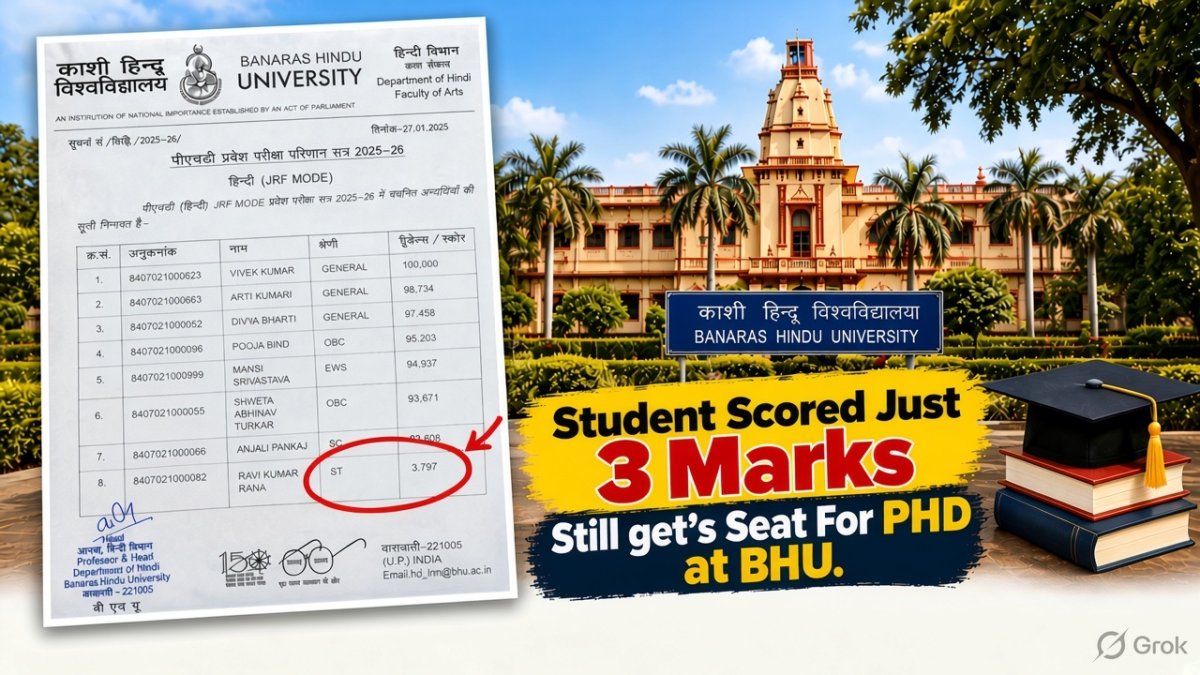
The reported selection of an ST-category candidate with a score of 3.797 in Banaras Hindu University's (BHU) PhD admissions for the 2025–26 academic session has sparked debate over reservation policies, academic merit and the standards applied in India's higher education system. The controversy has brought renewed attention to the question of whether the existing reservation framework strikes an appropriate balance between social justice and academic performance.
Reservation Policy and Academic Merit
Reservation was introduced to address historical discrimination and improve access to educational opportunities for historically disadvantaged communities. However, the implementation of reservation policies in higher education deserves continued scrutiny to ensure that they fulfil their intended objectives while maintaining transparent and credible academic standards.
Critics argue that substantial differences in selection scores raise legitimate questions about the relationship between entrance performance and admission outcomes. When admission lists display significantly different scores among selected candidates, universities should clearly explain the applicable selection criteria, category-wise cut-offs and allocation of seats.
Social justice and academic merit should not be treated as mutually exclusive objectives. A system that seeks to promote equal opportunity must also maintain transparency and public confidence in the institutions responsible for higher education. Reservation policies should be regularly evaluated to determine whether they are achieving their intended goals and whether reforms could improve their effectiveness.
Does PhD Admission Guarantee Academic Competence?
The controversy has also prompted discussion about whether candidates admitted through category-based selection can eventually become college or university professors.
A PhD programme requires sustained research, subject knowledge and academic commitment. Admission is only the first stage of that journey. Candidates must complete their research and satisfy the applicable requirements for academic positions before they can be recruited as professors.
Nevertheless, a candidate's entrance score alone cannot determine their future research ability or teaching competence. Academic performance throughout the programme, research contributions and professional qualifications are also relevant.
The broader concern is whether the admission system maintains clear and credible standards while providing opportunities to candidates from different social backgrounds. Universities should ensure that their selection procedures are transparent and that the public can understand how admission decisions are reached.
Why Reservation Reform Deserves Serious Debate
India needs an open and evidence-based discussion about the future of reservation in higher education. Reform advocates argue that policies should be assessed on their outcomes, including educational access, academic progression and the effectiveness of support provided to disadvantaged students.
A meaningful reform debate should examine whether existing policies adequately address educational disadvantage, whether support systems help students succeed and whether admission criteria are communicated clearly. It should also consider how to preserve opportunities for historically disadvantaged communities while maintaining confidence in academic institutions.
Criticism of reservation policies should focus on the framework, its implementation and its measurable outcomes rather than making assumptions about individual candidates based on their caste or entrance scores.
Conclusion: The Case for Reservation Reform
The BHU PhD admission controversy highlights the continuing debate over reservation and merit in Indian higher education. Reservation policies should not be exempt from scrutiny simply because they pursue social justice, and academic merit should not be discussed without acknowledging unequal access to educational opportunities.
The need of the hour is a transparent, accountable and evidence-based admission framework. Reservation policies should be periodically reviewed, their outcomes assessed and necessary reforms considered to ensure that social inclusion and academic standards remain important objectives.
Ultimately, the objective should be a higher education system that expands opportunities, applies its rules transparently and commands public confidence. Reservation reform deserves serious consideration—not to deny opportunities to any community, but to ensure that policies intended to promote equality are effective, fair and compatible with credible academic standards


Join the Conversation