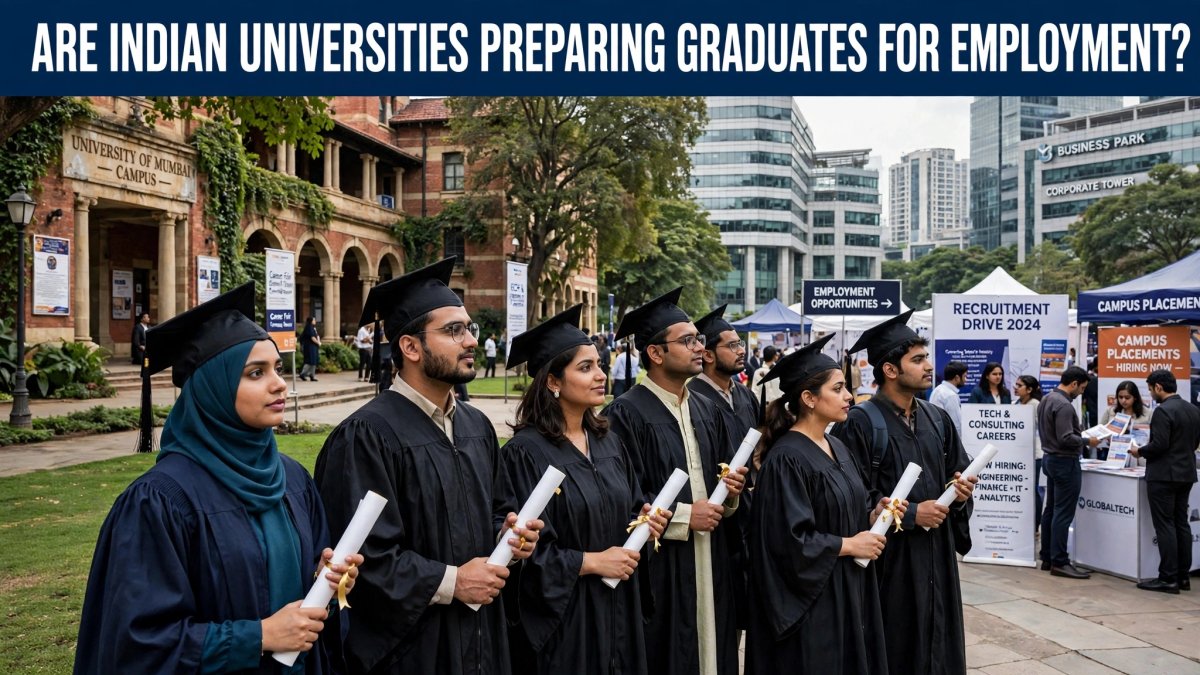
Are Indian Universities Preparing Students for the Real Job Market?
India has one of the world's largest higher education systems, producing millions of graduates every year. A university degree is widely viewed as an important route to professional success, financial independence and social mobility. Yet, despite the expansion of colleges and universities, many graduates face difficulties securing employment that matches their qualifications.
The central concern is not simply whether young people are obtaining degrees, but whether their education equips them for the demands of the modern workplace. Employers increasingly expect practical knowledge, communication abilities, digital literacy and problem-solving skills alongside academic qualifications. This raises an important question: are Indian universities preparing students for employment, or are they placing too much emphasis on examinations and certificates?
1. The Gap Between Degrees and Employability
A university qualification demonstrates that a student has completed an academic programme, but it does not automatically establish professional readiness. Many graduates understand theoretical concepts but struggle to apply that knowledge in practical situations.
The 2025 India Graduate Skill Index published by Mercer found that 42.6% of Indian graduates assessed in its study were considered employable. The report analysed more than one million students across over 2,700 campuses. Although such assessments do not represent every graduate or every industry, they highlight concerns about the alignment between education and workplace expectations.
The problem requires a broader understanding of employability. A graduate should not be judged only by examination results, but also by the ability to communicate, analyse information, work independently and adapt to professional responsibilities.
2. Outdated Curricula and Limited Practical Exposure
One persistent challenge is the gap between what students learn in classrooms and what employers require. In some institutions, curricula are not updated frequently enough to reflect technological developments and changing industry practices.
Students may spend several semesters studying theoretical material without receiving sufficient opportunities to apply it through projects, internships, laboratory work or field experience.
The Need for Practical Learning
• Industry-relevant curricula: Universities should regularly review courses with academic experts and industry professionals.
• Project-based education: Students should work on practical assignments connected to real professional challenges.
• Internships: Workplace exposure should become an important component of undergraduate and postgraduate education.
• Updated technology: Institutions must provide access to relevant digital tools, laboratories and learning resources.
Academic knowledge remains essential, but it becomes more valuable when students understand how to apply it.
3. The Skills Employers Actually Seek
The modern employment market demands a combination of technical and non-technical abilities. Digital literacy, data interpretation and technological adaptability are increasingly important across sectors. At the same time, communication, teamwork, critical thinking and problem-solving remain essential.
Mercer's 2025 findings also highlight the importance of soft skills, including critical thinking, communication and learning agility. These abilities help employees adapt to changing responsibilities and new technologies.
Universities should therefore avoid treating skill development as an optional activity outside the academic curriculum. Communication exercises, presentations, collaborative projects and analytical assignments can help students develop professional confidence.
The objective should not be to turn every graduate into a specialist in a particular technology. It should be to produce adaptable individuals capable of learning and contributing in different professional environments.
4. The Disconnect Between Universities and Industry
A stronger relationship between educational institutions and employers could help reduce the gap between academic learning and professional requirements.
Companies understand the skills required in their respective sectors, while universities possess the academic infrastructure to develop knowledge and research capabilities. However, these strengths do not always translate into meaningful collaboration.
The Ministry of Education's Annual Report 2024–25 highlights initiatives supporting internships, apprenticeship-embedded degree programmes and industry-academia collaboration. It also reports that more than 100 higher education institutions were offering apprenticeship or internship-embedded degree programmes.
Such initiatives are important, but their effectiveness depends on implementation and accessibility. Internships should provide meaningful learning rather than merely serve as formal certificates. Universities must also ensure that opportunities are available beyond a limited group of prestigious institutions.
5. Government Universities and Unequal Opportunities
The quality of higher education should not depend entirely on a student's financial background or the institution they attend.
Students from government colleges and universities may face limitations in access to advanced laboratories, industry networks, placement services and professional training. Meanwhile, students at well-resourced institutions may have greater access to internships, corporate recruitment and specialised courses.
This does not mean every private institution offers better education or every public university lacks quality. There are excellent institutions in both sectors. The larger issue is the uneven distribution of educational resources and professional opportunities.
Government universities must receive adequate investment in infrastructure, faculty development, research facilities and career guidance. Equal opportunity requires more than admission to a college; it also requires access to the resources that help students succeed after graduation.
6. Graduate Unemployment and Underemployment
The transition from education to employment remains a major concern. Some graduates struggle to find suitable jobs, while others accept positions that do not adequately use their qualifications.
The State of Working India 2026 report by Azim Premji University examines the challenges young people face while moving from education into employment. It highlights that the growth in the number of graduates has not been matched by an equivalent expansion in graduate employment.
This challenge cannot be blamed entirely on universities. Job creation, economic conditions, regional inequalities and the changing structure of industries also influence employment outcomes.
Nevertheless, educational institutions have a responsibility to prepare students for realistic career opportunities. Better career counselling, transparent placement information and stronger connections with employers can help students make informed decisions.
7. What Needs to Change?
India needs a higher education system that values both academic excellence and practical competence. Reform should focus on improving the quality of learning rather than simply increasing the number of degree holders.
Several measures deserve priority:
• Curriculum reform: Update academic programmes to reflect changing professional and technological requirements.
• Practical education: Integrate internships, research projects, case studies and workplace learning into degree programmes.
• Faculty development: Support teachers in adopting modern teaching methods and relevant professional knowledge.
• Industry partnerships: Encourage universities and employers to collaborate on training, research and recruitment.
• Career guidance: Provide students with reliable information about employment opportunities and further education.
• Equal access: Strengthen public institutions so that students from different economic backgrounds can access quality education.
The success of these reforms should be measured through learning outcomes, practical competence and meaningful employment opportunities, rather than enrolment figures alone.
Conclusion : Degrees Must Lead to Opportunities
India's universities play a central role in shaping the country's future workforce. Their responsibility extends beyond awarding degrees and conducting examinations. They must develop graduates who can think independently, communicate effectively, adapt to technological change and contribute productively to society.
The solution is not to abandon academic learning in favour of narrow job training. Universities must preserve intellectual development while making education more relevant to the realities of employment.
India's demographic advantage can become a genuine economic strength only when young people have access to quality education and meaningful professional opportunities. A degree should represent more than the completion of a course; it should provide a credible foundation for a productive future.
Sources and Further Reading
1. Mercer — "India's Graduate Skill Index 2025" https://www.mercer.com/insights/talent-and-transformation/talent-assessment/indias-graduate-skill-index-2025/
2. Azim Premji University — "State of Working India 2026" https://azimpremjiuniversity.edu.in/publications/2026/report/swi-2026
3. Ministry of Education — "Annual Report 2024–25" https://www.education.gov.in/sites/upload_files/mhrd/files/document-reports/MoE_AR_En.pdf
4. PRS Legislative Research — "Demand for Grants 2025–26: Education" https://prsindia.org/files/budget/budget_parliament/2025/Demands_For_grants_2025-26_Education.pdf
5. NITI Aayog — "Education and Skilling for Employment: From Credentials to Learning Outcomes" https://www.niti.gov.in/node/2233



Join the Conversation