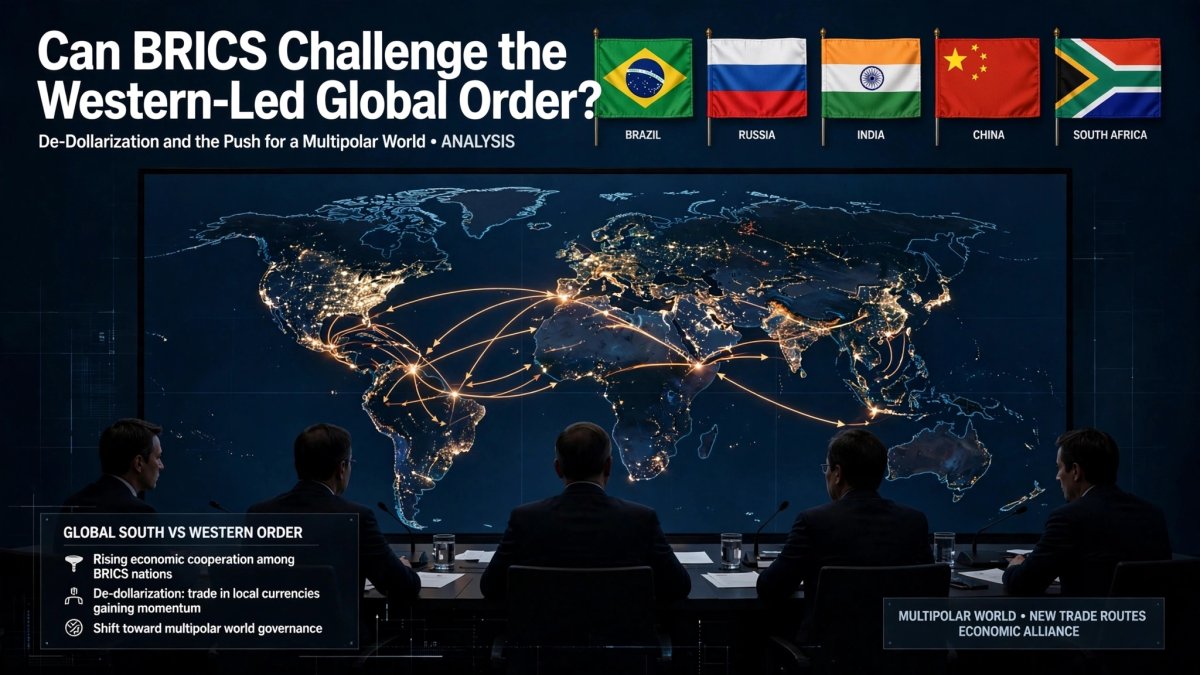
Can BRICS Challenge the Existing Western-Led Global Order?
The global balance of power is undergoing a significant transformation as emerging economies seek a greater role in international decision-making. For decades, Western-led institutions, particularly the International Monetary Fund (IMF), World Bank and other financial organisations, have played a central role in shaping the international economic system. However, the growing influence of emerging economies has intensified calls for a more representative global order.
Against this backdrop, BRICS has developed into an important platform for diplomatic coordination, economic cooperation and discussions on international governance reform. Originally comprising Brazil, Russia, India and China, the grouping has expanded to include several economies across Asia, Africa and the Middle East. Its growing influence raises an important geopolitical question: can BRICS challenge the existing Western-led global order, or will it remain a complementary platform within the international system?
1. The Evolution and Expansion of BRICS
BRICS originated as BRIC, a term introduced in 2001 to describe the growing economic importance of Brazil, Russia, India and China. The grouping developed into a diplomatic forum, holding its first leaders' summit in 2009. South Africa joined in 2011, transforming BRIC into BRICS.
A major expansion began in 2024, bringing Egypt, Ethiopia, Iran, Saudi Arabia and the United Arab Emirates into the grouping. Indonesia subsequently became a full member in January 2025. By 2026, BRICS comprised 11 full members, extending its geographical reach across Asia, Africa, the Middle East and Latin America.
According to India's Press Information Bureau, the expanded grouping represents approximately 49.5% of the world's population, 40% of global GDP and 26% of global trade. These figures illustrate its considerable economic and demographic presence.
2. Challenging the Western-Dominated Financial System
One of BRICS' central objectives is to increase the representation of emerging and developing economies in international financial institutions.
The IMF and World Bank were established in the aftermath of the Second World War, when the global economic landscape was substantially different from today. BRICS members argue that the voting structures and decision-making arrangements of these institutions should better reflect the changing contributions of emerging economies.
At the September 2026 BRICS Summit in New Delhi, leaders reiterated their call for reforms to the Bretton Woods institutions, emphasising greater representation, transparency and accountability for emerging-market and developing economies.
However, challenging the existing financial system does not necessarily mean replacing it. BRICS members continue to participate in established international institutions while advocating changes to their governance structures.
3. The New Development Bank and Financial Cooperation
The establishment of the New Development Bank (NDB) in 2014 represented a significant step towards strengthening financial cooperation among emerging economies.
Headquartered in Shanghai, the bank was created to mobilise resources for infrastructure and sustainable development projects in BRICS countries and other emerging economies. Its activities provide an additional source of development financing alongside established multilateral institutions.
The NDB has also explored expanding local-currency financing and diversifying its funding sources. These initiatives could reduce certain financial vulnerabilities associated with dependence on a limited number of international currencies.
The September 2026 New Delhi Declaration reaffirmed support for the bank's development, membership expansion and role in financing infrastructure and sustainable development across emerging economies.
Nevertheless, the NDB remains considerably smaller in scale and institutional reach than the World Bank. Its long-term influence will depend on its financial capacity, project performance and ability to attract investment.
4. Reducing Dependence on the US Dollar
Another important dimension of BRICS cooperation is the discussion surrounding international payments and the use of national currencies in cross-border trade.
The US dollar occupies a central position in international finance, trade settlements and foreign exchange reserves. Its international importance provides the United States with considerable financial influence.
Some BRICS members have expressed interest in increasing the use of their national currencies for bilateral transactions. Such arrangements could help reduce transaction costs, diversify payment options and limit exposure to certain currency-related risks.
However, discussions about alternative payment arrangements should not be confused with the establishment of a fully operational common BRICS currency. Differences in monetary policy, inflation, exchange-rate management and financial regulation make monetary integration difficult.
A gradual expansion of local-currency settlements is more realistic than the immediate creation of a unified currency capable of replacing the dollar.
5. China's Influence and Internal Differences
Despite its growing membership, BRICS is not a politically or economically uniform organisation. Its members have different national interests, political systems, economic priorities and foreign policy objectives.
China's economic scale gives it substantial influence within the grouping, while India's growing economy and strategic autonomy provide a different perspective on international cooperation. Russia approaches BRICS partly through its interest in strengthening partnerships beyond Western-led institutions, whereas Brazil and South Africa place considerable emphasis on development and international representation.
These differences can complicate collective decision-making.
India, for example, maintains relationships with the United States, Europe, Russia and other major powers. Its participation in BRICS does not mean that it supports every position taken by other members.
This diversity is both a strength and a limitation. It allows BRICS to represent a wider range of international perspectives, but reaching a common position on sensitive geopolitical issues remains difficult.
6. India's Strategic Role in BRICS
India occupies an important position within BRICS because of its economic growth, diplomatic relationships and engagement with multiple international groupings.
Its participation allows New Delhi to strengthen cooperation with emerging economies while continuing its partnerships with Western countries and other international organisations.
India held the BRICS chairship in 2026, hosting the 18th BRICS Summit in New Delhi from 12 to 13 September under the theme "Building for Resilience, Innovation, Cooperation and Sustainability."
The resulting New Delhi Declaration emphasised multilateralism, international governance reform, economic cooperation and sustainable development. It also highlighted the importance of a more representative international system.
For India, BRICS provides an additional diplomatic platform to advance the interests of developing economies without abandoning its broader foreign policy partnerships.
7. Can BRICS Replace the Existing Global Order?
BRICS has the economic scale and diplomatic reach to influence international discussions, particularly on development financing, trade, financial governance and the representation of emerging economies.
However, replacing the Western-led global order would require more than expanding membership. It would demand stronger institutional coordination, deeper financial integration, common policy objectives and the ability to implement collective decisions.
The grouping also faces challenges arising from geopolitical disagreements and differences among its members. Its consensus-based approach makes cooperation possible but can limit the speed and scope of collective action.
Consequently, BRICS is better understood as an emerging centre of influence within an increasingly multipolar international system rather than a unified alternative capable of replacing existing institutions.
Conclusion
BRICS represents the growing demand for a more inclusive and representative international order. Its expansion, development financing initiatives and calls for reform of global financial institutions demonstrate the increasing influence of emerging economies.
Nevertheless, internal differences, financial limitations and competing national interests restrict its ability to function as a unified geopolitical bloc.
The future significance of BRICS will depend on whether its members can translate shared demands into practical institutional reforms and sustained economic cooperation. Rather than simply replacing Western influence, its development may contribute to a more multipolar global system in which emerging economies exercise a greater role in shaping international decisions.
Sources and Further Reading
1. BRICS Official Portal -
https://brics.br/en/about-the-brics
2. Press Information Bureau, Government of India -
https://www.pib.gov.in/PressNoteDetails.aspx?
3. Prime Minister's Office – BRICS New Delhi Declaration 2026
4. New Development Bank – 18th BRICS Summit
https://www.ndb.int/event/ndb-at-the-18th-brics-summit/
5. Reuters Report via Investing.com – BRICS Finance Chiefs Call for Global Financial Institution Reforms

Join the Conversation