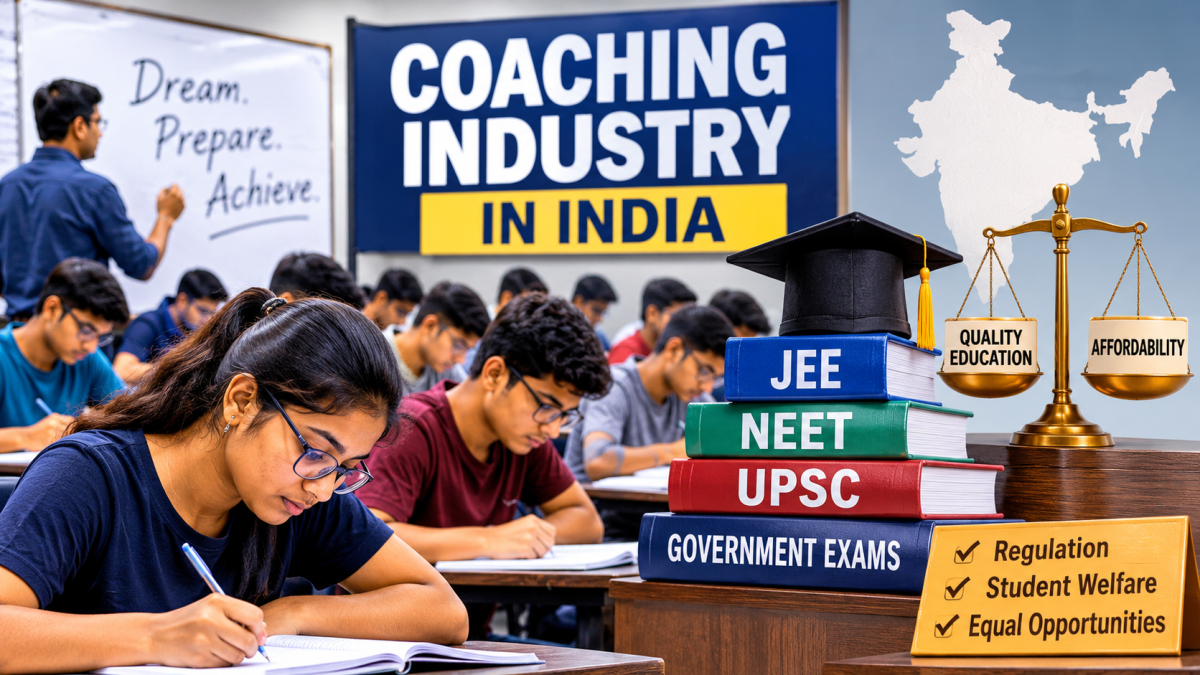
The Coaching Industry and the Business of Competitive Examinations in India
India's coaching industry has become an influential part of the education system, particularly for students preparing for competitive examinations such as JEE, NEET, UPSC and government recruitment tests. What was traditionally considered additional academic support has developed into a substantial private education sector, attracting students from different economic backgrounds.
The growing demand for coaching reflects intense competition for admission to prestigious institutions and limited government employment opportunities. While coaching centres provide structured preparation and specialised teaching, their expansion has raised concerns about expensive courses, educational inequality, misleading advertisements and student welfare.
1. The Rapid Expansion of India's Coaching Industry
India's coaching industry has expanded alongside the growing popularity of national-level entrance examinations and government recruitment tests. Cities such as Kota, Delhi, Hyderabad, Patna and Bengaluru have developed extensive coaching networks.
Growing Demand for Competitive Examination Preparation
Examinations such as JEE and NEET attract large numbers of applicants competing for limited seats in engineering and medical institutions. Similarly, UPSC examinations attract candidates seeking careers in public administration.
Coaching institutions offer structured study schedules, specialised faculty, practice examinations and examination-oriented guidance. For many students, these services have become an important part of competitive examination preparation.
The Ministry of Education's "Guidelines for Regulation of Coaching Centres, January 2024" https://www.education.gov.in/sites/upload_files/mhrd/files/document-reports/Guideliens_Coaching_Centres_en.pdf acknowledge concerns surrounding unregulated coaching institutions, excessive fees, infrastructure and student welfare.
2. The Economics Behind the Coaching Business
The growing demand for examination preparation has created commercial opportunities for educational institutions, individual educators and online learning companies.
Rising Fees and Commercialisation
Coaching institutions generate revenue through classroom programmes, online courses, test series, study materials and residential facilities.
For families, these services can represent a substantial financial commitment. Expenses may include tuition fees, accommodation, transportation, books and digital learning resources.
The increasing commercialisation of examination preparation raises questions about whether access to quality academic support is becoming increasingly dependent on household income.
Marketing and Success Claims
Coaching institutions frequently use examination results, ranks and successful candidates in their advertisements. However, promotional claims must accurately represent the courses attended and the actual contribution of the institution.
In November 2024, the Central Consumer Protection Authority (CCPA) introduced guidelines to prevent misleading advertisements in the coaching sector. The authority also reported issuing 45 notices and imposing penalties totalling ₹54.60 lakh on 18 coaching institutes.
Source: "Press Information Bureau – CCPA Guidelines on Misleading Coaching Advertisements" https://www.pib.gov.in/PressReleasePage.aspx?PRID=2073013&lang=2®=48
3. Financial Inequality and Access to Education
One of the most significant concerns surrounding the coaching industry is the relationship between household income and access to competitive examination preparation.
The Financial Burden on Families
Families often make considerable financial commitments to support students preparing for competitive examinations. For economically weaker households, expensive coaching programmes can create additional financial pressure.
Students unable to afford premium institutions may depend on government educational resources, school teachers, affordable local coaching or self-study.
The Role of Digital Education
Online learning platforms have expanded access to recorded lectures, digital study materials and examination practice.
However, digital education also depends on internet connectivity, suitable devices and reliable electricity. Consequently, online coaching can reduce geographical barriers without completely eliminating educational inequality.
The government also provides a "Free Coaching Scheme for eligible SC and OBC students" https://socialjustice.gov.in/schemes/30 , demonstrating the importance of affordable examination preparation opportunities.
4. Student Welfare and Institutional Accountability
The expansion of coaching centres has increased attention on students' academic environments, safety and overall welfare.
Academic Pressure and Student Support
Competitive examinations involve demanding preparation schedules, frequent assessments and uncertainty surrounding results.
Coaching institutions should provide supportive learning environments, reasonable academic schedules and access to appropriate counselling facilities.
Infrastructure and Safety
Overcrowded classrooms, inadequate accommodation and insufficient emergency arrangements can create serious concerns.
The Ministry of Education's 2024 guidelines address registration, infrastructure requirements, fee transparency, counselling and grievance-redressal mechanisms.
These measures recognise that coaching institutions have responsibilities beyond academic instruction.
5. Government Regulation of the Coaching Industry
The growing influence of private coaching institutions has encouraged discussions about stronger regulation and accountability.
Ministry of Education's 2024 Guidelines
On January 16, 2024, the Ministry of Education circulated its Guidelines for Regulation of Coaching Centres to state governments and Union Territories for consideration and implementation through appropriate legal frameworks.
The guidelines address:
• Registration requirements for coaching centres.
• Minimum infrastructure and classroom standards.
• Transparency in course fees and refund policies.
• Restrictions on misleading advertisements.
• Qualifications of teaching personnel.
• Counselling and student support.
• Grievance-redressal mechanisms.
The guidelines generally define a coaching centre as an institution providing coaching to more than 50 students.
Importantly, these are model guidelines circulated to states and Union Territories. Implementation depends on the relevant government's regulatory arrangements.
Source: "Ministry of Education – Guidelines for Regulation of Coaching Centres" https://www.education.gov.in/sites/upload_files/mhrd/files/document-reports/Guideliens_Coaching_Centres_en.pdf
Consumer Protection and Advertising Accountability
In April 2025, the CCPA reiterated that coaching institutions must provide accurate information about successful candidates, examination ranks and courses attended.
These requirements aim to prevent misleading success claims and help students and parents make informed decisions.
Source: "PIB – CCPA Advisory to Coaching Centres, April 2025" https://www.pib.gov.in/PressReleaseIframePage.aspx?PRID=2122361&lang=2®=48
6. Reforming India's Competitive Examination System
Regulating coaching institutions alone may not address the underlying reasons behind their growing popularity.
The quality of school education, availability of university seats and employment opportunities also require attention.
The National Education Policy 2020 emphasises conceptual understanding, flexible learning and reforms in assessment methods. Its broader objective includes reducing excessive dependence on coaching-oriented preparation.
Strengthening government schools, improving university access and making examination patterns more transparent could help reduce the pressure on students to depend entirely on private coaching.
Conclusion
India's coaching industry has become an important part of the competitive examination ecosystem. It provides specialised academic support to students pursuing engineering, medicine, civil services and government employment.
However, its expansion has also exposed concerns involving affordability, educational inequality, misleading advertisements, institutional accountability and student welfare.
The challenge is not simply to restrict private coaching institutions but to create an education system in which students can access quality preparation without excessive financial dependence on private providers.
Ultimately, competitive examinations should evaluate students' knowledge, understanding and abilities rather than their capacity to purchase expensive preparation programmes. A fairer education system requires opportunities that are accessible, transparent and based on genuine academic achievement.
Sources and Further Reading
1. "Ministry of Education – Coaching Centre Regulation Guidelines, 2024" https://www.education.gov.in/sites/upload_files/mhrd/files/document-reports/Guideliens_Coaching_Centres_en.pdf
2. "PIB – CCPA Guidelines on Misleading Coaching Advertisements" https://www.pib.gov.in/PressReleasePage.aspx?PRID=2073013&lang=2®=48
3. "PIB – CCPA Advisory to Coaching Centres, 2025" https://www.pib.gov.in/PressReleaseIframePage.aspx?PRID=2122361&lang=2®=48
4. "PRS Legislative Research – January 2024 Policy Review" https://prsindia.org/policy/monthly-policy-review/january-2024
5. "Ministry of Social Justice – Free Coaching Scheme" https://socialjustice.gov.in/schemes/30

Join the Conversation