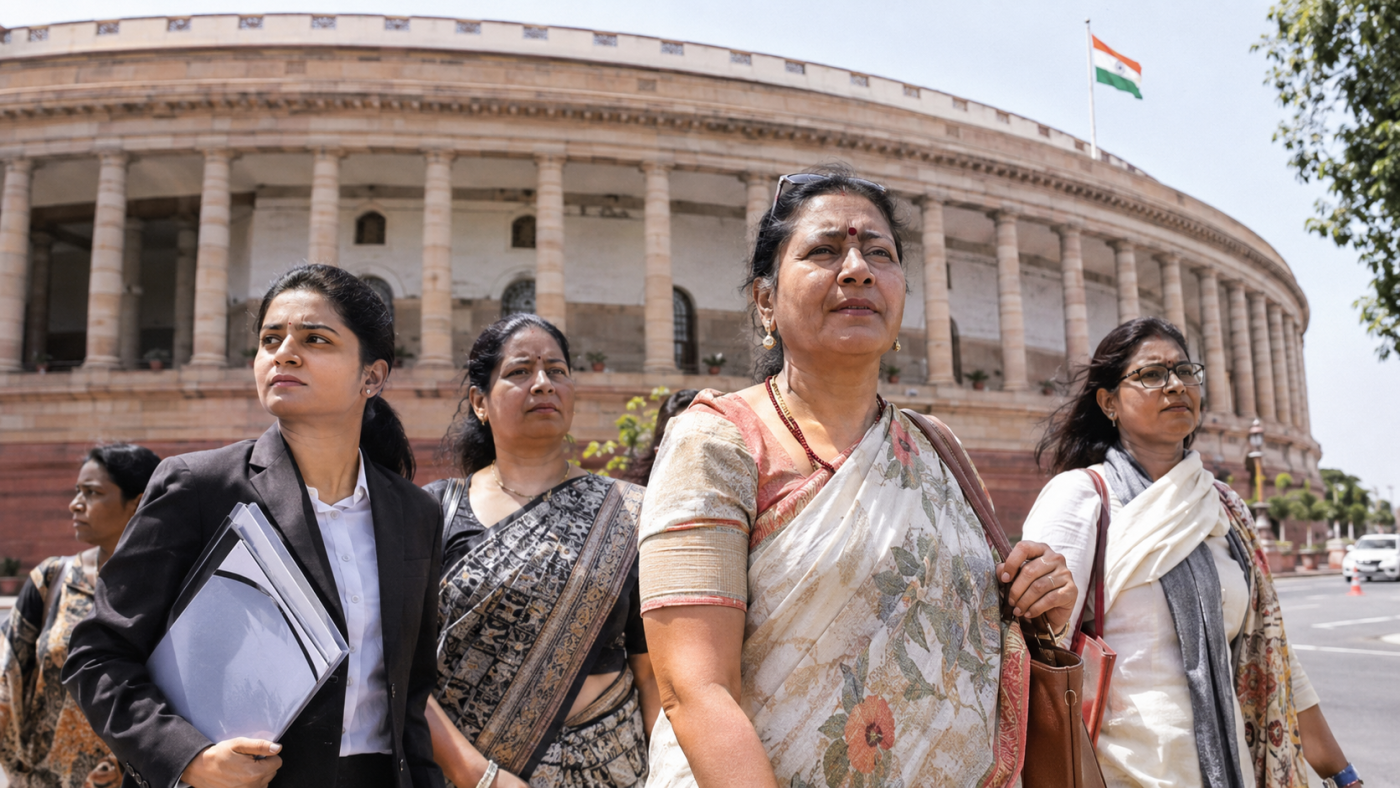
India's 33% women's reservation law remains unimplemented as disagreements over delimitation, Lok Sabha expansion and state representation threaten the government's ambition of introducing the quota before the 2029 general elections.
India's long-awaited promise of 33% reservation for women in the Lok Sabha and State Legislative Assemblies faces another political challenge as the Union government considers reviving constitutional amendments linked to the delimitation of parliamentary constituencies.
The controversy has intensified following the defeat of the Constitution (131st Amendment) Bill, 2026, which failed to secure the required parliamentary majority in April.
The BJP-led government wants to accelerate women's reservation, potentially before the 2029 Lok Sabha elections. However, opposition parties have raised concerns over the proposed expansion of Parliament and its implications for India's federal balance.
As of 21 November 2026, uncertainty continues over a proposed special parliamentary sitting. The Monsoon Session has remained formally unprorogued for 100 days, with no official date announced for a fresh debate.
The dispute raises a fundamental question: Can India implement women's reservation without significantly changing the political representation of its states?
What Is the Women's Reservation Act?
The Constitution (106th Amendment) Act, 2023, popularly known as the Nari Shakti Vandan Adhiniyam, provides for reserving approximately one-third of seats for women in the Lok Sabha, State Legislative Assemblies and Delhi Legislative Assembly.
The law also provides reservation for women within seats reserved for Scheduled Castes (SCs) and Scheduled Tribes (STs).
Although Parliament approved the legislation in September 2023, its provisions were formally brought into force on 16 April 2026.
However, the commencement of the law does not mean that reserved constituencies have already been introduced.
Under Article 334A, implementation requires a delimitation exercise following publication of relevant census figures.
This requirement has become central to the present political disagreement.
Why Did the 2026 Constitutional Amendment Fail?
On 16 April 2026, the government introduced three interconnected legislative proposals, including the Constitution (131st Amendment) Bill and the Delimitation Bill.
The proposals sought to facilitate an earlier delimitation exercise, potentially using the 2011 Census, rather than waiting for the results of Census 2027.
They also proposed increasing the Lok Sabha's constitutional maximum membership from 550 to 850. The House currently has 543 elected seats.
However, the constitutional amendment suffered a major defeat on 17 April 2026.
The voting result was:
-
298 MPs voted in favour.
-
230 MPs voted against.
-
352 affirmative votes were needed to satisfy the two-thirds majority requirement among members present and voting.
Despite receiving more votes in favour than against, the proposed amendment failed to meet the constitutional threshold.
Importantly, the defeat did not repeal the original women's reservation law enacted in 2023.
The government subsequently declined to proceed with voting on the two associated Bills.
Why Is Delimitation So Controversial?
Delimitation involves redrawing electoral constituencies and determining how parliamentary seats are distributed, generally using population data within the applicable constitutional framework.
India's distribution of Lok Sabha seats among states has remained largely frozen on the basis of the 1971 Census.
This arrangement was intended partly to ensure that states making progress in population stabilisation were not disadvantaged.
However, India's population has changed considerably, with different states experiencing different growth rates.
Northern states such as Uttar Pradesh and Bihar have recorded higher population growth than several southern states, including Tamil Nadu and Kerala.
A fresh population-based distribution could consequently increase the relative parliamentary influence of some states while reducing that of others.
According to an analysis by PRS Legislative Research, using 2011 population figures under an illustrative redistribution with the existing House size, Tamil Nadu's allocation could fall from 39 to 32 seats, while Uttar Pradesh's could increase from 80 to 89.
These are analytical projections, not approved constituency allocations.
Even if Parliament expands and every state gains seats, some states could still lose their proportionate share of national representation.
This is why delimitation is not merely a technical electoral exercise—it can influence India's political and federal balance for decades.
BJP Government vs Opposition: What Are Their Positions?
The BJP-led Union government, headed by Prime Minister Narendra Modi, has argued that women's political representation should not face further delays.
Prime Minister Modi and Union Home Minister Amit Shah supported the April legislation, portraying implementation of the quota as an important democratic reform.
The government has also explored approaches intended to address regional concerns while expanding parliamentary representation.
However, opposition parties, particularly the Congress, have questioned the necessity of linking women's reservation to a major delimitation exercise.
Congress has advocated implementing the quota while maintaining the existing 543-seat Lok Sabha and current state-wise allocation, rather than undertaking an immediate redistribution.
Opposition leaders argue that changes to parliamentary representation require broader consultation and safeguards for states with slower population growth.
The disagreement is therefore not simply over whether women should receive reservation, but over the constitutional and electoral method through which it should be implemented.
Could the 2029 Elections Include Women's Reservation?
The government's political objective has been to introduce women's reservation before the 2029 Lok Sabha elections.
However, achieving that target remains uncertain.
The existing constitutional framework links implementation to a delimitation exercise following the relevant census.
Census 2027 is underway, but completing population enumeration and finalising a nationwide delimitation exercise are separate processes.
PRS Legislative Research has assessed that completing delimitation based on Census 2027 before the 2029 elections is unlikely.
A revised constitutional amendment could offer an alternative legal pathway, but it would require Parliament's approval.
As of 21 November 2026, there is no confirmed guarantee that 33% women's reservation will apply in the 2029 general elections.
Also Read: Bihar’s General Category Protests Challenge BJP, Opposition
Why Has Parliament's Special Sitting Become Important?
Another development has added uncertainty to the political situation.
Both Houses of Parliament were adjourned indefinitely on 13 August 2026, but the Monsoon Session had not been formally prorogued as of 21 November.
This extended period has generated speculation that the government could reconvene Parliament to consider revised delimitation-related legislation.
According to reports published on 21 November, no official date or duration had been announced for the proposed special sitting.
Congress leader Jairam Ramesh has criticised the government's approach and questioned the absence of a publicly agreed revised proposal.
Meanwhile, the possibility of an amended legislative framework continues to attract political attention.
The next parliamentary debate could therefore prove decisive in determining whether the government can secure the constitutional majority missing in April.
Why Should Indian Voters Care?
The implications extend beyond political parties.
Women's reservation could significantly increase opportunities for women to participate directly in legislative decision-making.
At the same time, delimitation could affect constituency boundaries, the number of MPs representing individual states and the relative political influence of different regions.
For citizens, these changes concern the foundations of representative democracy.
The debate also raises questions about equal voting representation, federalism, social inclusion and constitutional accountability.
A lasting solution would need to address both women's political participation and the legitimate concerns surrounding state-wise representation.
Parliament Faces a Test of Constitutional Consensus
India has already recognised the constitutional importance of greater women's representation. What remains unresolved is how to deliver that commitment.
The April 2026 defeat demonstrated that constitutional reform requires more than political determination—it requires parliamentary consensus and compliance with constitutional procedures.
The government maintains that implementation should be accelerated, while opposition parties continue to demand safeguards against potentially unequal political consequences.
As Parliament considers its next steps, the central challenge is to ensure that expanding women's democratic representation does not undermine confidence in India's federal electoral framework.
Whether that balance can be achieved before 2029 remains one of the most consequential questions in Indian parliamentary politics.
Join the Conversation