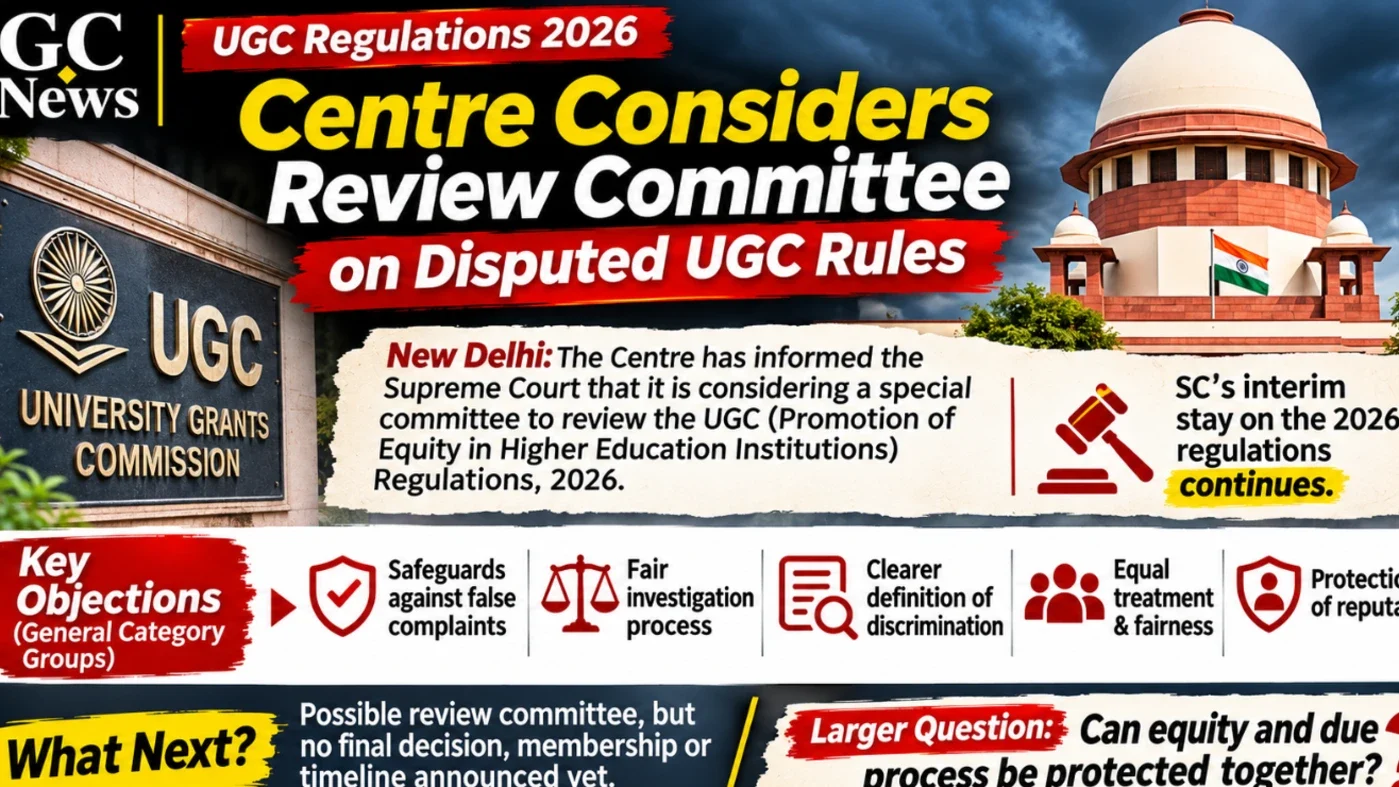
New Delhi: The controversy surrounding the University Grants Commission (Promotion of Equity in Higher Education Institutions) Regulations, 2026, has taken another turn, with the Central Government informing the Supreme Court that it is considering the formation of a special committee to review the disputed regulations.
During proceedings reported on November 5, the Centre indicated that it was contemplating a review committee. However, no final decision regarding the committee's formation, membership, or timeline was announced.
The Supreme Court's interim stay on the 2026 regulations continues, meaning the new framework cannot presently be implemented.
Why Did the Supreme Court Stay the UGC Regulations?
The UGC notified the Promotion of Equity in Higher Education Institutions Regulations, 2026, on January 13, 2026.
The regulations were intended to strengthen institutional mechanisms for addressing discrimination in universities and other higher education institutions.
However, the new framework attracted objections from General Category students, organisations, and other stakeholders who questioned whether the regulations provided adequate procedural safeguards for everyone involved.
On January 29, 2026, the Supreme Court stayed the regulations, expressing concerns about provisions described as too vague and too sweeping.
The interim order prevented the new regulations from taking effect while the legal challenges continued.
Importantly, the regulations have been stayed, not permanently struck down. Their final legal status will depend on further judicial proceedings and any subsequent government action.
What Were the Main Objections Raised by General Category Students?
Several General Category organisations and student groups argued that the 2026 framework required reconsideration before implementation.
Their principal concerns included:
-
Protection against false or malicious complaints: Critics argued that the regulations needed clearer provisions to address deliberately false allegations while protecting genuine complainants.
-
Fair investigation procedures: Questions were raised about whether students and faculty accused of discrimination would receive adequate opportunities to respond before adverse findings or institutional action.
-
Clarity in the definition of discrimination: Opponents argued that broad or ambiguous terminology could create uncertainty about which conduct would amount to a violation.
-
Equal treatment and institutional fairness: General Category stakeholders sought safeguards to ensure that complaint-handling procedures did not create unfair treatment based on caste identity.
-
Protection of reputation: Concerns were expressed that allegations could cause reputational harm before an inquiry established the facts.
These were objections raised by stakeholders, rather than findings that every provision of the regulations was unconstitutional.
What Does the Supreme Court Stay Mean for General Category Students?
For General Category students and faculty who opposed the 2026 regulations, the interim stay represents an important development.
The regulations cannot currently be enforced, and the government has an opportunity to reconsider the disputed provisions.
However, the stay does not eliminate existing legal protections against discrimination or prevent educational institutions from taking action under other applicable laws and policies.
The potential review committee could provide an opportunity to examine demands for clearer definitions, impartial investigations, due process, and safeguards against malicious complaints.
Whether those demands will be incorporated into any revised framework remains uncertain.
What About SC, ST, and OBC Students?
The 2026 regulations were designed to strengthen protections against discrimination in higher education, including provisions addressing caste-based discrimination affecting SC, ST, and OBC students.
Supporters of the regulations argued that stronger institutional accountability was necessary to address discrimination and improve access to effective grievance-redressal mechanisms.
With the 2026 regulations stayed, the earlier 2012 framework continues to apply.
This has also raised concerns among those who believe the older framework does not provide sufficiently strong enforcement mechanisms.
Any future review will therefore have to address two significant concerns: ensuring effective protection against discrimination and guaranteeing fair procedures for everyone involved in a complaint.
What Happens Next?
The Central Government's statement about contemplating a review committee suggests that the disputed regulations may undergo further examination.
However, as of the November 5 development, the following matters remained unresolved:
-
Whether the government would formally constitute the committee.
-
Who would serve as its members.
-
Whether General Category student representatives and other affected stakeholders would be consulted.
-
Whether the committee would recommend amendments or an entirely revised framework.
-
When the Supreme Court would next consider the matter and whether the interim stay would continue.
A committee being considered is not the same as a committee being officially constituted. Any announcement of its formation should therefore be supported by a formal government notification.
The Larger Question: Can Equity and Due Process Be Protected Together?
The UGC regulations controversy has generated a wider debate about how Indian universities should address discrimination while ensuring fairness to complainants and respondents.
General Category organisations have demanded safeguards against misuse and greater clarity in the regulatory framework. At the same time, student groups advocating stronger anti-discrimination protections have emphasised the importance of accessible and effective remedies.
The challenge for policymakers is to develop rules that are clear, constitutionally sound, enforceable, and procedurally fair.
For now, the Supreme Court's interim stay remains in effect, the 2012 framework continues to operate, and the proposed review committee remains a matter of government consideration rather than a confirmed institutional process.
GC News | GCNews.in
Category: Supreme Court | UGC | Education Policy | General Category Issues
Report based on the supplied November 5, 2026 case summary. The latest court order, government notification, and committee status should be independently verified before publication.

Join the Conversation