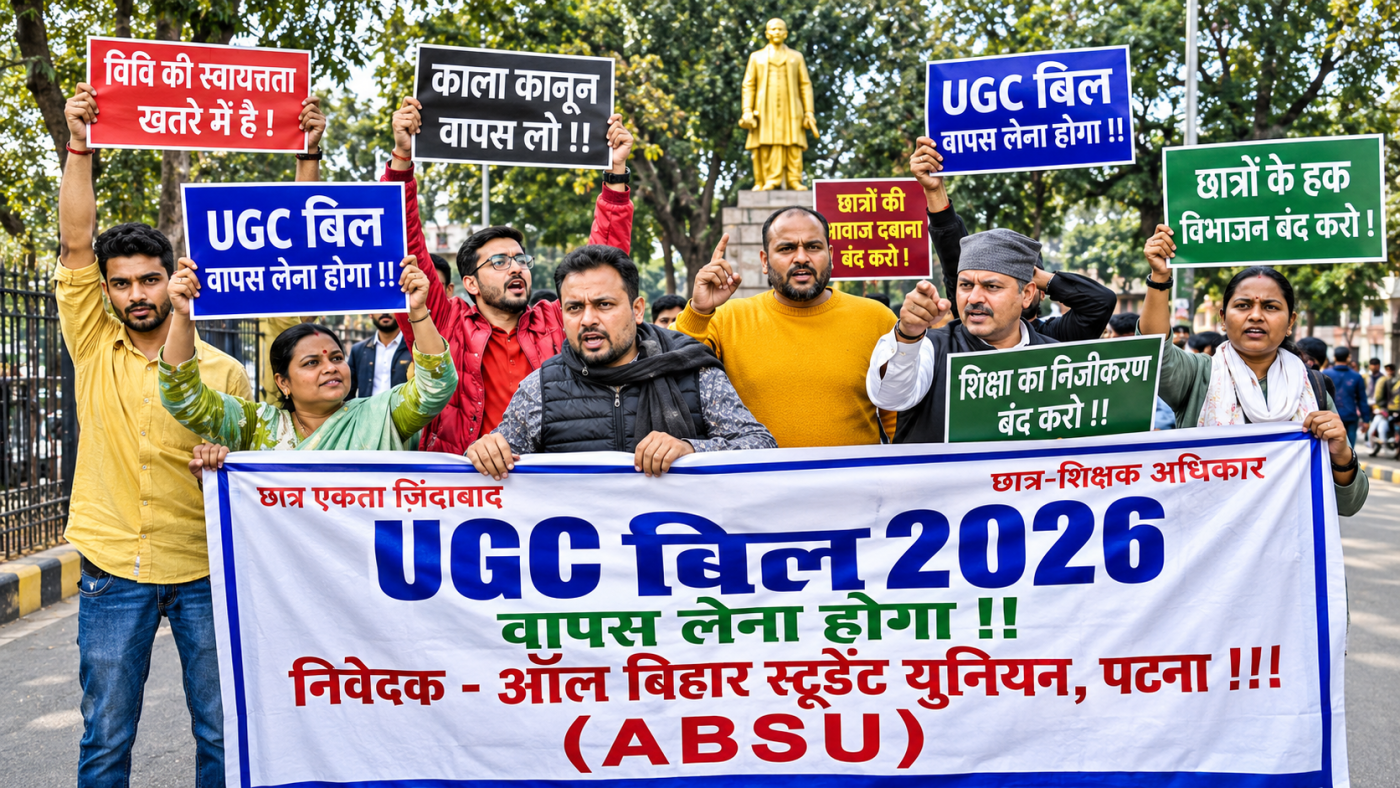
Reported calls for a political boycott amid anger over UGC regulations, the SC/ST Act and reservation policies reflect a growing demand among sections of Bihar’s General Category community for answers from political leaders across party lines.
A political disagreement that began with objections to university regulations has developed into a broader confrontation over representation, legal safeguards and the responsibility of political parties towards citizens who believe their concerns have been overlooked.
In Bihar, sections of the General Category community are questioning not only the policies of the Bharatiya Janata Party-led Union government but also the response of opposition parties to issues involving caste-based legislation, educational equality and reservation.
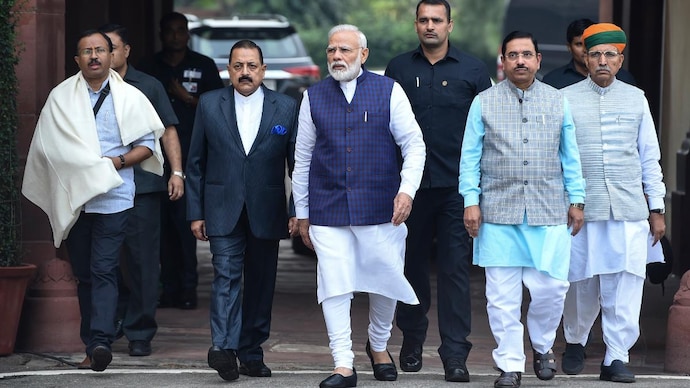
A reported call to boycott Prime Minister Narendra Modi's rally on November 23, along with political leaders from other parties who do not address General Category concerns, illustrates the direction of this debate. However, the specific announcement and its organisers have not yet been independently verified. The Prime Minister's officially confirmed Bihar programme took place in Vaishali on November 21, making clarification of the reported November 23 event essential.
Even without confirmation of that particular boycott announcement, the underlying political discontent is well documented.
The dispute raises a question extending beyond one political party: How should elected representatives respond when sections of the electorate believe that their grievances are receiving inadequate political attention?
Also Read: PM Modi asks firms about pay hikes, cites tax relief on income up to ₹12 lakh
From Campus Regulations to a Wider Political Dispute
The University Grants Commission's Promotion of Equity in Higher Education Institutions Regulations, 2026, notified on January 13, became a major point of contention shortly after their introduction.
The regulations were intended to strengthen institutional mechanisms against discrimination in higher education, particularly discrimination affecting historically disadvantaged communities.
However, critics from General Category organisations challenged provisions defining caste-based discrimination specifically in relation to Scheduled Castes, Scheduled Tribes and Other Backward Classes.
They argued that students from the General Category could also experience caste-based hostility and that the regulations should expressly recognise their entitlement to protection.
The distinction is legally important. Although the regulations contained a broader definition of discrimination applying to stakeholders generally, the narrower definition of caste-based discrimination became the centre of the controversy.
On January 29, the Supreme Court stayed the implementation of the 2026 regulations, expressing concern over their wording and possible consequences. The earlier 2012 regulations consequently remained applicable.
The government subsequently indicated that the provisions were under reconsideration. On November 5, the Centre informed the Supreme Court that it was contemplating a committee to review the framework.
Yet the continued protests suggest that, for some organisations, the controversy is no longer confined to the text of a university regulation.
It has become a question of political confidence.
Bihar’s Protests Show That the Discontent Is Real
The General Category protests in Bihar are not confined to social media discussions.
In January, protesters in Patna demonstrated against the UGC regulations, alleging that the proposed framework could encourage divisions among students. Demonstrations were also reported in Nawada, where protesters criticised the Union government and demanded withdrawal of the disputed provisions.
In Muzaffarpur, Savarna Samaj Sangharsh Morcha announced a protest programme covering the UGC regulations, the SC/ST (Prevention of Atrocities) Act and the reservation system.
These developments establish that opposition to the regulations has found organised expression within parts of Bihar.
However, the existence of demonstrations does not establish that the entire General Category population shares identical demands, supports a particular protest strategy or intends to boycott political events.
That distinction matters, particularly when individual organisations claim to speak for communities containing millions of people with different political and social views.
The Controversy Surrounding the So-Called “Modi Act”
Another issue raised by activists is the Scheduled Castes and Scheduled Tribes (Prevention of Atrocities) Act.
Some critics have adopted the political expression “Modi Act” while referring to the legislation and its amendments. The term is not its official legal name.
The original Act was enacted in 1989, before Narendra Modi became Prime Minister. Parliament amended it in 2018 under the BJP-led government following a controversy over procedural safeguards and arrest provisions.
The legislation aims to prevent atrocities and protect Scheduled Caste and Scheduled Tribe communities from discrimination, violence and humiliation.
Critics have expressed concerns about the possibility of false allegations, wrongful implication and the adequacy of procedural protections.
Those supporting the legislation emphasise its role in addressing caste-based atrocities, barriers to justice and the historical vulnerability of marginalised communities.
The debate therefore involves two serious considerations: ensuring effective protection for victims of caste-based offences and safeguarding individuals against wrongful prosecution.
Neither concern can be resolved simply through political slogans.
In September 2026, the Supreme Court dismissed a public interest litigation challenging provisions of the Act and its amendments, observing that legal safeguards against misuse already existed.
For policymakers, the issue remains how to maintain the law's protective purpose while ensuring fair investigation, due process and public confidence.
Why the Reported Boycott Call Goes Beyond the BJP
The most politically significant aspect of the reported boycott appeal is its claimed extension to opposition parties.
A protest directed solely at the Prime Minister could be interpreted as dissatisfaction with the Union government's decisions.
A call extending to politicians across party lines, however, reflects a different argument: political accountability should not depend on whether a leader belongs to the ruling party or the opposition.
The BJP leads the Union government and therefore faces questions regarding policies introduced under its administration.
Opposition parties, meanwhile, can be questioned about their own legislative positions, public statements and proposed alternatives.
This does not mean every party holds the same position, bears the same responsibility or has the same ability to change a particular law.
It means that political debate increasingly concerns not only who introduced a policy but also who supports it, who opposes it, who proposes amendments and who offers a reasoned explanation.
The distinction between political allegiance and issue-based representation is central to understanding the dispute.
General Category Concerns and Social Justice Are Not Necessarily Opposing Objectives
The controversy also exposes a larger difficulty in India's caste-policy debates.
General Category protesters demanding stronger safeguards and fair treatment should not automatically be understood as opposing the dignity or constitutional rights of historically disadvantaged communities.
Equally, legislation protecting Scheduled Castes, Scheduled Tribes and Other Backward Classes cannot be understood without recognising the documented history and continuing reality of caste discrimination.
India's constitutional framework seeks to reconcile equality before the law with measures designed to address entrenched social disadvantage.
The challenge is not simply whether one group receives recognition.
It is whether public institutions can protect vulnerable communities, provide accessible remedies to everyone facing unlawful discrimination and apply legal safeguards consistently.
The concerns raised by General Category organisations deserve examination on their legal and factual merits, just as the experiences of communities protected by affirmative-action policies require serious consideration.
An informed debate must also distinguish between the General Category as an administrative classification and the diverse economic and social circumstances of individuals within it.
These are complicated questions of law, institutional design and public policy. Reducing them to accusations against entire communities risks obscuring the actual issues.
The Questions Political Leaders Still Face
The documented protests and continuing litigation place several substantive questions before the government and opposition.
Can the UGC create an anti-discrimination framework that explicitly addresses the concerns of all students while retaining effective protections for communities facing persistent caste-based disadvantage?
What procedural protections are appropriate under special criminal legislation, and how can those safeguards operate without making it harder for genuine victims to obtain justice?
How should reservation policy respond to continuing social inequality, economic disadvantage and demands for transparency?
And, importantly, how will elected representatives explain their positions to citizens who disagree with them?
These questions are not answered by the size of a political rally, the visibility of a protest or the intensity of social media debate.
They require evidence, legislative clarity, public consultation and reasoned responses.
The Centre's proposed review of the UGC regulations may provide an opportunity to address at least one part of the dispute. Whether it produces a revised framework that satisfies constitutional requirements and addresses competing concerns remains to be seen.
A Test of Representation, Not Just Party Loyalty
The emerging debate in Bihar reflects a wider tension in democratic politics: the relationship between collective identity, public policy and political representation.
Organisations calling for boycotts are exercising a form of political expression. Political parties, in turn, are entitled to defend their policies and challenge the arguments made against them.
But the effects of such campaigns should not be assumed in advance.
An announced boycott is not evidence of widespread participation. A protest gathering does not necessarily translate into a common electoral position. Nor does criticism of a particular law establish agreement over what should replace it.
What is already evident is that sections of the General Category community are seeking a more direct discussion of their concerns regarding higher education, criminal-law safeguards and reservation policy.
The resulting debate reaches beyond the Prime Minister, beyond the BJP and beyond any single opposition party.
The central question is no longer merely which political leader faces criticism. It is whether India's political institutions can respond to competing demands for equality, protection and representation without treating the legitimate concerns of one community as a threat to the rights of another.
That is the deeper political significance of the unrest in Bihar—and the question that will remain after the slogans, demonstrations and rallies have ended.
Nice Nice
Thank you ma'am
Very well explained and insightful article. The author has highlighted important issues with clarity and a balanced perspective. Excellent analysis and great work by GC News.
Yes, I have been following this website for the past 12 days, and I’m genuinely impressed by the consistently high-quality, well-researched articles they publish.
Thank you ma'am
An important issue that deserves greater public attention. Political parties must listen to people's concerns rather than treating them as mere vote banks. The article raises some serious questions worth discussing.
Thank you sir 🙂
Every community deserves to have its concerns heard and addressed fairly. It's good to see discussions about these issues gaining attention. Political leaders should focus on genuine dialogue and equal opportunities for everyone.
Yes absolutely
We would love to see an open discussion forum where readers can freely share their opinions, exchange ideas, and engage in meaningful conversations on important topics. If anyone from the GC News team is reading this comment, I sincerely request you to consider developing a dedicated discussion platform that encourages open dialogue, respectful debate, and constructive participation.
Okay, Ma’am. I’ll discuss this with the team and get back to you. Thank you for showing interest in my article. I truly appreciate it.
Thank you ma'am