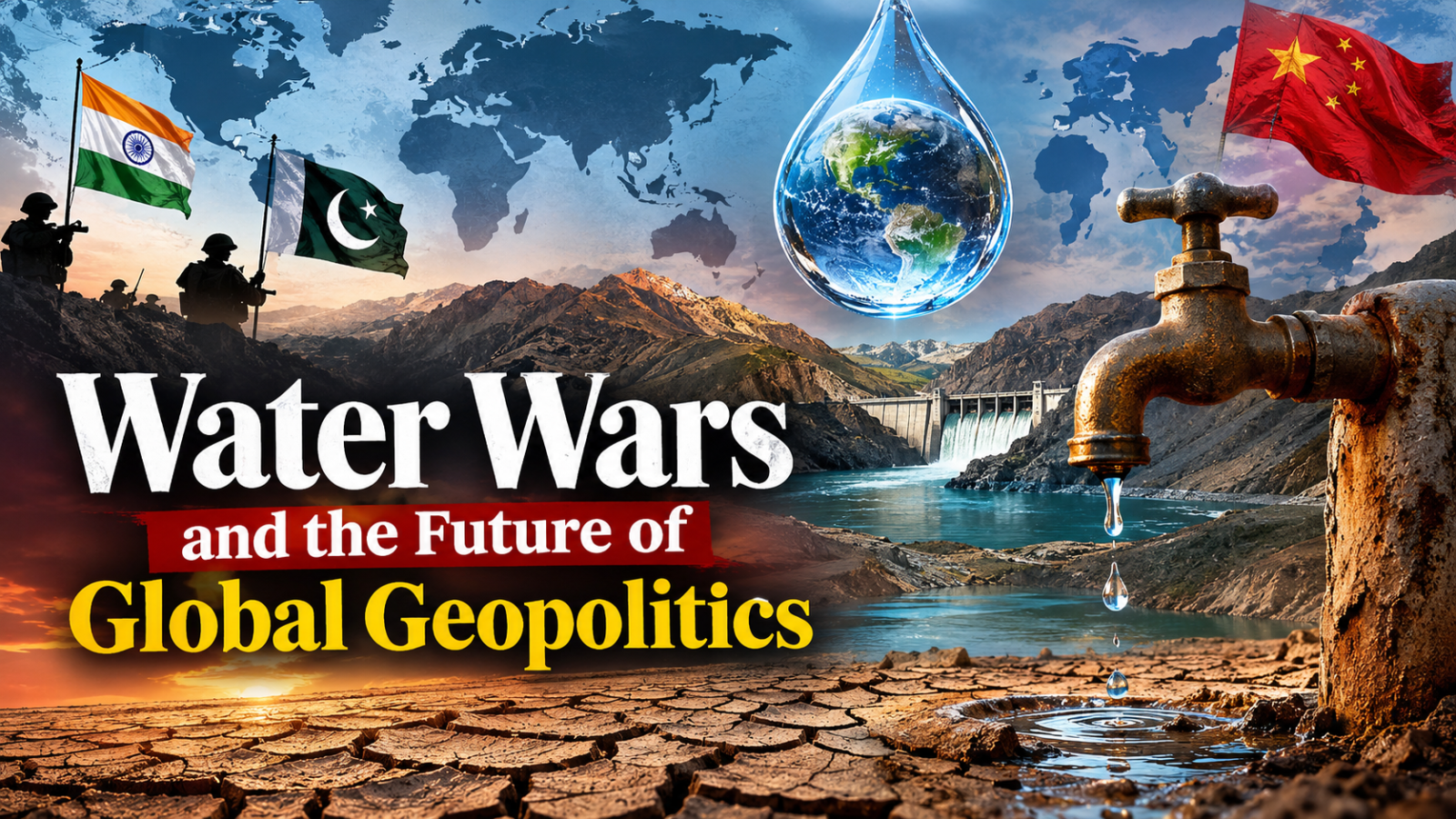
Water is becoming one of the most consequential resources in global geopolitics. As populations grow, economies expand and climate patterns change, access to reliable freshwater is increasingly connected to national security, food production, energy supplies and international relations. What was once treated primarily as an environmental and development concern is now an important issue in strategic planning and diplomatic negotiations.
Rivers do not follow political borders. A dam constructed in one country can influence water management downstream, while prolonged drought in one region can place pressure on agriculture, food prices and migration across much wider areas. Groundwater depletion, pollution and rising demand can further complicate relations between countries that depend on the same water systems.
The scale of the challenge is significant. According to UN-Water, approximately four billion people experience severe water scarcity for at least one month each year. Agriculture accounts for roughly 70–72% of global freshwater withdrawals, making reliable water supplies essential to food security and economic stability.
These pressures have increased the strategic importance of shared rivers, lakes and aquifers. From the Indus River system in South Asia to the Tigris and Euphrates in the Middle East, water management can influence diplomatic relations, regional security and development priorities.
However, the emergence of what are often called water wars does not mean that conflict is inevitable. Water scarcity can intensify existing disagreements, but shared resources can also encourage cooperation. The future of global water politics will depend on whether governments choose to manage scarcity through transparent agreements and practical diplomacy or allow competition and mistrust to undermine regional stability.
1. Why Water Is Becoming a Geopolitical Issue
Freshwater is essential to nearly every major economic and social system. It supports agricultural production, manufacturing, electricity generation, public health and the functioning of cities. When access becomes unreliable, the consequences extend well beyond households and the environment.
Unlike many traded commodities, water is difficult to replace on a large scale. Countries cannot always import enough freshwater to compensate for declining river flows or depleted aquifers. They may also face geographical limitations, inadequate infrastructure and high transportation costs.
Water Security and National Security
Governments increasingly recognise that water insecurity can affect a country's ability to maintain economic growth and protect public welfare. Agricultural shortages can affect food supplies, industrial disruptions can reduce economic output, and inadequate drinking-water access can place additional pressure on public services.
These problems become particularly sensitive when a country depends on a river that originates beyond its borders.
An upstream country may have greater control over reservoirs, dams and certain infrastructure decisions. Downstream countries may consequently be concerned about changes in river flows, especially when they depend on predictable water supplies for irrigation, electricity generation and drinking water.
Such geographical differences do not automatically give an upstream state unlimited control over a river. Water use is influenced by infrastructure, seasonal conditions, environmental requirements, national laws and applicable international agreements.
The Difference Between Water Scarcity and Water Conflict
Water scarcity and water conflict are related, but they are not the same.
A country may experience serious water shortages without entering into an international dispute. Effective planning, conservation, infrastructure investment and agreements with neighbouring countries can help manage limited supplies.
Conversely, even a region with considerable water resources may experience political tensions if governments distrust one another, water access is unequal or shared resources are managed without effective consultation.
The geopolitical risk therefore depends not only on how much water is available but also on who controls access, how decisions are made and whether institutions can resolve disagreements peacefully.
2. India and Pakistan: The Strategic Importance of the Indus River System
The Indus River system is one of South Asia's most important shared freshwater resources. It supports agriculture, electricity generation and millions of livelihoods across India and Pakistan, making its management central to regional water security.
The Indus Waters Treaty was signed in 1960 with the involvement of the World Bank. It established arrangements governing the use of the river system and provided mechanisms for resolving certain disagreements between the two countries.
For decades, the treaty served as an important framework for managing water-related disputes despite repeated periods of political tension and military confrontation.
However, disagreements over hydropower projects, technical provisions and the interpretation of treaty obligations have placed the agreement under increasing strain.
The Indus Waters Treaty Dispute in 2026
The treaty's status became a particularly contentious issue after India announced in April 2025 that it was placing the agreement in abeyance following the deadly Pahalgam attack in Kashmir. India accused Pakistan of supporting cross-border terrorism, an allegation Pakistan has denied.
On August 31, 2026, the Court of Arbitration operating under the Permanent Court of Arbitration's secretariat issued an award concerning the treaty's status and an order on interim measures involving India's Ratle hydroelectric project.
The Court of Arbitration concluded that the Indus Waters Treaty remained fully in force and that India's decision to place it in abeyance did not legally suspend or terminate the agreement. India rejected the court's jurisdiction and stated that the ruling would not affect its actions.
The dispute illustrates the difference between a court's legal findings and the position maintained by a government. It also highlights the difficulty of managing shared natural resources when disagreements over security and international law become intertwined.
Sources: Permanent Court of Arbitration and Reuters reporting on the August 31, 2026, award.
Why the Dispute Matters Beyond South Asia
The consequences of uncertainty surrounding the Indus Waters Treaty extend beyond diplomatic relations.
Water availability is important to agricultural planning, electricity generation and the livelihoods of communities that depend on the river system. Uncertainty over the interpretation or implementation of shared-water arrangements can complicate long-term investment and resource management.
The case also demonstrates that water-sharing agreements are not isolated technical documents. They can become closely connected to national security, international arbitration and wider diplomatic relationships.
The broader lesson is that durable water governance requires clear rules, credible dispute-resolution mechanisms and sustained communication, particularly when relations between neighbouring countries deteriorate.
3. China, the Himalayas and Downstream Water Security
The Tibetan Plateau and the wider Himalayan region are important sources of freshwater for several major Asian river systems. Changes in water management in upstream areas can affect communities and economies across China, India, Bangladesh and other parts of the region.
One particularly important river is the Yarlung Tsangpo, which flows into India and becomes the Brahmaputra before continuing into Bangladesh.
The river supports agriculture, fisheries, ecosystems and communities that depend on seasonal flows. Its importance makes information sharing and cooperation between upstream and downstream countries essential.
Hydropower Development and Strategic Uncertainty
China's development of hydropower infrastructure on rivers originating in the Tibetan Plateau has prompted questions about downstream water security, environmental impacts and the availability of reliable hydrological information.
Large infrastructure projects can bring legitimate benefits, including electricity generation and economic development. At the same time, downstream countries have an interest in understanding how changes in river management may affect flood risks, ecosystems and seasonal water availability.
The actual effects depend on the design and operation of individual projects, local environmental conditions and the characteristics of each river system. The construction of a dam should not automatically be interpreted as evidence that a country intends to use water as a political weapon.
Nevertheless, limited information exchange can increase uncertainty. When neighbouring governments lack reliable data or effective consultation, even routine infrastructure decisions may generate suspicion.
Why India and Bangladesh Need Reliable Water Cooperation
For India and Bangladesh, the Brahmaputra is an important environmental and economic resource. Agricultural production, fisheries and livelihoods depend on its flows, while floods can cause considerable damage to communities and infrastructure.
Effective cooperation could include timely sharing of hydrological data, flood warnings, environmental assessments and technical discussions about major infrastructure projects.
Such arrangements would not eliminate every disagreement. They could, however, help countries distinguish genuine environmental and water-management risks from political speculation.
Water diplomacy in the Himalayas will therefore depend on combining domestic development priorities with transparency, scientific information and attention to the interests of downstream communities.
4. The Middle East: Water Scarcity and Regional Stability
Water insecurity is a major concern across parts of the Middle East, where arid climates, limited rainfall, growing demand and pressure on groundwater resources create significant management challenges.
Several countries depend on river systems that cross international borders. The Tigris and Euphrates connect Turkey, Syria and Iraq, while the Jordan River basin involves several countries and is closely associated with wider political and territorial disputes.
These river systems demonstrate how freshwater management can become intertwined with agriculture, electricity generation, economic development and national security.
Turkey, Syria and Iraq: The Tigris-Euphrates Basin
The Tigris and Euphrates rivers support farming, urban water supplies and economic activity across their basin. Dams and irrigation infrastructure play important roles in water management, but decisions made upstream can influence the availability and timing of flows downstream.
Drought, changing rainfall patterns, rising temperatures and inefficient water use can place additional pressure on these shared resources.
For downstream communities, reduced water availability may affect crop production, household supplies and local employment. For governments, the challenge is to balance domestic development with the interests of neighbouring countries.
Water cooperation is especially important when these pressures coincide with political instability or humanitarian challenges. Technical agreements on data sharing, drought preparedness and infrastructure management can help reduce avoidable risks.
The Jordan River Basin and Unequal Access
The Jordan River basin provides another example of the relationship between water security and regional politics.
Access to freshwater, infrastructure development, groundwater use and competing demands have long formed part of the region's complex political landscape. Water availability also affects agriculture, public health and the ability of communities to meet everyday needs.
Groundwater depletion adds a further challenge. Excessive extraction can reduce the long-term reliability of supplies and increase the cost of providing water to households and farms.
Desalination has expanded water supplies in several Middle Eastern countries, but it requires substantial investment, energy and infrastructure. It cannot resolve every problem involving groundwater depletion, agricultural demand or unequal access.
The region's experience demonstrates why water management must combine infrastructure development with conservation, effective institutions and cooperation wherever shared resources are involved.
5. Climate Change and the Growing Risk of Water Stress
Climate change is altering the conditions under which countries manage freshwater. Changes in precipitation, higher temperatures, changing snow and glacier patterns, and more intense droughts and floods can make water availability less predictable.
These changes do not affect every region in the same way. Some areas experience prolonged droughts, while others face destructive flooding or changes in the seasonal timing of river flows.
Agriculture and Food Security
Agriculture is particularly exposed to water insecurity. According to UN-Water, approximately 72% of global freshwater withdrawals are used for agriculture.
When water becomes scarce, farmers may struggle to irrigate crops, livestock production can become more expensive, and food supplies may become more vulnerable to weather-related disruption.
The effects can extend to international markets. Reduced agricultural output in one major producing region may influence food prices elsewhere, particularly when several regions face shortages simultaneously.
Countries that rely heavily on imported food can consequently become more exposed to water-related shocks occurring beyond their borders.
Glaciers and Seasonal River Flows
Glaciers and snowpacks contribute to seasonal water supplies in several mountainous regions. Changes in melting patterns can alter the timing and reliability of flows, affecting communities that depend on these sources for irrigation, drinking water and hydropower.
In parts of Asia, Himalayan and Tibetan water systems are particularly important because they support large populations across multiple countries.
However, climate change is not the only cause of water insecurity. Unsustainable groundwater extraction, poor infrastructure, pollution, inefficient irrigation and weak governance can intensify the effects of climatic changes.
Effective adaptation therefore requires both climate planning and better everyday water management.
6. Can Water Become a Tool of Geopolitical Pressure?
Water infrastructure can have strategic significance because dams, reservoirs, canals and diversion systems influence how water is stored, released and distributed.
An upstream country may possess geographical advantages over downstream neighbours, particularly when the latter depend heavily on river flows. This imbalance can create political sensitivity when water-sharing arrangements are weak or relations are strained.
However, describing every dam or water dispute as an attempt to exert political pressure would oversimplify the evidence. Many infrastructure projects serve legitimate economic purposes, including electricity production, flood management and irrigation.
The key questions are how water is managed, what obligations apply, how downstream impacts are assessed and whether countries have effective means to resolve disagreements.
The Risk of Mistrust and Miscalculation
Water-related tensions can intensify when governments lack reliable information or interpret another country's infrastructure decisions as a threat.
For example, a change in reservoir operations may be influenced by rainfall, electricity demand or flood-control requirements. Without timely information, neighbouring countries may struggle to determine whether a change reflects ordinary resource management or a more consequential decision.
Clear communication and predictable operating arrangements can reduce this uncertainty.
Why International Law Matters
International agreements and legal principles provide frameworks for managing shared watercourses. They can establish expectations for cooperation, information exchange and the peaceful resolution of disagreements.
Their effectiveness depends on the arrangements that countries have accepted, the institutions responsible for implementation and the willingness of governments to follow agreed procedures.
Water can become an instrument of political tension, but shared dependence can also give governments a strong reason to maintain dialogue.
7. Why International Water Cooperation Matters
International water cooperation is important because a large proportion of the world's freshwater flows across national borders.
According to UN-Water's 2024 assessment, 153 UN Member States share transboundary rivers, lakes or aquifers. Yet only 43 had operational cooperation arrangements covering at least 90% of their transboundary basin areas. Just 26 countries had operational arrangements covering all their shared transboundary waters.
The assessment defines operational cooperation in terms of practical arrangements such as joint bodies, regular meetings, information exchange and coordinated management plans.
These figures highlight an important gap between the geographical reality of shared water and the institutional arrangements available to manage it.
What Effective Cooperation Looks Like
Countries can reduce uncertainty by establishing regular communication channels, exchanging hydrological information and coordinating responses to droughts and floods.
Joint river-basin organisations can help governments assess environmental conditions, plan infrastructure and consider downstream consequences.
International development institutions can also support wastewater treatment, improved irrigation, conservation and climate-resilient water infrastructure.
Cooperation does not require neighbouring countries to agree on every political issue. It can begin with practical measures that provide mutual benefits, such as flood warnings, shared monitoring systems and transparent data exchange.
These arrangements can help protect populations while creating channels for dialogue during periods of wider diplomatic tension.
Source: UN-Water, Progress on Transboundary Water Cooperation — 2024 Update.
8. The Economic and Human Costs of Water Insecurity
The consequences of water scarcity extend far beyond international diplomacy. Inadequate or unreliable water supplies can affect agricultural output, public health, industrial production, household incomes and government expenditure.
Rural communities may be particularly vulnerable when farming depends on unpredictable rainfall or declining groundwater levels. Lower agricultural productivity can reduce household incomes and place additional pressure on already vulnerable families.
Urban areas face different challenges, including rapid population growth, ageing infrastructure, contamination and unequal access to reliable supplies.
Industries that depend on substantial quantities of water may also face higher costs or production interruptions. Hydropower generation and other forms of electricity production can be affected when water supplies become insufficient.
These pressures can deepen existing inequalities. Wealthier households and businesses may be better able to purchase alternative supplies or invest in conservation, while poorer communities may have fewer options.
Water Security and Migration
Water-related pressures can contribute to decisions about where people live and work. When repeated droughts, declining agricultural incomes or unreliable public services undermine livelihoods, some households may consider moving elsewhere.
Migration is rarely driven by water scarcity alone. Employment opportunities, conflict, public services, family circumstances and government policy also influence people's decisions.
Nevertheless, water insecurity can become an important factor when communities already face economic or environmental difficulties.
Investments in reliable water services and sustainable resource management can therefore support public health, economic resilience and social stability.
9. How Governments Can Prevent Water Disputes from Escalating
Water-related tensions cannot be addressed through diplomacy alone. Effective responses require cooperation between national governments, local authorities, scientists, agricultural communities and international institutions.
Strengthen Existing Agreements
Governments should maintain credible mechanisms for implementing water-sharing arrangements and resolving disagreements. Where agreements need updating, negotiations should account for changing environmental conditions, population growth and evolving patterns of demand.
Dispute-resolution procedures can help prevent technical disagreements from becoming prolonged political confrontations.
Invest in Water Efficiency
Reducing unnecessary water consumption can ease pressure on shared resources.
Efficient irrigation, leakage reduction, wastewater reuse and sustainable groundwater management can improve the long-term reliability of water supplies. Policies should also consider environmental requirements and the needs of communities that depend on rivers, wetlands and aquifers.
Improve Data Sharing and Early Warning Systems
Accurate information about river flows, rainfall, groundwater levels and reservoir conditions can help countries prepare for shortages and floods.
Shared monitoring systems and reliable early warning arrangements can reduce uncertainty and support evidence-based decision-making.
These measures are particularly important in regions where downstream communities face significant risks from seasonal flooding or prolonged drought.
Include Communities in Water Decisions
Water decisions affect farmers, households, industries and ecosystems. Governments should therefore involve affected communities and relevant technical experts when developing water-management policies.
Transparent decision-making can help identify problems early, improve public confidence and reduce the risk that water allocation becomes a source of social tension.
Connect Water Policy With Climate and Food Security
Water management should not be treated as a separate policy area. Agriculture, energy, urban development and climate adaptation all influence how freshwater is used and distributed.
Coordinated planning can help governments anticipate future demand, protect essential services and reduce the effects of extreme weather.
No single measure will eliminate water insecurity, but a combination of sustainable resource management, effective institutions and international cooperation can make disputes easier to manage.
Conclusion: Water Security Will Shape the Future of Global Geopolitics
Water scarcity is becoming a significant issue in international relations because it connects environmental change with food security, economic development and national interests. The Indus River system, the Brahmaputra and the rivers of the Middle East show how water-management decisions within one country can affect communities and governments beyond its borders.
Climate change, rising demand and unsustainable resource use will make effective water governance increasingly important. Yet water shortages do not make international conflict inevitable. The consequences will depend on how governments manage shared resources, respond to changing conditions and maintain diplomatic cooperation.
The continuing dispute over the Indus Waters Treaty illustrates the complexity of water diplomacy when environmental resources intersect with security concerns and competing legal positions. Elsewhere, river-basin cooperation, reliable information exchange and joint planning can help countries manage uncertainty without escalating political disagreements.
The long-term response must include stronger water-sharing agreements, climate-resilient infrastructure, more efficient water use and fair access to essential supplies. Governments should also recognise that water insecurity is not only an interstate issue: it can undermine public health, livelihoods, food systems and economic development within their own borders.
Ultimately, water may contribute to geopolitical tension, but it can also provide a foundation for cooperation. Countries that recognise their shared dependence on freshwater and invest in transparent, sustainable management will be better equipped to protect their populations and navigate an increasingly uncertain global environment.
Water security is therefore more than an environmental priority. It is an essential part of long-term economic resilience, regional diplomacy and international stability.
Sources and Further Reading
-
UNESCO — United Nations World Water Development Report 2024: Water for Prosperity and Peace.
https://www.unesco.org/en/reports/wwdr/2024 -
UN-Water — Progress on Transboundary Water Cooperation: 2024 Update.
https://www.unwater.org/publications/progress-transboundary-water-cooperation-2024-update -
UN-Water — Water Scarcity: Facts and Figures.
https://www.unwater.org/water-facts/water-scarcity -
Permanent Court of Arbitration — Indus Waters Western Rivers Arbitration, Case No. 2023-01.
https://pca-cpa.org/en/cases/284/ -
Reuters — India Must Uphold Water-Sharing Treaty With Pakistan, Arbitration Court Says, August 31, 2026.
https://www.reuters.com/business/energy/india-must-uphold-water-sharing-treaty-with-pakistan-arbitration-court-says-2026-08-31/ -
Food and Agriculture Organization of the United Nations — Transboundary Water Governance.
https://www.fao.org/land-water/water/governance/transboundary-water/en -
United Nations — Sustainable Development Goal 6: Clean Water and Sanitation.
https://sdgs.un.org/goals/goal6 -
United Nations Environment Programme — Water.
https://www.unep.org/explore-topics/water

Join the Conversation