Africa’s Critical Minerals and the Global Power Struggle
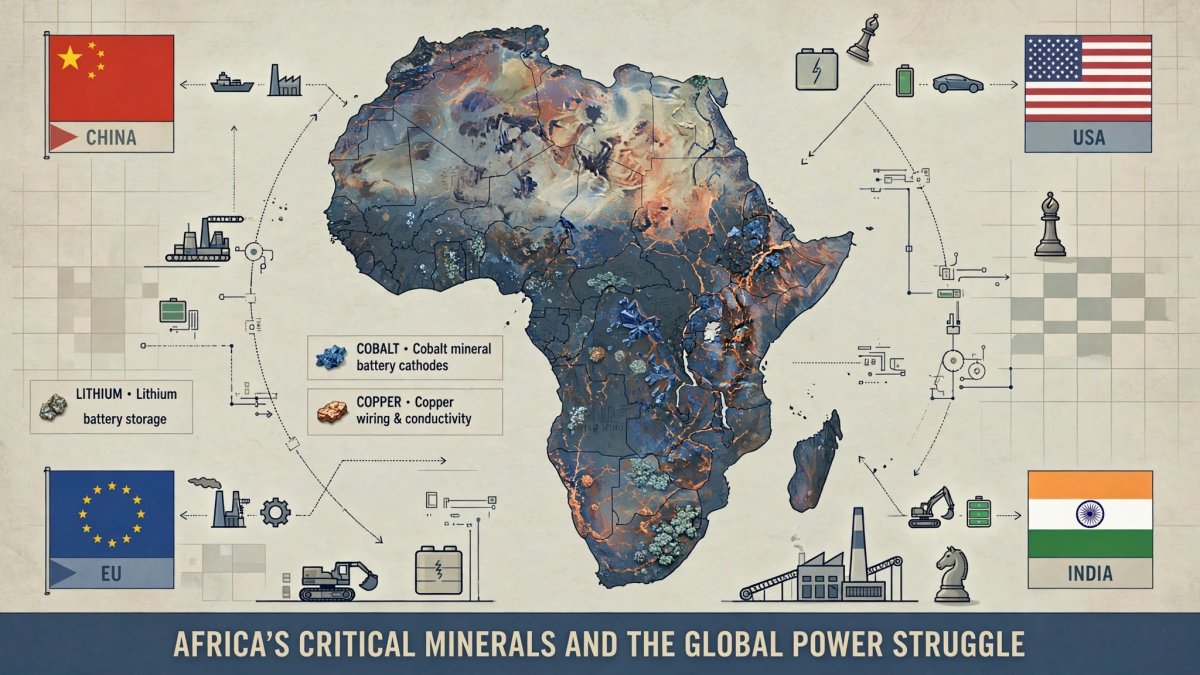
Africa’s critical minerals are becoming increasingly important to the global economy, technological development and international geopolitics. As countries compete to secure the resources required for electric vehicles, renewable energy, electronics and advanced manufacturing, the continent has emerged as a strategically significant source of cobalt, copper, lithium, manganese and other essential materials. China, the United States, the European Union and India are strengthening their engagement with African countries to secure supplies and diversify their industrial supply chains.
However, Africa’s growing importance presents both opportunities and challenges. Mineral extraction can generate investment, employment and government revenue, but exporting raw materials without developing local industries can limit long-term economic benefits. The central question is whether African countries can use international competition to strengthen their economies, improve living standards and gain greater influence in global affairs.
1. Critical Mineral Reserves: Africa’s Strategic Advantage
Africa possesses substantial mineral resources that are essential to modern industries. The Democratic Republic of the Congo (DRC) is a major global producer of cobalt, while the DRC and Zambia are important copper-producing countries. Zimbabwe has attracted investment in lithium, South Africa is known for platinum-group metals and manganese, and Guinea possesses significant bauxite resources.
These minerals support industries such as battery manufacturing, electricity networks, construction, electronics and renewable energy. Their importance is expected to remain significant as countries modernise infrastructure and expand low-carbon technologies.
Nevertheless, possessing mineral resources does not automatically create prosperity. Developing competitive industries requires investment, reliable electricity, skilled workers, transport infrastructure and effective public institutions. African countries must therefore look beyond extraction and consider how to participate in processing, manufacturing and other higher-value activities.
2. China’s Role in Africa’s Mineral Industry
China has developed a significant presence in African mining through investment, infrastructure projects and commercial partnerships. Chinese companies have interests in mineral operations across the continent, particularly in copper, cobalt and lithium. China's established processing and manufacturing industries also provide an advantage in converting extracted minerals into materials used by global manufacturers.
For African countries, Chinese investment can bring financing, technical expertise and access to international markets. Infrastructure associated with mining projects may also improve transport connections and support economic activity.
However, concerns arise when mineral-producing countries remain dependent on exporting raw materials while most processing and manufacturing take place abroad. Such arrangements can limit opportunities for local employment, technology development and industrial diversification.
The issue is not whether African countries should reject Chinese investment. Rather, governments need to negotiate transparent agreements that deliver fair public revenue, protect workers and communities, and encourage sustainable economic development. Similar standards should apply to investors from every country.
3. The United States and the Competition for Critical Minerals
The United States views critical minerals as important to its economic security, manufacturing capacity and energy transition. Reducing vulnerabilities in supply chains has encouraged Washington to pursue partnerships with mineral-producing countries and support alternative transport routes.
One prominent initiative is the Lobito Corridor, which aims to improve transport links between mineral-producing regions in the DRC and Zambia and Angola’s Atlantic coast. Better rail and port connections could reduce transport costs, improve access to international markets and encourage further investment.
For African countries, such projects can create opportunities to diversify trading partners and improve infrastructure. However, the benefits will depend on financing arrangements, implementation and whether local businesses can participate in the resulting economic activity.
Competition with China may attract additional investment, but African governments should avoid becoming passive participants in a geopolitical contest. Their priority should be to negotiate partnerships that support national development objectives and provide measurable benefits to local populations.
4. The European Union’s Supply-Chain Strategy
The European Union is seeking reliable access to critical raw materials for electric vehicles, renewable energy systems and advanced manufacturing. Diversifying supplies is important because disruptions in concentrated supply chains can affect industrial production and the cost of strategic technologies.
African countries could benefit from European investment in mining, mineral processing, technical training and infrastructure. Cooperation could also support environmental standards, recycling and the development of more sustainable industrial practices.
However, securing access to African resources should not become the sole objective of these partnerships. African governments increasingly want investment that creates local jobs and strengthens domestic industries rather than simply facilitating exports.
Long-term cooperation will therefore require transparent agreements, commercially viable projects and clear implementation plans. Partnerships should be evaluated according to the investment delivered, employment created, environmental protections enforced and economic opportunities provided to local communities.
5. India’s Interests in Africa’s Critical Minerals
India has growing strategic and economic interests in critical minerals because of its ambitions in electric mobility, renewable energy, electronics and advanced manufacturing. Access to diversified supplies of lithium, cobalt, copper and other materials could support these industries and reduce dependence on concentrated international supply chains.
Africa offers opportunities for Indian companies to participate in mineral exploration, processing, infrastructure development and technical cooperation. Indian expertise in engineering, industrial production and information technology could also contribute to the development of supporting industries.
For African countries, stronger cooperation with India could provide another source of investment and help diversify international partnerships. Collaboration in vocational education, mineral processing and local manufacturing could create benefits beyond the extraction sector.
Nevertheless, successful partnerships require more than diplomatic agreements. They depend on commercially sustainable projects, reliable financing and clear benefits for both sides. India can strengthen its position by supporting African countries' industrial ambitions rather than treating the continent primarily as a source of raw materials.
6. The Democratic Republic of the Congo: Cobalt and Copper
The DRC occupies a central position in the global cobalt industry and also possesses substantial copper resources. These minerals are important for batteries, electrical equipment and infrastructure associated with the energy transition.
The country's resource wealth gives its government an opportunity to negotiate improved investment terms and secure greater public revenue. However, translating mineral production into broad economic progress remains a challenge.
Concerns surrounding working conditions, environmental damage, informal mining and the distribution of mining revenues have highlighted the importance of stronger governance. Local communities need effective protections, while governments must ensure that public revenue supports infrastructure and essential services.
The DRC's long-term success will depend on whether it can develop a more diversified economy. Investment in electricity, education, transport and domestic processing could help the country capture more value from its resources. Without these foundations, mineral exports alone are unlikely to deliver inclusive development.
7. Zimbabwe and Namibia: Lithium Opportunities
Zimbabwe has attracted considerable interest from companies seeking lithium for rechargeable batteries. Its government has also pursued policies intended to encourage greater domestic processing and reduce reliance on exports of unprocessed minerals.
Lithium development could create employment, attract investment and support industrial growth. However, processing requires reliable electricity, water, transport infrastructure and skilled workers. Without these conditions, domestic facilities may struggle to compete internationally.
Namibia has also attracted interest in lithium and other minerals as companies explore opportunities to diversify supply chains. Its prospects will depend on the quality of individual projects, infrastructure availability, environmental safeguards and the commercial conditions facing investors.
Both countries must balance their desire for local processing with the practical requirements of industrial development. Clear regulations and realistic investment incentives can encourage companies to establish processing facilities without creating unnecessary uncertainty.
The objective should be to build industries that remain competitive over time, rather than introduce restrictions that disrupt production without generating sustainable alternatives.
8. Infrastructure and Regional Economic Integration
Transport and energy infrastructure will play a decisive role in determining whether Africa can benefit from its mineral wealth. Many mineral deposits are located far from ports, manufacturing centres and reliable electricity networks. High transport costs and inadequate logistics can make African products less competitive.
Railways, roads, ports and cross-border electricity connections can help address these challenges. Initiatives such as the Lobito Corridor demonstrate how infrastructure development has become closely connected to the international competition for critical minerals.
However, infrastructure should serve broader economic objectives. Transport corridors can support agricultural exports, local businesses and regional trade when they connect communities and industrial centres rather than functioning exclusively as routes for mineral shipments.
Regional cooperation is particularly important because mineral supply chains often cross national borders. Governments can benefit from coordinating customs procedures, transport planning and industrial policies to reduce costs and improve trade.
Infrastructure investment will have the greatest impact when it supports diversified economic activity and creates opportunities for countries beyond the immediate mining sector.
9. Economic Opportunities and Industrial Development
Critical minerals provide African countries with an opportunity to attract foreign investment, increase export earnings and develop new industries. Mining can generate tax revenue and employment, while processing and manufacturing can create additional opportunities for engineers, technicians, transport operators and local suppliers.
Governments can strengthen these benefits by investing in technical education, encouraging local businesses to participate in supply chains and improving access to finance. Transparent procurement policies can help domestic companies compete for contracts associated with mining projects.
Nevertheless, economic benefits are not guaranteed. Mining can be capital-intensive, and employment opportunities vary between projects. Commodity prices can also fluctuate sharply, creating uncertainty for government budgets and investors.
African countries should therefore avoid excessive dependence on a small number of mineral exports. Using resource revenues to support education, infrastructure, agriculture and manufacturing can help create more resilient economies.
The long-term goal should be to transform mineral wealth into productive capacity that continues to benefit the population even when international commodity markets weaken.
10. Environmental Protection, Human Rights and Governance
Mining can create environmental and social challenges, including water pollution, land degradation, waste-management problems and pressure on local communities. Poorly regulated operations can damage ecosystems and affect agriculture, livelihoods and public health.
Governments must enforce environmental standards, require appropriate rehabilitation plans and ensure that companies manage waste responsibly. Communities should receive reliable information about projects and have opportunities to participate in decisions affecting their land and livelihoods.
Labour protections are equally important. Workers need safe conditions, fair treatment and access to effective mechanisms for reporting violations. Companies should also demonstrate that their supply chains meet appropriate labour and environmental standards.
Governance determines whether mineral revenues contribute to public development or become concentrated among a limited number of beneficiaries. Transparent contracts, credible audits and responsible management of public finances can help reduce corruption and strengthen public trust.
International investors and buyers also have responsibilities. Environmental and human-rights standards should be applied consistently, rather than selectively according to geopolitical interests.
Conclusion: Can Africa Turn Mineral Wealth into Global Influence?
Africa’s critical minerals have become a major focus of international competition as China, the United States, the European Union, India and other partners seek secure supplies for strategic industries. This growing interest offers African countries opportunities to attract investment, improve infrastructure and strengthen their positions in global markets.
However, mineral wealth alone cannot guarantee lasting prosperity. Without reliable electricity, effective governance, skilled workers and competitive industries, countries risk remaining dependent on raw-material exports while capturing only a limited share of the value created by global supply chains.
African governments must negotiate transparent partnerships, encourage commercially viable domestic processing and protect workers and communities. Regional cooperation and investment in education, infrastructure and manufacturing will also be essential.
Ultimately, Africa's success should not be measured by how much mineral wealth it exports or which foreign power secures the largest commercial presence. The more important measure is whether these resources help African countries create productive industries, expand employment, improve public services and achieve sustainable economic development.
Sources and Further Reading
1. Organisation for Economic Co-operation and Development (OECD) — Critical Minerals in Africa: A Regional Overview (2026)
https://www.oecd.org/en/publications/critical-minerals-in-africa_53e5f664-en.html
2. International Energy Agency (IEA) — Global Critical Minerals Outlook 2026
https://www.iea.org/reports/global-critical-minerals-outlook-2026
3. International Energy Agency (IEA) — Stepping Up the Value Chain in Africa (2025)
https://www.iea.org/reports/stepping-up-the-value-chain-in-africa
4. World Bank — Mineral Resources of Africa (2025)
https://www.worldbank.org/en/brief/2025/10/15/mineral-resources-of-africa
5. African Development Bank and Intergovernmental Forum on Mining — Critical Minerals for Africa’s Inclusive Growth and Development (2025)
6. Stockholm Environment Institute — Critical Minerals in Africa: Local Value Creation and Trade Integration (2026)
https://www.sei.org/publications/critical-minerals-africa-local-value-creation-trade-integration/
7. Organisation for Economic Co-operation and Development (OECD) — Conclusions and Recommendations on Critical Minerals in Africa

Join the Conversation