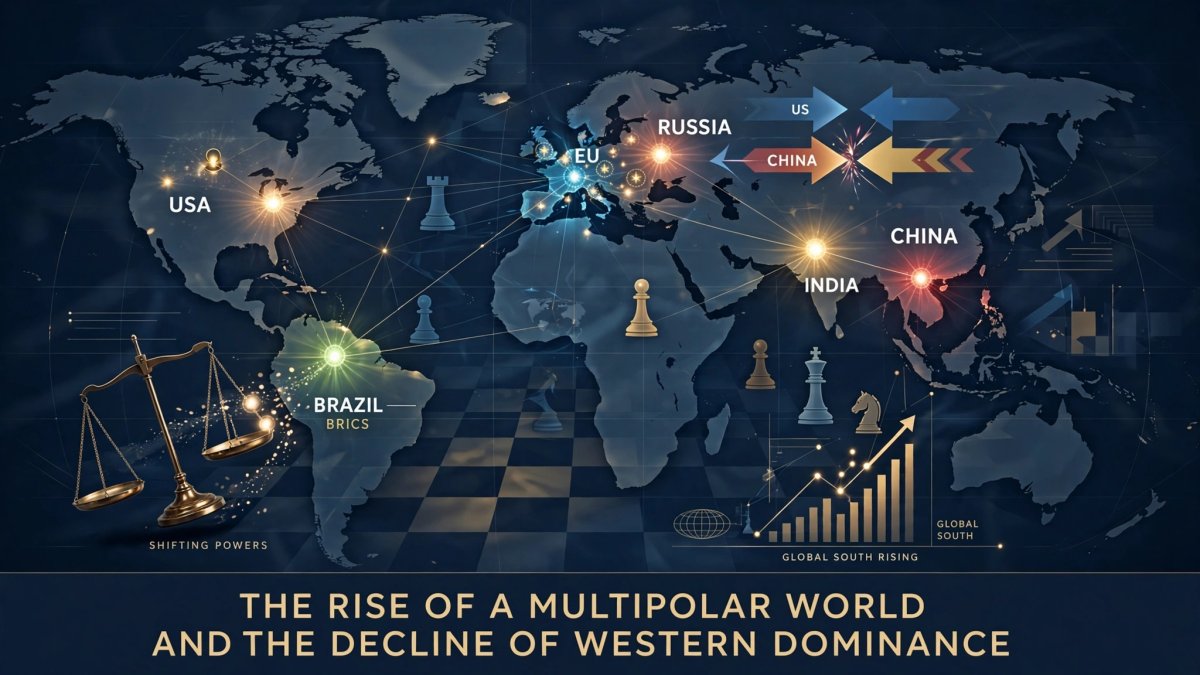
The Decline of Western Dominance in a Multipolar World
The global political and economic order is undergoing a significant transformation. For decades following the end of the Cold War, the United States and its Western allies exercised considerable influence over international trade, finance, security and diplomacy. However, the rapid economic growth of China, the increasing strategic influence of India, the expanding role of BRICS and the growing ambitions of regional powers are challenging the traditional distribution of global power.
This transformation is contributing to the emergence of a multipolar world in which influence is distributed among several major powers rather than concentrated primarily in one country or a single political bloc. Although the United States and Europe remain important centres of economic, military and technological strength, their ability to shape international developments without considering other powers has become increasingly constrained.
The transition does not necessarily mean the end of Western influence. Instead, it signals a more competitive international environment in which countries pursue their interests through different partnerships, institutions and diplomatic strategies. Understanding this changing balance of power is essential to examining the future of global governance, economic cooperation and international security.
1. From a US-Led Order to a Multipolar World
The collapse of the Soviet Union in 1991 marked the beginning of a period in which the United States emerged as the world's predominant military and geopolitical power. Western countries exercised considerable influence through institutions such as the International Monetary Fund (IMF), the World Bank and the North Atlantic Treaty Organization (NATO).
The expansion of globalisation further strengthened Western economic influence. International trade, financial markets, technological innovation and the widespread use of the US dollar helped establish the United States as a central force in the international economy.
However, the distribution of economic and political power has gradually changed. Emerging economies have expanded their industrial capacity, developed stronger domestic markets and increased their participation in international decision-making.
The global financial crisis of 2008 also exposed weaknesses in established financial systems and encouraged discussions about the need for broader international representation.
Today, countries increasingly seek strategic autonomy rather than complete dependence on a single major power. This shift is encouraging a multipolar international system in which cooperation and competition coexist.
2. China's Rise as a Global Power
China is one of the most important contributors to the changing global balance of power. Its economic transformation over several decades has made it a major centre of manufacturing, international trade and technological development.
Through infrastructure investment, industrial expansion and international trade partnerships, China has strengthened its presence across Asia, Africa, Latin America and other regions. Its Belt and Road Initiative has also sought to improve connectivity through investments in transport, energy and other infrastructure projects.
China's growing technological capabilities have increased competition with Western economies in areas such as electric vehicles, telecommunications, artificial intelligence, renewable energy and advanced manufacturing.
However, China's rise also presents significant challenges. Disputes over the South China Sea, tensions surrounding Taiwan, trade restrictions and concerns about technology security have complicated its relations with the United States and several Western countries.
China faces domestic economic difficulties as well, including demographic pressures, problems in the property sector and concerns about future growth.
Consequently, China's growing influence should not be interpreted as an automatic replacement of American leadership. Rather, it represents a major shift towards a more competitive international system in which economic strength, technological capabilities and diplomatic relationships determine influence.
3. Russia's Strategic Position and Relations with the West
Russia remains an important geopolitical actor because of its nuclear capabilities, energy resources, military power and permanent membership of the United Nations Security Council.
Relations between Russia and Western countries have deteriorated significantly, particularly following Russia's full-scale invasion of Ukraine in February 2022. Western governments introduced extensive sanctions, provided support to Ukraine and sought to reduce their dependence on Russian energy.
Russia, meanwhile, expanded its engagement with countries outside the Western alliance system, including China, India and several other Asian, African and Middle Eastern states. These relationships have helped Moscow maintain important economic and diplomatic connections, although sanctions have imposed considerable costs and complications.
Russia's international position demonstrates that Western countries cannot always secure universal agreement on their foreign policy objectives. Many governments continue to assess international conflicts according to their national interests rather than automatically aligning with either Washington or Moscow.
Nevertheless, Russia faces substantial constraints, including the economic consequences of sanctions, military expenditure and the long-term challenges associated with its war against Ukraine.
Its influence remains significant, but the extent of its future global role will depend on economic resilience, military developments and diplomatic relationships.
4. BRICS and the Growing Influence of Emerging Economies
BRICS has become an important platform for discussions about international economic cooperation and the representation of emerging economies. Originally consisting of Brazil, Russia, India, China and South Africa, the grouping has expanded its membership and attracted interest from additional countries.
Its members differ considerably in political systems, economic priorities and foreign policy objectives. Nevertheless, they share an interest in strengthening the influence of developing economies in international institutions.
BRICS discussions have included financial cooperation, trade settlement in national currencies, development financing and reform of global governance. The New Development Bank provides an institutional mechanism for financing infrastructure and sustainable development projects.
However, BRICS should not be viewed as a unified alliance capable of replacing Western-led institutions. Its members maintain different relationships with the United States and Europe, while disagreements among major members can limit collective action.
The group's importance lies partly in providing an additional platform through which emerging economies can coordinate positions and pursue alternatives to existing arrangements.
Its future influence will depend on whether its members can convert shared concerns into practical cooperation without allowing bilateral disputes to undermine their common objectives.
5. India's Emergence as a Major Geopolitical Player
India has become increasingly important in discussions about the future international order. Its large population, expanding economy, technological capabilities and strategic location give it considerable geopolitical significance.
India maintains relationships with the United States, Europe, Russia, Japan and other major powers while participating in organisations such as BRICS, the G20 and the Quadrilateral Security Dialogue.
This approach is often described as strategic autonomy or multi-alignment. Rather than committing itself entirely to one geopolitical bloc, India seeks to cooperate with different partners according to its national interests.
Its engagement with Western countries includes defence cooperation, technology partnerships, trade and investment. At the same time, India continues to maintain important historical relationships with Russia, particularly in defence and energy.
India's participation in the Global South debate has also strengthened its diplomatic profile. It has called for greater representation of developing countries in international institutions and emphasised issues such as development finance, food security and technology access.
However, India faces significant challenges, including employment creation, infrastructure requirements, income inequality and regional security concerns.
Its ability to translate economic growth into sustained global influence will depend on domestic development, institutional capacity and its ability to maintain productive international relationships.
6. The Changing Role of the United States and Europe
Despite the emergence of new powers, the United States remains a leading global actor. Its military capabilities, financial markets, technological industries, universities and network of international partnerships continue to provide substantial advantages.
The US dollar also retains a central position in international finance and trade. Although several countries have explored alternatives to dollar-dependent transactions, replacing the dollar's global role would require major changes in financial markets, institutional confidence and international monetary arrangements.
Europe remains influential through its economic market, regulatory frameworks, diplomatic engagement and technological capabilities. The European Union also plays an important role in setting standards for areas such as data protection, competition policy and environmental regulation.
Nevertheless, Western countries face challenges involving political polarisation, economic competition, defence spending, energy security and disagreements over international policy.
Their ability to influence global affairs increasingly depends on cooperation with other major powers rather than unilateral decision-making.
The changing international order therefore represents a challenge to Western dominance, but not necessarily the disappearance of Western leadership. The United States and Europe are likely to remain influential while adapting to a more competitive and diverse geopolitical environment.
7. Economic Competition, Trade and Technological Rivalry
Economic and technological competition is becoming a defining feature of international relations. Governments increasingly recognise that leadership in semiconductors, artificial intelligence, renewable energy, advanced manufacturing and critical minerals can influence both economic growth and national security.
The United States and China have introduced measures intended to protect strategic industries and strengthen domestic production. Export controls, tariffs, investment restrictions and industrial subsidies have become important instruments of economic policy.
Other countries are responding by diversifying supply chains, attracting investment and developing domestic technological capabilities.
India, for example, has sought to strengthen manufacturing and expand its role in global supply chains. European countries are also pursuing policies aimed at improving industrial competitiveness and reducing strategic dependencies.
However, excessive economic restrictions can increase costs, disrupt trade and weaken international cooperation. Developing countries may face particular difficulties when access to technology, finance or essential materials becomes restricted by geopolitical tensions.
The central challenge is balancing legitimate national security concerns with the economic benefits of international trade. Countries that successfully combine innovation, competitive industries and reliable partnerships may gain greater influence in the emerging global economy.
8. Reforming Global Institutions and International Governance
International institutions established after the Second World War continue to play important roles in maintaining cooperation, managing financial challenges and addressing security concerns. However, their structures reflect an earlier distribution of global power.
Many emerging economies argue that their growing economic and demographic importance is not adequately represented in decision-making processes.
Reform of the United Nations Security Council is a prominent example. Several countries have called for a more representative Council, including changes to permanent membership and the distribution of decision-making authority.
Similarly, discussions concerning the IMF and World Bank frequently focus on voting shares, development financing and the representation of developing countries.
Reform could improve the legitimacy of these institutions and encourage broader international participation. However, meaningful changes require agreement among countries with different priorities, and established powers may resist arrangements that reduce their influence.
Multipolarity also creates a risk of institutional fragmentation. If countries increasingly rely on competing organisations, regional arrangements and separate financial systems, international cooperation may become more complicated.
The challenge is to make existing institutions more representative while preserving their capacity to address shared global problems.
9. Risks and Opportunities in a Multipolar World
A multipolar world offers both opportunities and risks. The emergence of additional centres of power can provide countries with more diplomatic choices, encourage competition and create new opportunities for economic partnerships.
Developing countries may gain greater influence over international discussions concerning trade, development finance, climate policy and technological access. Competition among major powers may also encourage investment in infrastructure, research and innovation.
However, the same developments can intensify geopolitical tensions. Rivalry between major powers may increase military expenditure, complicate regional disputes and encourage countries to form competing alliances.
Differences over international trade, territorial claims, technology and security could make coordinated responses to global crises more difficult.
Climate change, pandemics, cyber threats and financial instability require cooperation that extends beyond national borders. No major power can effectively address all these challenges independently.
The success of a multipolar system will therefore depend on whether countries can manage strategic competition while preserving practical cooperation.
A balanced international order would allow states to protect their national interests without treating every disagreement as a zero-sum contest.
Conclusion: A New Balance of Global Power
The emergence of a multipolar world marks an important transformation in international relations. China's economic and technological growth, India's increasing strategic importance, the activities of BRICS and the ambitions of other regional powers are changing how global influence is distributed.
Although the United States and Europe continue to possess considerable economic, military and institutional strength, they face a more competitive international environment. Their future position will depend partly on their ability to adapt, cooperate and respond to the priorities of other major powers.
At the same time, emerging economies must overcome domestic challenges and demonstrate that greater international influence can translate into sustainable development and effective governance.
The decline of Western dominance should therefore be understood as a redistribution of influence rather than the complete end of Western power. A multipolar world may create opportunities for more inclusive international decision-making, but it will not automatically produce greater stability or equality.
Ultimately, the future of global order will depend on whether major powers can move beyond narrow competition and cooperate on shared challenges. The most effective international system will be one that accommodates different national interests while preserving the principles of peaceful coexistence, economic cooperation and collective responsibility.
Sources and Further Reading
1. World Economic Forum (WEF) — The Global Risks Report 2026: Multipolarity Without Multilateralism
https://www.weforum.org/publications/global-risks-report-2026/global-risks-report-2026-chapter-2/
2. World Economic Forum (WEF) — Global Risks Report 2026: Key Findings
https://www.weforum.org/publications/global-risks-report-2026/global-risks-report-2026-key-findings/
3. Council on Foreign Relations (CFR) — Research and analysis on India's multi-alignment and the international order
4. International Monetary Fund (IMF) — World Economic Outlook
https://www.imf.org/en/Publications/WEO
5. Stiftung Wissenschaft und Politik (SWP) — Research on multipolarity and competing visions of the international order
https://www.swp-berlin.org/en/
6. United Nations — Information on the Security Council and international governance
Join the Conversation