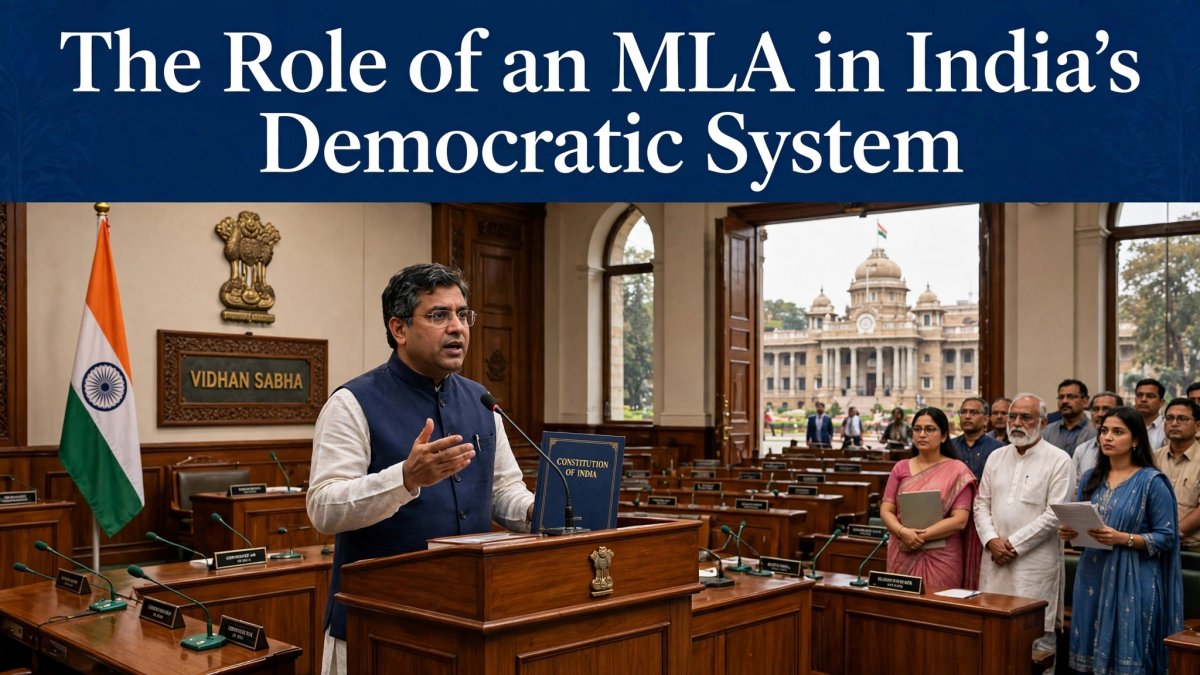
The Role of an MLA in Indian Democracy: Powers, Duties and Accountability
A Member of the Legislative Assembly (MLA) occupies an important position in India's democratic and constitutional framework. Directly elected by voters from an Assembly constituency, an MLA represents public interests in the State Legislative Assembly and participates in law-making, government oversight and discussions on public policy. Beyond electoral representation, the office carries significant responsibilities relating to governance, public welfare and democratic accountability.
Although MLAs are frequently associated with constituency development and local issues, their constitutional role extends much further. They serve as legislators, representatives of the public and participants in the system of democratic checks and balances.
1. Legislative Responsibilities and Law-Making
One of the principal responsibilities of an MLA is to participate in the legislative process. State Legislative Assemblies can discuss, amend and pass legislation on subjects covered by the State List and Concurrent List of the Seventh Schedule.
These subjects include agriculture, public health, police, local government and several other areas affecting everyday life.
MLAs contribute through legislative debates, proposed amendments, voting and discussions on Bills. Their participation allows different constituencies and communities to present their concerns during the formulation of state laws.
The constitutional distribution of legislative powers is explained in the "Constitution of India, particularly Articles 168 and 246 and the Seventh Schedule" https://www.legislative.gov.in/
2. Representing Constituency Interests
An MLA serves as the elected representative of a particular geographical constituency. This responsibility involves maintaining communication with residents, understanding their concerns and bringing relevant issues before the state government.
Public representatives are expected to raise matters involving drinking water, roads, electricity, public transport, educational institutions, healthcare facilities and sanitation.
An MLA can communicate these concerns to government departments, coordinate with district officials and seek appropriate administrative action.
However, an MLA does not personally exercise executive authority over every government department. The implementation of public services generally rests with the relevant administrative authorities and local institutions.
The representative's responsibility is to advocate for the constituency, monitor public concerns and pursue institutional responses.
3. Scrutinising the State Government
A functioning democracy requires the government to remain accountable to the elected legislature. MLAs play an important role in maintaining this accountability.
Members can question ministers, participate in debates, raise matters of public importance and seek explanations regarding government decisions and administrative performance.
Through legislative questions, motions and committee proceedings, MLAs can examine whether government departments are implementing policies effectively and using public resources responsibly.
According to "PRS Legislative Research's Annual Review of State Laws 2025" https://prsindia.org/legislatures/states/annual-review-of-state-laws/annual-review-of-state-laws-2025 , state legislatures perform three primary responsibilities: passing legislation, examining government finances and holding the executive accountable.
Opposition members also perform an important democratic function by questioning government decisions and presenting alternative perspectives.
4. Examining the State Budget and Public Expenditure
Financial oversight is another major responsibility of an MLA. The state government presents an annual budget outlining its expected revenue, expenditure and development priorities.
MLAs participate in budget discussions and examine how public money is proposed to be distributed across different sectors.
These allocations may cover education, healthcare, agriculture, infrastructure, welfare programmes and public administration.
Under Articles 202 and 203 of the Constitution, the state budget and demands for grants are placed before the legislature for consideration and approval.
Members can question expenditure priorities and seek explanations regarding financial decisions.
Effective financial scrutiny helps ensure that public expenditure remains subject to democratic examination rather than being treated solely as an administrative decision.
5. Promoting Development and Public Welfare
Constituency development is among the most visible aspects of an MLA's responsibilities.
Residents frequently approach their elected representatives regarding infrastructure deficiencies, employment opportunities, welfare schemes and difficulties in accessing public services.
An MLA can recommend development priorities, communicate with relevant departments and follow up on projects intended to improve local infrastructure.
Depending on the state, development schemes may also allow MLAs to recommend eligible works through designated administrative procedures.
Nevertheless, public development projects must follow applicable financial rules, technical requirements and government guidelines. An MLA's recommendation does not automatically mean that the representative personally controls the funds or implements the project.
6. Participating in Constitutional and Democratic Processes
MLAs also contribute to important constitutional processes beyond the routine functioning of the State Legislative Assembly.
Under Article 54 of the Constitution, elected members of State Legislative Assemblies participate in the election of the President of India through the Electoral College, alongside elected members of both Houses of Parliament.
The "Election Commission of India" https://www.eci.gov.in/ explains the constitutional framework governing presidential elections.
Furthermore, under Article 368, state legislatures participate in the constitutional amendment process when ratification by at least half of the state legislatures is required.
These responsibilities demonstrate that an MLA's office is connected not only to state-level administration but also to the wider constitutional structure of India.
7. Public Accountability and Ethical Responsibilities
An electoral mandate carries responsibilities throughout an MLA's term in office. Representatives are expected to act transparently, respect constitutional principles and remain accessible to the people they represent.
Public accountability involves communicating decisions, responding to legitimate grievances, disclosing relevant information and avoiding the misuse of public authority.
MLAs must also recognise that their responsibilities extend to the entire constituency, irrespective of the political affiliation, community or social background of individual residents.
Democratic representation requires responsible public service and respect for the rights of all citizens.
Challenges Facing the Role of an MLA
Despite the importance of the office, several challenges can affect the performance of MLAs. Limited legislative sitting days, disruptions in Assembly proceedings, insufficient scrutiny of legislation and competing political priorities can restrict meaningful legislative participation.
The "PRS Annual Review of State Laws 2025" https://prsindia.org/legislatures/states/annual-review-of-state-laws/annual-review-of-state-laws-2025 reported that state legislatures met for an average of 24 days during 2025 and collectively passed more than 600 Bills. The findings underline the importance of adequate legislative time, detailed examination of Bills and effective institutional oversight.
Strengthening committee systems, improving access to legislative research and encouraging constructive debate can contribute to more effective state legislatures.
Conclusion
The role of an MLA is fundamental to India's representative democracy. An MLA is not merely a political figure or a representative who addresses constituency-level grievances. The office carries legislative, financial, constitutional and accountability-related responsibilities.
Effective representation requires active participation in Assembly proceedings, careful scrutiny of government policies, responsible engagement with citizens and respect for constitutional limits.
Ultimately, the contribution of an MLA can be understood through legislative participation, public accountability and the ability to represent constituency concerns within India's democratic framework.
Sources and Further Reading
1. "Government of India – Constitution of India, Legislative Department" https://www.legislative.gov.in/
2. "PRS Legislative Research – Annual Review of State Laws 2025" https://prsindia.org/legislatures/states/annual-review-of-state-laws/annual-review-of-state-laws-2025
3. "PRS Legislative Research – State Legislatures" https://prsindia.org/legislatures/states
4. "Ministry of External Affairs – Constitution of India" https://www.mea.gov.in/Images/pdf1/Part6.pdf
5. "Supreme Court of India – Constitution of India" https://www.sci.gov.in/constitution/
Join the Conversation