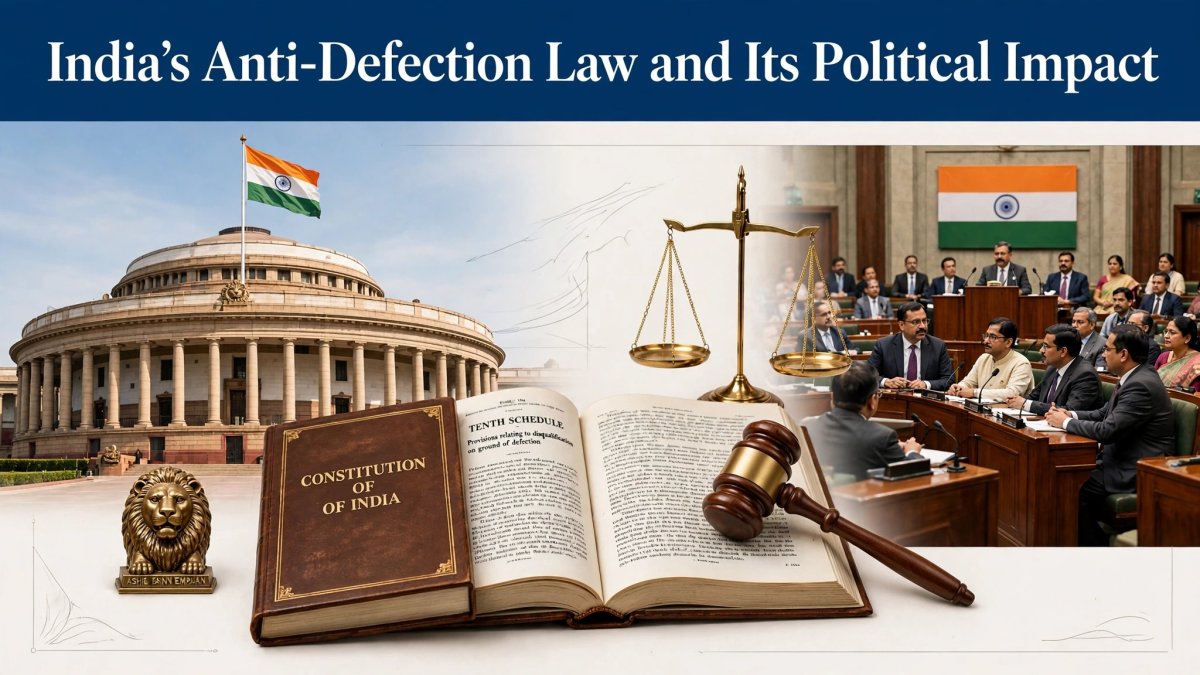
The Anti-Defection Law and Its Impact on Indian Politics
Political defections have long been a significant concern in India's parliamentary democracy. When elected representatives change political allegiance, disregard party directives or shift their support between competing political groups, the consequences can extend beyond individual party politics to affect government stability and legislative accountability. To address this challenge, India introduced the Anti-Defection Law through the 52nd Constitutional Amendment Act, 1985, incorporating the Tenth Schedule into the Constitution.
The legislation establishes circumstances under which Members of Parliament and Members of Legislative Assemblies can lose their legislative membership for violating specified conditions relating to political allegiance. Although the law was designed to discourage political defections and protect the electoral mandate, its implementation has generated continuing constitutional debates concerning legislative independence, the authority of Speakers and the balance between party discipline and democratic representation.
1. Historical Background and Constitutional Introduction
Before the introduction of the Anti-Defection Law, frequent political defections created instability in several state governments. The phenomenon became particularly prominent after the 1967 general elections, when legislators frequently changed political affiliations. The expression "Aaya Ram, Gaya Ram" subsequently became associated with repeated party switching.
The growing concern over political defections prompted Parliament to introduce constitutional safeguards against such practices.
The Constitution (52nd Amendment) Act, 1985, inserted the Tenth Schedule into the Constitution. Its primary objective was to discourage legislators from abandoning their political affiliations for personal or political advantages and to protect the stability of elected governments.
The Constitution (91st Amendment) Act, 2003, subsequently strengthened the framework by removing the exemption previously available for a split involving one-third of a legislature party.
2. Grounds for Disqualification Under the Tenth Schedule
The Tenth Schedule specifies circumstances in which legislators can face disqualification on grounds of defection.
Voluntarily giving up party membership: An elected representative belonging to a political party may be disqualified if they voluntarily give up membership of that party. A formal resignation is not always necessary; conduct may also be considered when determining whether membership has been voluntarily abandoned.
Voting against the party directive: A legislator may face disqualification if they vote or abstain from voting contrary to a direction issued by their political party without obtaining prior permission, provided the party does not condone the action within 15 days.
Independent legislators joining political parties: An independently elected representative becomes liable for disqualification if they join a political party after being elected.
Nominated members joining political parties: A nominated legislator may join a political party within six months of taking their seat. Joining a party after that period can attract disqualification.
These provisions apply to both Parliament and State Legislatures, establishing a common constitutional framework against political defections.
3. The Role of the Speaker in Disqualification Proceedings
The Speaker of the Lok Sabha or the Speaker of a State Legislative Assembly plays a central role in deciding disqualification petitions under the Tenth Schedule. In the Rajya Sabha, the corresponding authority rests with the Chairman.
When a disqualification petition is submitted, the presiding officer examines the allegations and determines whether the legislator has violated the applicable constitutional provisions.
However, this arrangement has generated debates about institutional impartiality, particularly when the Speaker belongs to the ruling political party and the proceedings involve legislators from competing political groups.
The timing of decisions has also become an important constitutional concern. Delayed decisions can leave political uncertainty unresolved and affect the functioning of elected governments.
4. The Merger Exception and the 91st Constitutional Amendment
The Anti-Defection Law recognises a specific exception for mergers. Under Paragraph 4 of the Tenth Schedule, disqualification does not apply when at least two-thirds of the members of a legislature party agree to a merger with another political party.
The 91st Constitutional Amendment Act, 2003, removed the earlier provision that protected a split involving one-third of legislators. This change was intended to prevent smaller groups of legislators from using the previous exemption to justify political defections.
The two-thirds requirement remains an important distinction between a constitutionally recognised merger and individual defections.
5. Supreme Court Judgments and Judicial Oversight
The Supreme Court has played an important role in interpreting the Anti-Defection Law and defining the constitutional limits of the Speaker's authority.
In Kihoto Hollohan v. Zachillhu (1992), the Supreme Court upheld the constitutional validity of the Tenth Schedule while establishing that decisions made by the Speaker under the law are subject to judicial review.
In Keisham Meghachandra Singh v. Speaker, Manipur Legislative Assembly (2020), the Supreme Court highlighted concerns regarding delays in deciding disqualification petitions and suggested that such matters should ordinarily be decided within three months.
Another significant development came in Subhash Desai v. Principal Secretary, Governor of Maharashtra (2023). The Supreme Court examined issues surrounding political defections, the appointment of party whips and the constitutional responsibilities of the Speaker.
The judgment reinforced the importance of examining the political party's organisational structure and constitutional procedures when resolving disputes under the Tenth Schedule.
These judicial interventions demonstrate that anti-defection proceedings must operate within constitutional boundaries and remain subject to judicial scrutiny.
6. Impact on Parliamentary Democracy and Legislative Independence
The Anti-Defection Law has influenced the functioning of India's parliamentary and legislative institutions in several ways.
On one hand, it seeks to discourage opportunistic party switching, protect elected governments from destabilising defections and preserve the political commitments presented to voters during elections.
On the other hand, strict enforcement of party directives can restrict the ability of individual legislators to express independent views or disagree with their party leadership on legislative matters.
This creates an important democratic debate: how can political parties maintain organisational discipline while allowing elected representatives sufficient independence to participate in meaningful legislative deliberation?
The effectiveness of the law therefore depends not only on preventing defections but also on ensuring that legislative institutions retain their capacity for informed discussion, scrutiny and accountability.
7. Challenges and the Debate Over Reform
Despite its constitutional importance, the Anti-Defection Law continues to face several challenges.
Concerns include delays in deciding disqualification petitions, questions about the impartiality of presiding officers and disputes over the interpretation of voluntary resignation from party membership.
There have also been proposals to reconsider the scope of party whips, particularly whether disqualification should apply to every legislative vote or be restricted to crucial matters involving government stability and financial legislation.
An effective reform framework would need to balance party discipline, legislative independence, constitutional accountability and the electorate's mandate.
Conclusion
The Anti-Defection Law remains an important component of India's constitutional framework for maintaining political stability and discouraging opportunistic changes in legislative allegiance. Introduced through the 52nd Constitutional Amendment in 1985, it established specific grounds for disqualification and assigned an important adjudicatory responsibility to legislative presiding officers.
However, its continued effectiveness requires timely decisions, impartial proceedings and careful protection of democratic principles. The challenge is to prevent political defections without unnecessarily weakening the independence of elected representatives.
Ultimately, the credibility of India's parliamentary democracy depends on balancing political stability, responsible party discipline and the constitutional responsibility of legislators to represent the people.
Sources and Further Reading
1. "Government of India – Constitution of India, Tenth Schedule" https://www.legislative.gov.in/
2. "PRS Legislative Research – The Anti-Defection Law Explained" https://prsindia.org/theprsblog/the-anti-defection-law-explained
3. "Supreme Court of India – Subhash Desai v. Principal Secretary, Governor of Maharashtra (2023)" https://www.api.sci.gov.in/supremecourt/2022/20234/20234_2022_1_1502_44512_Judgement_11-May-2023.pdf
4. "Supreme Court Judgment – Kihoto Hollohan v. Zachillhu (1992)" https://indiankanoon.org/doc/1686885/
5. "Indian Express – Explained: The Anti-Defection Law and Its Challenges" https://indianexpress.com/article/explained/the-anti-defection-law-and-how-it-has-often-failed-to-discourage-defection-7554426/

Join the Conversation