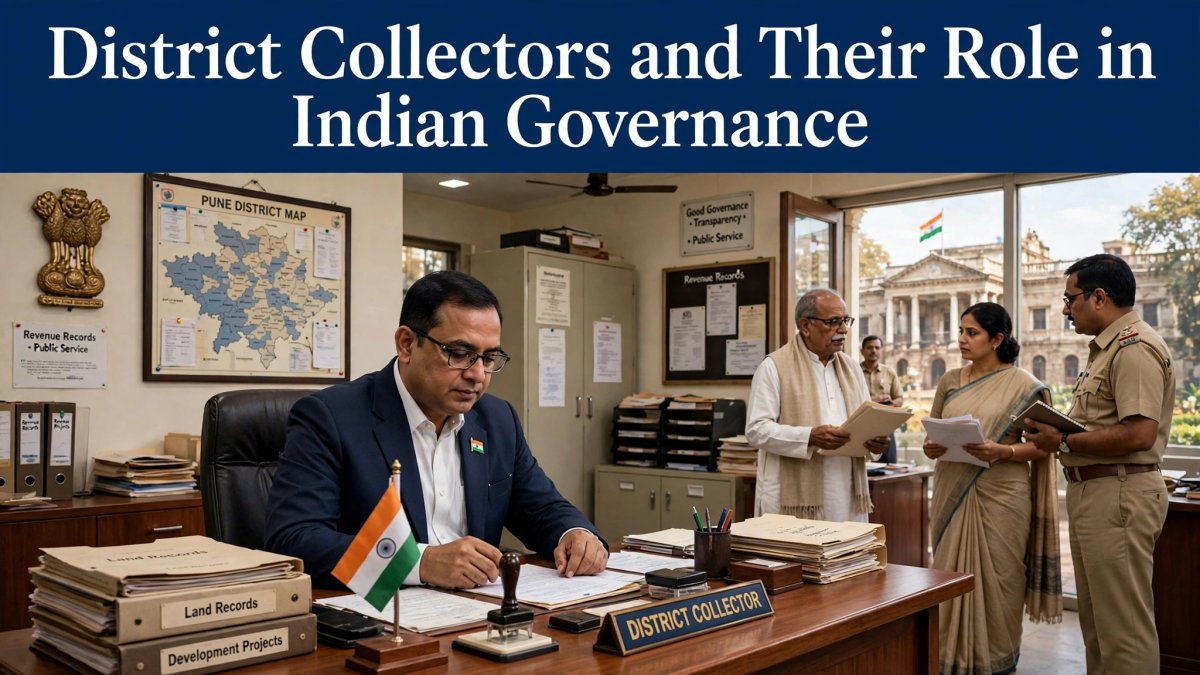
The Role of District Collectors in Indian Administration
The District Collector occupies one of the most significant positions in India's administrative structure, serving as a crucial link between the state government and the people at the district level. Responsible for coordinating government departments, overseeing revenue administration, maintaining public order and monitoring development programmes, the District Collector plays a central role in ensuring the effective functioning of district administration.
Generally appointed from the Indian Administrative Service (IAS), the District Collector often performs multiple administrative functions under different designations, including District Magistrate and Deputy Commissioner. Although the specific responsibilities vary across states, the office remains an important institution for implementing government policies, addressing public grievances and coordinating essential administrative activities.
1. Administrative Leadership and District Governance
The District Collector serves as the principal administrative authority in the district and coordinates the functioning of various government departments. These may include revenue, education, healthcare, agriculture, rural development and public welfare.
The Collector works with district-level officials to monitor administrative performance, address coordination difficulties and ensure that government decisions are implemented effectively.
According to the "Department of Administrative Reforms and Public Grievances (DARPG)" https://darpg.gov.in/sites/default/files/sdadmin15.pdf , district administration involves regulatory functions, public service delivery, revenue management and coordination with local institutions.
However, the Collector does not independently control every department. Several departmental officers remain accountable to their respective state-level administrative authorities.
2. Revenue Administration and Land Management
Revenue administration is among the traditional and continuing responsibilities of the District Collector. The office supervises land revenue administration, government land management, land acquisition procedures and other matters governed by applicable state legislation.
Land records are particularly important because they establish information concerning ownership, possession, cultivation and land-related transactions. The Collectorate works through revenue officials, including Revenue Divisional Officers and Tahsildars, to address administrative issues and maintain relevant records.
The District Collector may also exercise statutory authority in land-related proceedings, subject to applicable laws and prescribed procedures.
The "Government of Telangana's Hyderabad District Collectorate" https://hyderabad.telangana.gov.in/collectrate/ describes the Collector's responsibilities in revenue administration, land matters, planning and district governance.
3. Law and Order and Public Administration
The District Collector frequently performs the responsibilities of the District Magistrate, making the office important to maintaining public order and administrative coordination.
In this capacity, the District Magistrate exercises powers assigned under applicable laws, including the Bharatiya Nagarik Suraksha Sanhita, 2023.
Responsibilities may include issuing lawful administrative orders, coordinating preventive measures, managing public gatherings in accordance with legal requirements and working with police authorities during situations requiring administrative intervention.
The Collector does not replace the police or independently conduct criminal investigations. Instead, the office performs its designated executive-magisterial functions while coordinating with law enforcement agencies.
The "District Administration of Surat" https://surat.nic.in/objectives/ identifies the maintenance of law and order, supervision of executive magistracy and coordination of district-level administration among the responsibilities associated with the Collector.
4. Implementation of Government Schemes and Development Programmes
The effective implementation of government welfare programmes depends significantly on administrative coordination at the district level.
The District Collector monitors the progress of development initiatives relating to rural infrastructure, education, healthcare, sanitation, agriculture and social welfare. The office coordinates with implementing departments to identify administrative obstacles and improve programme delivery.
Government initiatives frequently require cooperation between district officials, municipal authorities, Panchayati Raj institutions and other public agencies.
The Collector may convene review meetings, examine implementation reports and seek explanations from responsible officials regarding delays or administrative difficulties.
The "Department of Administrative Reforms and Public Grievances" https://darpg.gov.in/sites/default/files/sdadmin15.pdf discusses the Collector's role in coordinating development programmes and facilitating public service delivery.
5. Disaster Management and Emergency Response
Disaster management is another critical responsibility of district administration. Floods, droughts, cyclones, industrial accidents and other emergencies require coordinated planning and timely administrative intervention.
Under the Disaster Management Act, 2005, the District Disaster Management Authority (DDMA) is established for every district, with the District Magistrate or Collector generally serving as its chairperson.
The authority is responsible for preparing district disaster management plans, coordinating preparedness activities, organising emergency responses and facilitating relief and rehabilitation measures.
The Collector coordinates with emergency services, healthcare institutions, local authorities and relevant government departments to ensure an organised response.
The "National Disaster Management Authority" https://ndma.gov.in/ provides the national framework and guidelines for disaster preparedness, mitigation and emergency management.
6. Conducting Elections and Protecting Electoral Administration
District administration also plays an important role in conducting free and orderly elections.
Under the Representation of the People Act, 1951, the Election Commission appoints a District Election Officer for each district, subject to the statutory framework.
The District Election Officer coordinates election-related administrative arrangements, including polling infrastructure, electoral personnel, logistical requirements and coordination with Returning Officers.
The objective is to ensure that electoral procedures are conducted according to applicable laws and instructions issued by the Election Commission of India.
The "Election Commission of India" https://www.eci.gov.in/ provides official information concerning electoral administration, election procedures and the responsibilities of election authorities.
7. Public Grievances and Citizen Services
An accessible district administration is essential for maintaining public confidence in government institutions. Citizens approach the Collectorate with complaints concerning land disputes, delayed government services, welfare benefits, administrative irregularities and other public issues.
The District Collector can examine representations, direct matters to the appropriate departments and monitor whether grievances are being addressed within the applicable administrative framework.
Public grievance mechanisms, scheduled grievance hearings and digital service platforms can improve communication between citizens and government authorities.
The "DARPG" https://darpg.gov.in/ promotes administrative reforms, transparency and citizen-centric public service delivery across government institutions.
Challenges Facing District Collectors
Despite the importance of the office, District Collectors face several administrative challenges. These include increasing public expectations, shortages of personnel, coordination difficulties, complex regulatory responsibilities and pressure to deliver multiple government programmes within limited resources.
The growing complexity of urbanisation, land management, environmental concerns and disaster preparedness further increases the demands placed on district administration.
Effective governance therefore requires institutional coordination, transparent decision-making, adequate administrative resources and clear accountability mechanisms.
Conclusion
The District Collector remains a central institution in India's administrative framework, connecting government policies with their implementation at the district level. From revenue administration and public order to disaster management, electoral responsibilities and citizen services, the office performs a wide range of functions essential to effective governance.
However, successful district administration cannot depend on one officer alone. It requires cooperation among government departments, local institutions, law enforcement agencies and citizens.
Ultimately, the effectiveness of a District Collector should be reflected in responsive administration, transparent governance, efficient public services and the timely implementation of government policies.
Sources and Further Reading
1. "Department of Administrative Reforms and Public Grievances – State and District Administration" https://darpg.gov.in/sites/default/files/sdadmin15.pdf
2. "Government of Telangana – Hyderabad District Collectorate" https://hyderabad.telangana.gov.in/collectrate/
3. "Government of Gujarat – District Collector's Objectives and Responsibilities" https://surat.nic.in/objectives/
4. "Government of India – Disaster Management Act and National Disaster Management Framework" https://ndma.gov.in/
5. "Election Commission of India – Official Website" https://www.eci.gov.in/
6. "Government of India – Ministry of Home Affairs" https://www.mha.gov.in/
7. "Government of India – Department of Administrative Reforms and Public Grievances" https://darpg.gov.in/
Join the Conversation