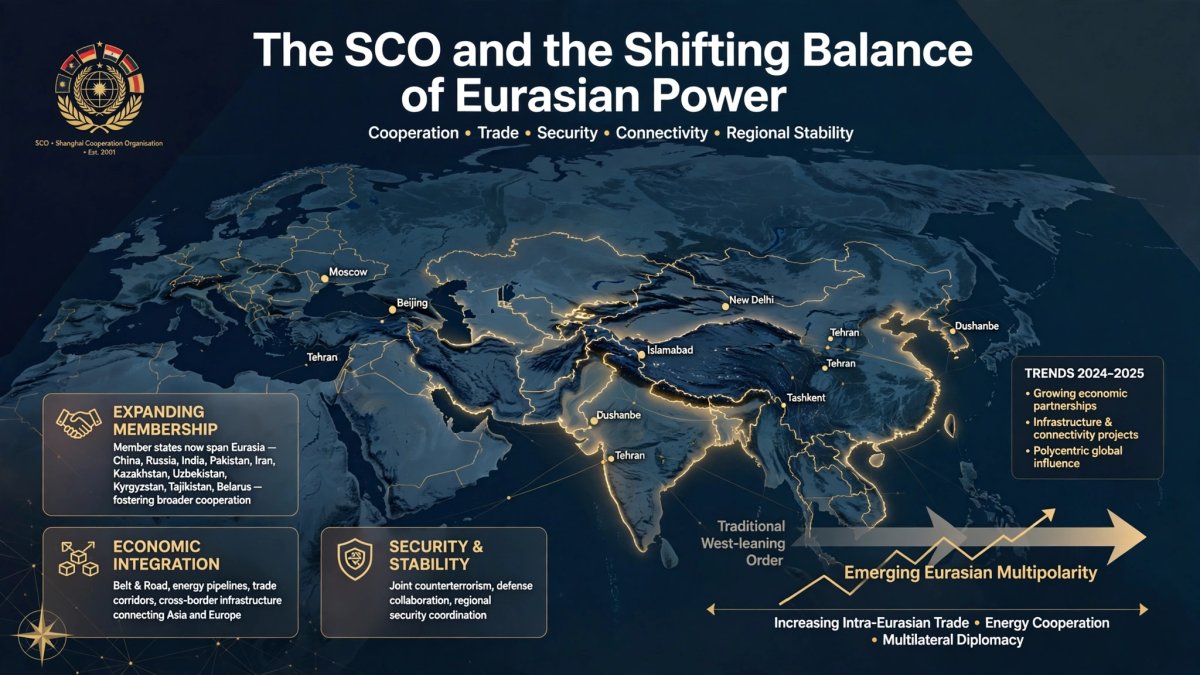
The SCO and the Shifting Balance of Eurasian Power
The Shanghai Cooperation Organisation (SCO) has become an increasingly significant institution in the changing geopolitical landscape. Established in 2001, the organisation connects major powers and developing economies across Eurasia, providing a platform for regional security, economic cooperation and diplomatic engagement.
As international relations experience growing competition between major powers, the SCO represents an important example of regional multilateralism. Its expanding membership and strategic ambitions demonstrate the increasing importance of Eurasia in global affairs.
For India, the organisation offers opportunities to strengthen relationships with Central Asian countries, maintain diplomatic engagement with major powers and advance its interests in an increasingly multipolar international system.
1. The Evolution of the Shanghai Cooperation Organisation
The SCO was officially established on 15 June 2001 in Shanghai, China. Its founding members were China, Russia, Kazakhstan, Kyrgyzstan, Tajikistan and Uzbekistan.
The organisation developed from the Shanghai Five mechanism, which initially focused on building confidence and addressing security concerns among neighbouring countries.
Its membership subsequently expanded. India and Pakistan became full members in 2017, followed by Iran in 2023 and Belarus in 2024. The organisation now comprises ten member states.
The SCO's principal objectives include:
• Strengthening regional security and stability.
• Combating terrorism, extremism and organised crime.
• Promoting international trade and economic cooperation.
• Improving transportation and regional connectivity.
• Encouraging cultural, educational and diplomatic exchanges.
The SCO is not a military alliance. Its framework is based on consultation, cooperation and respect for national sovereignty.
Source: "Shanghai Cooperation Organisation – Official Background" https://eng.sectsco.org/20170109/192193.html
2. China and Russia: Major Geopolitical Influences
China and Russia remain two of the most influential countries within the organisation.
For China, the SCO provides an important platform for strengthening its relationships across Eurasia. Beijing has consistently promoted economic connectivity, infrastructure development and regional cooperation.
Russia views the organisation as an important mechanism for maintaining its diplomatic influence across Central Asia and strengthening relationships with countries outside traditional Western political structures.
Both countries support discussions about a multipolar international order in which global decision-making is not concentrated among a limited number of powers.
However, their interests are not always identical. China prioritises economic expansion and regional connectivity, while Russia has significant security and geopolitical interests in Eurasia.
Their cooperation within the SCO therefore reflects overlapping interests rather than complete strategic agreement.
3. India's Strategic Importance in the SCO
India's participation in the SCO is an important element of its foreign policy towards Eurasia.
As one of the world's major economies, India has significant interests in Central Asian energy resources, regional stability, transportation networks and economic partnerships.
The organisation provides New Delhi with direct diplomatic engagement with countries including Russia, China, Iran, Kazakhstan and Uzbekistan.
India's Major Priorities
• Counterterrorism: India uses multilateral platforms to highlight concerns about terrorism, extremism and regional security.
• Energy security: Central Asia possesses considerable energy resources, creating opportunities for India's long-term economic interests.
• Regional connectivity: Projects such as the International North-South Transport Corridor and Chabahar Port could improve India's access to Eurasian markets.
• Strategic autonomy: India maintains relationships with different international groupings, including BRICS and the Quad, without formally aligning itself with a single geopolitical bloc.
During the September 2026 Bishkek Summit, Prime Minister Narendra Modi highlighted three pillars of India's vision for the SCO: Security, Connectivity and Opportunity.
He emphasised that regional cooperation should produce practical benefits for citizens, businesses and young people rather than remain limited to diplomatic declarations.
Source: "Prime Minister of India's Statement at the 26th SCO Summit" https://www.pmindia.gov.in/en/news_updates/pms-statement-at-the-26th-sco-summit/
4. The 2026 Bishkek Summit and Its Significance
The 26th SCO Summit was held in Bishkek, Kyrgyzstan, on 1 September 2026. The meeting was particularly significant because it coincided with the organisation's 25th anniversary.
Leaders and representatives from member countries discussed regional security, economic cooperation and institutional development.
According to the official SCO announcement, 28 outcome documents were approved. These included the Bishkek Declaration, amendments to the SCO Charter and decisions concerning security and organisational development.
The summit also advanced institutional cooperation through the development of permanent mechanisms addressing security threats and drug-related challenges.
Pakistan assumed the rotating SCO presidency for 2026–27.
The summit demonstrated the continued importance of multilateral engagement among Eurasian countries despite their different political and economic interests.
Source: "Official SCO – 26th Summit in Bishkek" https://eng.sectsco.org/20260901/2493609.html
5. Economic Cooperation and Eurasian Connectivity
Economic cooperation represents one of the most important opportunities for the SCO.
Eurasia possesses significant natural resources, industrial capacity, agricultural potential and expanding consumer markets. Better transportation infrastructure and trade arrangements could strengthen economic relationships among member countries.
At the 25th Meeting of the SCO Council of Heads of Government, held in Dushanbe on 20 October 2026, member states discussed strengthening the organisation's economic dimension.
The proposed SCO Development Bank also received attention as an initiative intended to expand financing opportunities for multilateral development projects.
Discussions covered cooperation in industry, transportation and trade. The meeting also considered the implementation of the Multilateral Trade and Economic Cooperation Programme for 2026–2030.
India has emphasised the importance of resilient supply chains, simplified customs procedures, digital trade and improved market access.
However, economic integration faces considerable obstacles. Differences in financial regulations, trade policies, infrastructure development and national economic priorities continue to limit cooperation.
Sources:
"Official SCO – Dushanbe Council Meeting" https://eng.sectsco.org/20261020/2569392.html
"Government of India – Ministry of Defence" https://www.pib.gov.in/PressReleseDetailm.aspx?
6. Challenges Facing the Organisation
Despite its expanding influence, the organisation faces several structural challenges.
• Conflicting national interests: India, China and Pakistan have significant political and territorial disagreements, making deeper cooperation difficult.
• Economic differences: Member countries have different levels of economic development, industrial capacity and financial resources.
• Geopolitical competition: Major powers within the organisation have overlapping but sometimes competing strategic interests.
• Institutional limitations: The consensus-based decision-making process can make it difficult to achieve agreement on complicated international issues.
Furthermore, expanding membership does not automatically guarantee greater institutional effectiveness. The SCO must demonstrate that it can translate diplomatic commitments into measurable results.
7. The Future of Eurasian Geopolitics
The future significance of the SCO will depend on its ability to strengthen practical cooperation among its members.
Regional security, trade connectivity, energy partnerships, technological development and diplomatic engagement are likely to remain important priorities.
The organisation has also continued its security engagement. On 6 November 2026, its Secretary-General participated in the first SCO Plus Expert Security Dialogue in Samarkand, highlighting the importance of cooperation on regional security concerns.
For India, the organisation offers a valuable opportunity to strengthen its presence in Central Asia and maintain relationships with influential Eurasian countries.
However, New Delhi must continue balancing its continental interests with its Indo-Pacific partnerships and broader international commitments.
The SCO's long-term success will ultimately depend on whether its members can manage their differences while identifying areas of common interest.
Conclusion
The Shanghai Cooperation Organisation represents an important development in the evolving geopolitical structure of Eurasia. Its expanding membership and growing economic and diplomatic activities demonstrate the increasing importance of regional cooperation.
However, the organisation faces significant challenges arising from competing national interests, political disagreements and institutional limitations.
For India, the SCO provides an important diplomatic platform to strengthen Eurasian engagement while preserving strategic autonomy.
Ultimately, the organisation's influence will be determined not simply by the number of participating countries but by its ability to deliver meaningful cooperation, economic development and regional stability.
Sources and Further Reading
1. "Shanghai Cooperation Organisation – Official Background" https://eng.sectsco.org/20170109/192193.html
2. "Shanghai Cooperation Organisation – Official Documents" https://eng.sectsco.org/documents/
3. "Shanghai Cooperation Organisation – Frequently Asked Questions" https://eng.sectsco.org/20231127/1168690.html
4. "Ministry of External Affairs, India – SCO Brief" https://www.mea.gov.in/Portal/ForeignRelation/SCO-21-Aug-25.pdf
5. "Shanghai Cooperation Organisation – Dushanbe Meeting, October 2026" https://eng.sectsco.org/20261020/2569392.html
6. "Shanghai Cooperation Organisation – Bishkek Summit, September 2026" https://eng.sectsco.org/20260901/2493609.html
7. "Ministry of Foreign Affairs, Türkiye – SCO Profile" https://www.mfa.gov.tr/shanghai-cooperation-organization.en.mfa

Join the Conversation