SC/ST Act Compensation Before Conviction: How the Payment System Works and What Happens in False Cases
The Scheduled Castes and the Scheduled Tribes (Prevention of Atrocities) Act, 1989, is designed to protect people from caste-based atrocities and provide relief and rehabilitation to victims. One aspect of the law that often raises questions is the payment of financial assistance before a criminal case reaches its final outcome.
Why is compensation sometimes paid before a court decides whether the accused is guilty? Can the money be recovered if an allegation is later established to have been deliberately fabricated? And how can the system protect genuine victims while ensuring fairness to the accused?
These questions deserve a closer look at the compensation rules, the purpose of early financial assistance, and the need for accountability in the criminal justice system.
How Does Compensation Work Under the SC/ST Act?
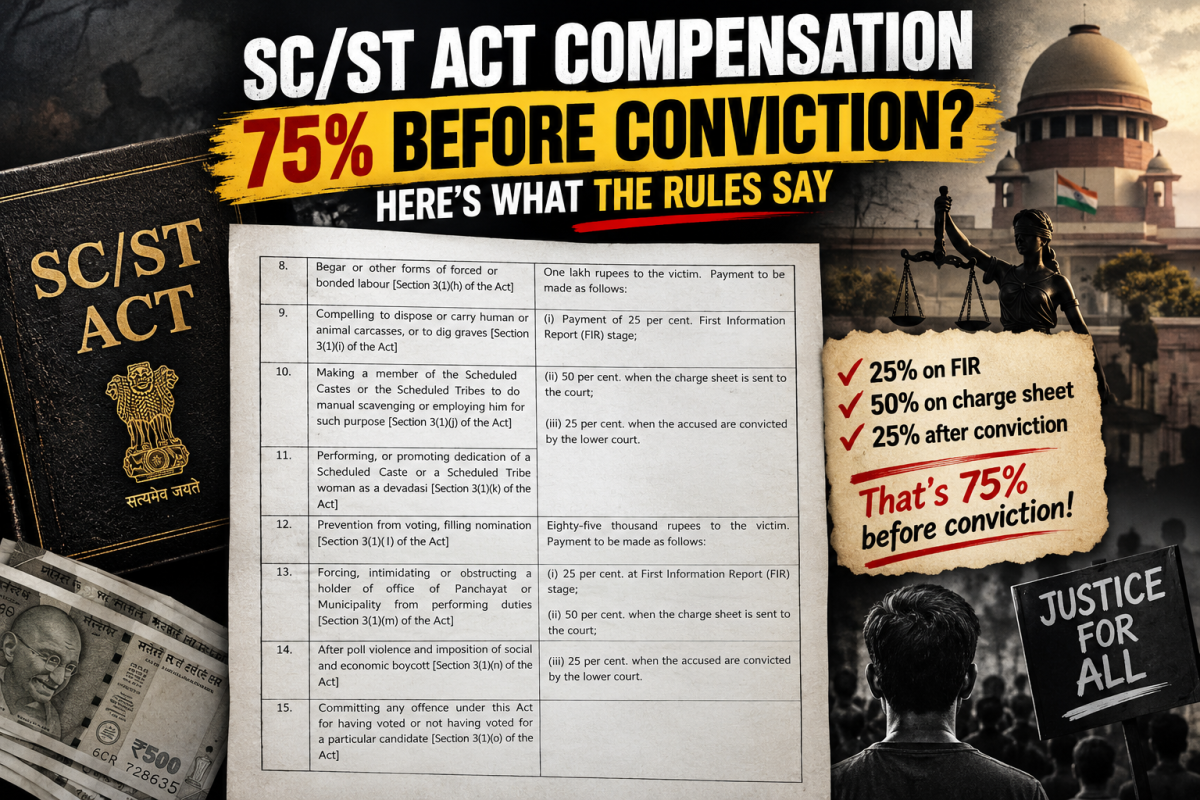
The compensation and relief framework operates under the Scheduled Castes and the Scheduled Tribes (Prevention of Atrocities) Rules, 1995, particularly Rule 12 and its accompanying Schedule. The amount of assistance and the stages of payment depend on the nature of the alleged offence and the applicable provisions.
For certain offences, the prescribed schedule provides for compensation in stages:
-
25% after the registration of the FIR: The initial payment is intended to provide early financial assistance.
-
50% after the charge sheet is submitted: A further portion is released when the investigation reaches the charge-sheet stage.
-
25% after conviction by the trial court: The remaining portion is linked to the court's finding of guilt.
Under this particular payment pattern, 75% of the prescribed compensation may be released before conviction. However, this should not be treated as a universal rule for every offence covered by the Act. The applicable entry in the Schedule must be checked before stating the precise payment stages for a particular case.
The purpose of providing early assistance is to help victims and their families deal with the immediate consequences of an alleged atrocity. Depending on the circumstances, relief and rehabilitation measures may address essential needs such as medical care, transport, food, shelter and other necessary support.
The key distinction is that financial relief is intended to address the victim's immediate needs; it is not, by itself, a judicial determination of the accused person's guilt.
Why Is Compensation Paid Before a Conviction?
Criminal trials can take considerable time. If financial assistance were always postponed until the conclusion of a trial, victims and their families could be left without timely support when they need it most.
Early relief is therefore intended to address hardship without requiring victims to wait for the entire judicial process to finish. This is particularly relevant when an alleged incident has caused physical injury, financial loss, displacement or serious disruption to family life.
At the same time, payment before conviction raises questions about verification, administrative oversight and the treatment of cases that do not ultimately result in a conviction.
These concerns should be examined carefully. The timing of compensation alone does not establish that the system has been misused. It also does not mean that every allegation has already been proved in court.
What Do Low Conviction Rates Actually Tell Us?
Conviction rates are sometimes cited in debates about the SC/ST Act, particularly when questions arise about the quality of investigations and the possibility of false complaints.
However, conviction statistics require careful interpretation. A case that does not result in conviction is not automatically a false case.
There can be several reasons why a prosecution fails, including insufficient evidence, witnesses changing their testimony, investigative shortcomings, procedural problems or the prosecution's inability to prove the charges beyond reasonable doubt.
A deliberately fabricated complaint is a different matter. Establishing that an allegation was knowingly false requires evidence and an appropriate legal process. It cannot be inferred simply because the accused was acquitted or the prosecution failed.
For this reason, any serious assessment of the law should distinguish between cases ending in acquittal, cases affected by weaknesses in investigation or prosecution, and cases in which deliberate fabrication is actually established.
This distinction is essential for an informed discussion about both the effectiveness of the law and the rights of the people involved.
Can Compensation Be Recovered if a Complaint Is Proven False?
One of the most important questions concerns financial assistance already paid to a complainant or victim when a case is later found to involve deliberate fabrication.
It would be inaccurate to assume that recovery is impossible in every such situation. Equally, it would be misleading to suggest that compensation must automatically be returned whenever the accused is acquitted.
The legal position depends on the applicable rules, the circumstances of the case, the findings made by the competent authority or court, and the procedure followed for recovery.
An acquittal does not necessarily establish that the original complaint was deliberately false. Before drawing conclusions about recovery, the relevant legal provisions and any applicable judicial or administrative directions must be examined.
Where deliberate fabrication is established, appropriate action may be considered under the applicable law. Any recovery of public funds should follow a lawful procedure, with the relevant facts assessed and the affected parties given the protections available to them.
The objective should be to address proven misuse without creating unnecessary barriers for genuine victims seeking assistance.
Protecting the Rights of the Accused
Being accused of a criminal offence can have serious consequences even before a trial concludes. A person may experience damage to their reputation, difficulties at work, family stress and social stigma.
These consequences make fair investigation and due process important at every stage of criminal proceedings. Allegations must be investigated properly, evidence must be assessed objectively, and guilt must be determined by the court in accordance with the law.
Where a complaint is deliberately fabricated, the matter should be addressed through the appropriate legal process. However, safeguards against false allegations must not be used to discourage genuine victims from reporting caste-based violence or seeking protection.
Protecting the rights of the accused and ensuring access to justice for victims are both necessary parts of a fair legal system.
Does the Compensation System Need Greater Accountability?
The central issue is how financial relief can reach genuine victims promptly while ensuring that public funds are administered transparently and responsibly.
Several measures could help strengthen public confidence in the system.
1. Clear information about payment rules
Government authorities should make the applicable compensation amounts, payment stages and eligibility requirements easy to understand. This would help victims, families and the public know what assistance may be available.
2. Better administrative records
Accurate records of payments, the stage of the proceedings and the legal basis for assistance could improve oversight and make it easier to identify administrative errors.
3. Timely and impartial investigations
Investigations should be conducted promptly and professionally. Both incriminating and exculpatory evidence should receive appropriate consideration.
4. Faster judicial proceedings
Unnecessary delays can prolong uncertainty for victims and accused persons alike. Effective investigation, adequate judicial resources and timely trials can help reduce that burden.
5. Clear procedures for proven misuse
Authorities should follow transparent and legally sound procedures when deliberate fabrication or improper disbursement is established. Decisions about recovery should be based on the applicable law and the specific facts, rather than assumptions about cases that end without conviction.
These measures would address accountability without treating early compensation itself as evidence of wrongdoing.
The Need to Balance Victim Support and Due Process
The debate over compensation under the SC/ST Act is not simply a question of whether financial assistance should be paid before conviction. It is also about the purpose of relief, the realities faced by victims, the administration of public money and the safeguards that apply during criminal proceedings.
Delaying all assistance until a trial ends could undermine the purpose of providing timely relief. On the other hand, transparent administration and lawful procedures for addressing established misuse are important for maintaining confidence in the system.
A balanced approach recognises that genuine victims need support, accused persons are entitled to a fair legal process, and public authorities must administer compensation according to the rules.
Conclusion
Compensation under the SC/ST Act serves an important purpose by providing relief and rehabilitation to victims of caste-based atrocities. For certain offences, the applicable payment schedule allows assistance to be released before conviction, reflecting the need to address immediate hardship rather than waiting for the entire criminal trial to conclude.
However, the system also requires accurate records, proper investigation, timely trials and clear procedures for dealing with proven cases of deliberate fabrication or improper payment.
Neither an acquittal nor the payment of compensation before conviction should be treated as automatic proof of wrongdoing. Each case must be assessed on its own facts and under the applicable law.
Ultimately, a fair and effective system must protect victims, respect the rights of the accused and ensure responsible use of public funds. Maintaining that balance is essential to public confidence in the administration of justice.
Legal reference: The Scheduled Castes and the Scheduled Tribes (Prevention of Atrocities) Rules, 1995 — Ministry of Tribal Affairs, Government of India.
Editorial note: This article provides general legal information and is not a substitute for advice from a qualified lawyer. Specific compensation and recovery questions should be checked against the applicable rules, amendments and relevant court decisions.



Correct 💯