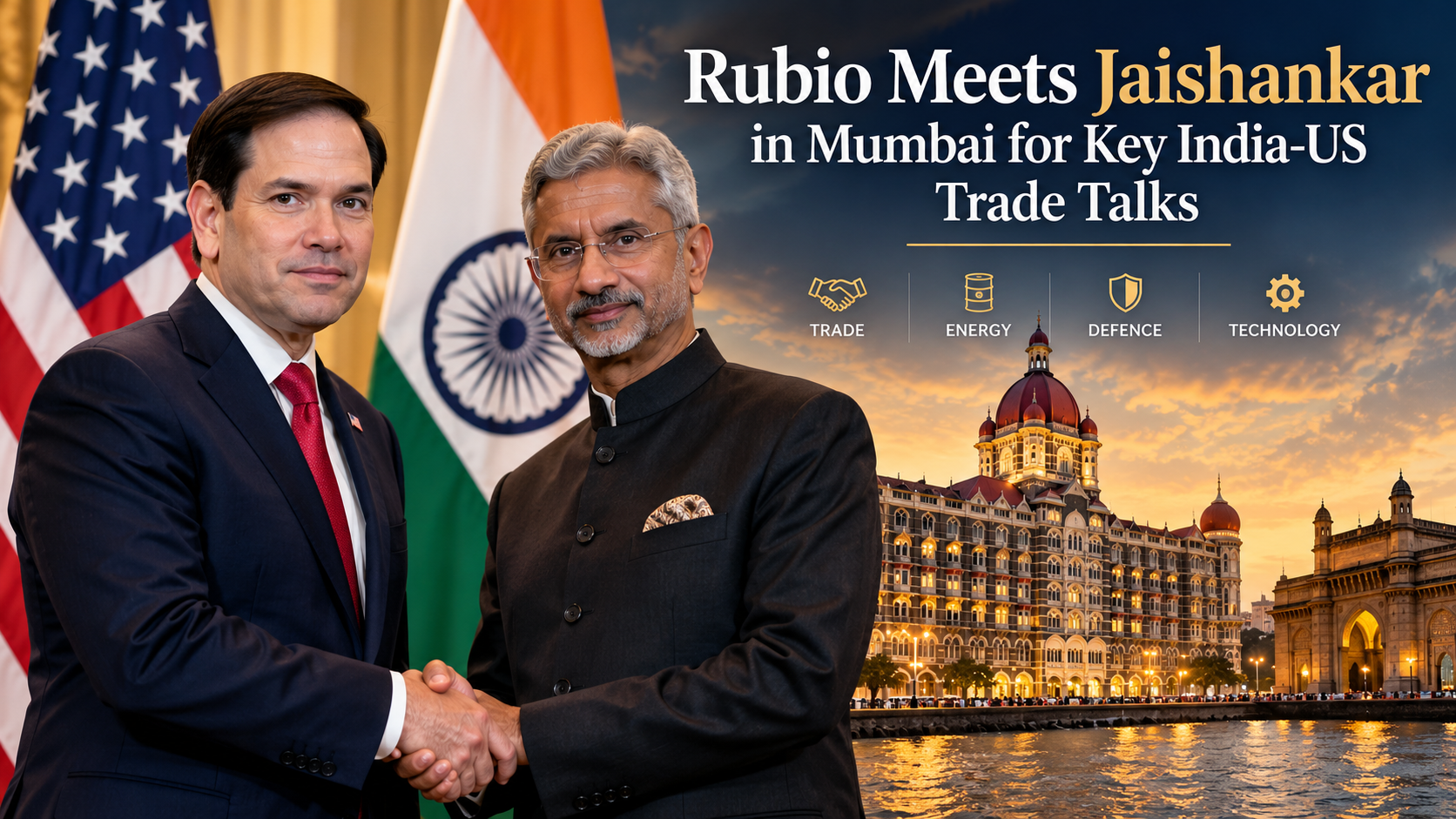
Rubio Meets Jaishankar in Mumbai as India-US Trade Deal Nears
The US secretary of state says negotiations are close to completion, as tariffs, Russian oil imports and energy security remain important issues in bilateral relations.
By Gummuluri SN Murthy Hemanth Kumar Sharma | October 20, 2026
MUMBAI: US Secretary of State Marco Rubio met External Affairs Minister S. Jaishankar in Mumbai on Tuesday, October 20, as India and the United States sought to advance a long-awaited trade agreement and strengthen cooperation in energy, defence and technology.
The meeting comes after months of difficult negotiations between the two countries over tariffs and India's continued purchases of Russian crude oil. Although both governments have expressed interest in concluding an agreement, several issues remain to be resolved.
Speaking to reporters in Mumbai, Rubio indicated that the negotiations were nearing completion. “We’re very, very close,” he said, adding that only a small number of issues remained to be settled.
However, the agreement has not yet been finalised, and the latest comments should be understood as an indication of progress rather than confirmation of a completed deal.
According to The Associated Press, the discussions covered trade, energy cooperation, technology, defence and regional developments.
Trade Deal Remains a Key Priority
Trade has been one of the most challenging areas in India-US relations over the past year. Washington imposed tariffs of up to 50% on many Indian goods in August 2025 following a breakdown in negotiations.
In February 2026, the two countries announced a framework for an interim trade agreement. Under that framework, the United States reduced its reciprocal tariff rate on Indian goods from 25% to 18% and removed an additional 25% duty previously imposed in connection with India's purchases of Russian oil.
The framework represented a significant change in the trade relationship, but it did not resolve every outstanding issue.
The White House's February 2026 fact sheet outlined the proposed tariff changes and the two countries' commitment to continue negotiations towards a broader bilateral trade agreement.
India has continued to seek competitive tariff treatment for its exporters, particularly in comparison with competing manufacturing economies such as Vietnam. Market access, the treatment of individual sectors and the terms of the wider agreement remain important considerations.
Rubio's latest assessment suggests that the two governments believe further progress is possible. Nevertheless, a final agreement will depend on how they resolve the remaining differences.
Russian Oil Remains a Sensitive Issue
India's purchases of discounted Russian crude have been a recurring source of tension with Washington since Russia launched its full-scale invasion of Ukraine in February 2022.
The United States has sought to use economic pressure to reduce revenue supporting Russia's war effort, while India has maintained that its energy policy must account for domestic demand, affordability and the reliability of supplies.
A recent temporary US waiver of certain sanctions-related measures concerning Russian oil has eased immediate pressure on India. Rubio acknowledged in an interview with The Indian Express that such measures can affect bilateral ties and require careful management.
The waiver provides temporary relief, but it does not eliminate the underlying differences between the two governments over Russia's energy trade.
India has also indicated that it intends to diversify its energy supplies, including by expanding purchases from the United States. Rubio's visit therefore carries significance beyond tariffs: energy cooperation is closely linked to the broader economic and strategic relationship.
The challenge for both countries is to find arrangements that support closer commercial ties without overlooking their differing positions on energy security and Russia.
India, US and UAE Discuss Energy Security
Rubio and Jaishankar also held a trilateral meeting with Sheikh Abdullah bin Zayed Al Nahyan, the United Arab Emirates' foreign minister, who was visiting India.
According to the AP report on the Mumbai talks, Rubio said the three officials discussed regional energy security and shared economic priorities.
The meeting brought together three countries with important interests in international energy markets. India is a major energy consumer, the United States is a significant energy producer, and the UAE is an important oil-producing country.
Disruptions to oil production or shipping routes can have consequences for import costs, inflation and economic stability. Coordination among major producers and consumers is therefore relevant to India's efforts to secure reliable supplies.
The trilateral discussions also offered an opportunity to address wider regional developments and explore areas of common interest.
No specific new energy agreement was identified in the public account of the meeting.
Defence and Technology Cooperation Also on the Agenda
Beyond trade and energy, India and the United States continue to pursue cooperation in defence, critical technologies and investment.
These areas have become important pillars of their wider strategic partnership, alongside regular diplomatic engagement and cooperation in the Indo-Pacific.
Jaishankar said the discussions included strengthening cooperation across trade, energy, technology and defence. The agenda is consistent with the areas identified by India's Ministry of External Affairs before the meeting.
In an earlier announcement, the ministry's spokesperson, Randhir Jaiswal, said the October 20 talks would cover energy, trade and investment, defence, and critical and emerging technologies, according to Reuters' October 16 report.
Both countries have an interest in expanding practical cooperation, but closer relations do not mean that every disagreement has disappeared. Trade policy and differences over energy purchases continue to complicate the relationship.
Rubio Pays Tribute to Mumbai Attack Victims
During his Mumbai visit, Rubio also paid tribute to the victims of the November 2008 terrorist attacks by laying a wreath at the memorial at the Taj Mahal Palace Hotel.
Jaishankar thanked Rubio for the gesture and reiterated the importance of cooperation against terrorism.
The tribute highlighted a separate but important dimension of the bilateral relationship: counterterrorism cooperation alongside economic and strategic engagement.
India and the United States have continued to identify counterterrorism as an area of shared interest, even when disagreements arise over trade or other foreign policy issues.
As reported by The Economic Times, Jaishankar also pointed to opportunities to strengthen cooperation in trade, investment, energy, technology and defence.
What Happens Next?
Rubio's meeting with Jaishankar has reinforced the expectation that India and the United States may be approaching an important stage in their trade negotiations. His public comments were optimistic, but the outstanding issues have not been resolved through the meeting alone.
A completed agreement would give businesses greater clarity about tariffs and market access. It could also support wider cooperation in energy, investment and strategic technology.
For India, the challenge is to improve commercial access to the US market while retaining flexibility in its energy policy. For Washington, the task is to advance its trade objectives while maintaining a strategic relationship with one of its important Indo-Pacific partners.
The participation of the UAE in discussions on regional energy security also demonstrated the value of broader diplomatic coordination on issues affecting oil supplies and economic stability.
The next significant development will be whether negotiators can turn the progress described by Rubio into a formal agreement. Until the terms are announced and finalised, the trade deal remains a work in progress.
For now, the Mumbai meeting has provided a positive signal, but the outcome of the remaining negotiations will determine how significant that progress proves to be.
Sources
-
The Associated Press — Rubio and India's foreign minister hold talks in Mumbai
-
Reuters — Indian foreign minister and Rubio to hold talks on October 20
-
The White House — US-India trade framework fact sheet, February 2026
-
The Indian Express — Marco Rubio discusses the trade deal and Russian oil sanctions
-
The Economic Times — Jaishankar thanks Rubio for paying tribute to 26/11 victims
Join the Conversation