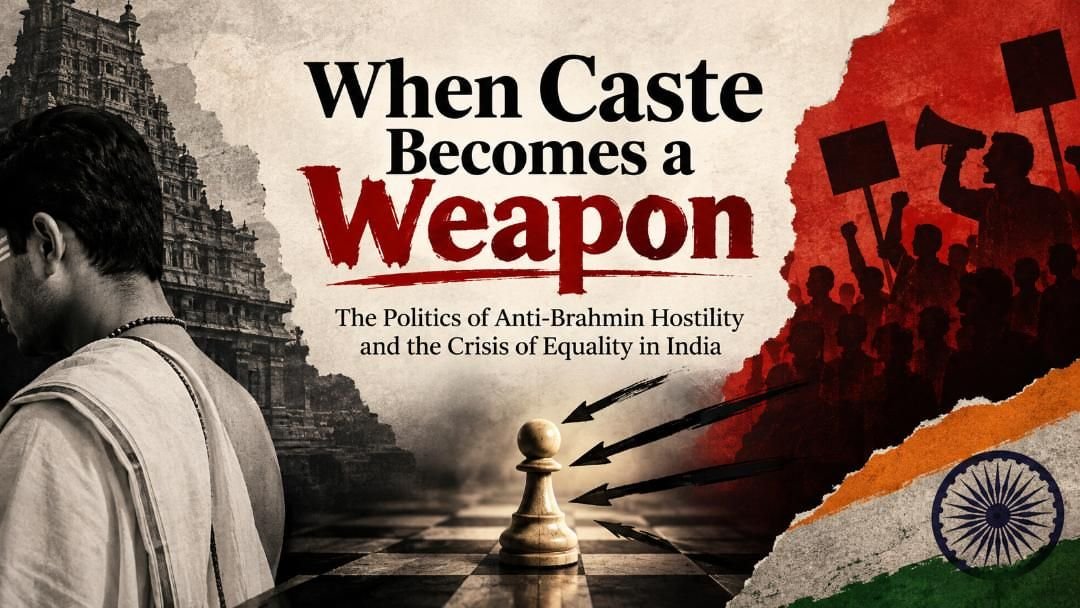
India has spent decades debating caste discrimination, social justice and equal opportunities. These discussions are necessary in a country where caste has historically influenced access to education, employment, social status and political representation. However, a disturbing question arises when the fight against discrimination begins to involve hostility towards people simply because of their caste.
Several photographs circulating on social media show posters questioning Brahmins' Indian identity, demanding that they leave the country, and portraying caste relations through a lens of hostility. Such messages raise serious concerns about the direction of India's social justice debate. While historical discrimination must never be ignored, targeting an entire community cannot be a substitute for addressing injustice.
If the objective is equality, why should anyone be made to feel like an outsider because of their birth?
When Criticism Turns Into Caste-Based Hostility
There is a clear difference between criticising caste-based discrimination and directing hostility towards an entire community.
The caste system has a long history of exclusion and unequal treatment, particularly affecting Dalits and other historically disadvantaged groups. Their experiences deserve recognition, and efforts to eliminate discrimination must continue. However, acknowledging this history does not mean that every individual belonging to a community associated with historical privilege should automatically be held responsible for the actions of others.
Brahmins, like members of every other caste, come from different economic backgrounds and hold different political, social and religious beliefs. Some enjoy financial security, while others struggle to meet their basic needs. Some support particular government policies, while others disagree with them.
Treating an entire community as a single group with identical privileges, intentions and beliefs ignores these realities.
When slogans suggest that Brahmins should leave India or question whether they belong here, the discussion moves beyond criticism of social structures. It becomes a question of whether a person's identity can be used to deny their sense of belonging.
Historical injustice deserves serious examination, but collective blame is not a substitute for evidence or individual responsibility.
Are Brahmins Being Portrayed as Outsiders in Their Own Country?
One of the most concerning aspects of the messages shown in these photographs is the suggestion that Brahmins are foreigners or outsiders.
India's national identity cannot reasonably be reduced to caste. A person's caste does not, by itself, determine their citizenship or their right to belong to the country.
Criticism of Brahminism as an ideology, or of historical practices associated with caste hierarchy, is a legitimate part of public debate. Social institutions and religious practices should remain open to scrutiny, particularly when questions of discrimination and equality are involved.
However, criticising an ideology is fundamentally different from declaring that people associated with a particular community do not belong in India.
The distinction matters. One approach challenges ideas and practices; the other risks turning identity into a reason for exclusion.
No community should be above criticism, but neither should an entire community be treated as foreign or unwelcome because of its caste.
A person's birth should never become a test of whether they deserve to belong in their own country.
Fighting Discrimination by Targeting Another Community?
The caste debate often exposes a contradiction between the language of equality and the treatment of people from opposing communities.
Movements seeking social justice frequently speak about dignity, equal treatment and freedom from discrimination. These are important objectives. But when messages target an entire caste rather than specific practices or institutions, it is reasonable to question whether the language being used supports those objectives.
Historical caste oppression and contemporary caste-based hostility must be examined in their proper contexts. They do not necessarily have identical histories or consequences. Recognising these differences, however, does not require accepting collective hostility as a legitimate response.
No individual should automatically be considered an oppressor simply because they were born into a particular caste. Equally, no person should be subjected to prejudice because they belong to a historically disadvantaged community.
The same principle must apply consistently.
Opposing discrimination against Dalits does not require hostility towards Brahmins. Likewise, opposing anti-Brahmin hostility does not require denying the historical discrimination experienced by Dalits.
A serious commitment to equality must be able to recognise both concerns without treating one as a reason to dismiss the other.
Historical Injustice Cannot Be Ignored, but Neither Can Individual Dignity
Any discussion of anti-Brahmin messaging must acknowledge the historical realities behind India's caste debate.
Dalits and other marginalised communities have faced untouchability, social exclusion, barriers to education and other forms of discrimination. These injustices have shaped India's social and political institutions, and their consequences remain an important subject of public policy.
Reservations and other affirmative-action measures must be understood within this historical context. Their purpose, implementation and effectiveness deserve informed discussion rather than simplistic arguments.
However, acknowledging historical privilege does not mean assuming that every member of a community has enjoyed the same advantages.
There are economically disadvantaged people among Brahmins and other communities, just as there are people with very different financial circumstances within historically marginalised groups. Individual circumstances vary, and social disadvantage can involve several overlapping factors.
Recognising poverty among one community does not erase discrimination against another. Similarly, acknowledging caste-based inequality does not require ignoring economic hardship elsewhere.
The challenge is to address each problem according to its nature and the evidence available.
Social justice should mean correcting injustice wherever it exists, not deciding whose suffering deserves recognition based solely on caste.
Poverty and Opportunity Should Not Become a Competition Between Castes
India's debates about reservations and welfare frequently become arguments over which community deserves support.
Such arguments risk overlooking the practical questions that matter most: Are disadvantaged children receiving a quality education? Can financially struggling families access healthcare? Are eligible students receiving scholarships? Are government programmes reaching the people they are intended to help?
Caste-based disadvantage, economic poverty and unequal access to education are related, but they are not identical problems. Policies should be assessed according to the specific disadvantages they seek to address.
Measures addressing historical caste discrimination may be necessary to improve representation and access to opportunities. Economic assistance can also help people facing financial hardship, including those whose difficulties do not fit neatly into a single social category.
These approaches do not have to be treated as mutually exclusive.
A fair society should be capable of addressing historical discrimination while ensuring that economic vulnerability is not dismissed simply because a person belongs to a particular caste.
The objective should be to expand opportunities and reduce hardship, not to create a permanent competition between communities over who deserves sympathy.
The Role of Social Media in Deepening Caste Divisions
Social media has made it easier for protest posters, slogans and political messages to reach large audiences. While this can bring attention to genuine grievances, it can also spread provocative messages without sufficient context.
The photographs discussed here raise questions about the language used to describe Brahmins and their place in Indian society. However, the images alone do not establish who organised every protest, whether all participants supported the messages, or whether the slogans represent an entire organisation or community.
Those details should be verified before drawing wider conclusions.
Nevertheless, the messages themselves deserve examination. A demand that an entire caste leave the country is different from a call to reform discriminatory institutions. Similarly, criticism of an individual's actions is different from accusing millions of people of sharing the same beliefs.
When social media rewards outrage, complex debates can become reduced to slogans that encourage people to see one another as enemies.
The result is a cycle of accusation and retaliation in which meaningful discussions about education, employment, discrimination and welfare receive less attention.
India needs more evidence-based debate about caste, not a competition to produce the most provocative statements against another community.
Constitutional Equality Must Apply to Everyone
The Indian Constitution provides an important framework for addressing caste discrimination and protecting individual dignity.
Article 14 guarantees equality before the law and equal protection of the laws. Article 15 prohibits discrimination on specified grounds, including caste, subject to the Constitution's provisions. Article 17 abolishes untouchability.
These constitutional principles are essential to understanding India's commitment to equality.
They do not prevent citizens from criticising historical institutions, religious traditions, social hierarchies or government policies. Freedom to question established practices is an important part of democratic debate.
However, constitutional equality also provides a reason to scrutinise messages that seek to exclude people because of their caste.
The appropriate response to discrimination is to examine the facts, identify the conduct involved and apply the relevant legal and social standards. Caste identity alone should not be treated as proof of an individual's character or actions.
This principle should apply to every community, regardless of its historical position or political influence.
A society committed to constitutional values must be willing to confront historical injustice without normalising new forms of collective hostility.
Moving Beyond Caste-Based Hostility
India's caste debate would benefit from greater attention to practical solutions rather than identity-based accusations.
Schools must be able to address discrimination against students. Institutions should respond appropriately to complaints of caste-based exclusion. Government programmes should be evaluated for their effectiveness, and policies intended to improve representation should be assessed through reliable evidence.
These issues require serious discussion, institutional accountability and sustained public engagement.
They cannot be resolved by declaring entire communities enemies or questioning whether fellow citizens belong in the country.
Political and social movements have every right to challenge injustice and demand reform. Their arguments should be examined on their merits, with attention to evidence, context and the consequences of their proposals.
At the same time, criticism should remain focused on the practices, policies and institutions being challenged rather than becoming a blanket judgement about everyone who shares a particular identity.
The aim should be to build a society where people can disagree about caste, reservations and social policy without treating one another as enemies by birth.
Conclusion: Equality Cannot Be Built on Collective Blame
The posters shown in these photographs raise a broader question about the future of India's debate on caste and social justice.
Historical discrimination must be acknowledged, disadvantaged communities must have meaningful access to opportunities, and discriminatory practices must be challenged wherever they occur. At the same time, these objectives do not justify treating an entire caste as foreign, unwelcome or collectively guilty.
Criticising caste hierarchy is different from attacking every individual associated with a community. Addressing historical injustice is different from assigning inherited guilt. Demanding equality is different from denying another person's dignity.
These distinctions are essential if India's social justice debate is to move beyond mutual suspicion and towards meaningful reform.
The real test of equality is whether we are willing to defend the dignity of people even when they belong to a community with which we disagree.
India does not need a new hierarchy of resentment. It needs a society capable of confronting historical wrongs, protecting the rights of disadvantaged people and ensuring that no individual is judged solely by their caste.
The goal should not be to make one community fear another. It should be to create a country in which discrimination loses its place in public life and equal dignity becomes a principle that applies to everyone.


Join the Conversation